Precision Casting: Transforming Complex Simulations
A deep dive into post-processing techniques, computational modeling, and AI-driven optimization that are reshaping how engineers approach complex casting simulations — from mold design to zero-defect production.
The Cost of the
Shop Floor Trial
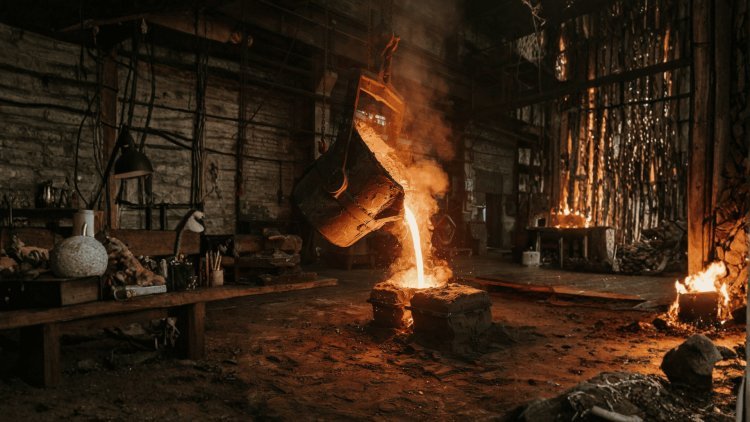
For generations, casting development has depended on physical experimentation. Engineers poured metal, inspected results, adjusted tooling, and repeated the process until an acceptable casting emerged. While this approach built valuable practical knowledge, it also embedded significant inefficiencies into the development cycle. Every unsuccessful trial consumes resources that can never be recovered, making defect prediction one of the most economically important capabilities in modern foundry engineering.
The Hidden Costs of Physical Iteration
The Traditional Cycle
Traditional casting development relies heavily on engineering judgment, experience, and iterative experimentation. Instead of predicting problems beforehand, manufacturers often discover defects only after pouring metal and performing inspection operations. Each iteration improves understanding, but every iteration also increases project cost and extends development schedules.
Physical Trial Workflow
Major Cost Drivers
Production Waste
- Rejected castings
- Excess material consumption
- Scrap recycling costs
Development Overhead
- Tooling modifications
- Machining adjustments
- Extended lead times
The Core Prediction Challenge
The most expensive casting defects share a common characteristic: they remain invisible during the pouring process. Engineers often discover them only after solidification, cleaning, machining, inspection, or destructive testing has already consumed substantial resources.
Why These Defects Matter
Porosity
Gas entrapment and shrinkage voids weaken structural sections and reduce mechanical reliability.
Hot Spots
Excessive heat retention promotes shrinkage defects, cracking, and localized quality degradation.
Cold Shots
Poor fusion between metal streams produces discontinuities that compromise structural integrity.
The Cost of Late Defect Discovery
Predict Before You Pour
Modern simulation transforms casting development from reactive problem-solving into predictive engineering. Instead of absorbing defect costs after production, engineers can identify risk zones virtually and modify the design before material, tooling, and labor are committed.
Traditional vs Simulation-Driven Development
Traditional Approach
- Multiple physical trials
- Late defect discovery
- High scrap potential
- Long development cycles
Simulation-Driven Approach
- Virtual validation
- Early defect insight
- Reduced scrap risk
- Faster optimization
The Most Valuable Tool In The Foundry
Every defect identified digitally represents material, time, energy, and labor saved. Predictive simulation shifts quality assurance from detection after production to prevention before production.
The Most Expensive Defect
Is The One Discovered
After The Pour.
Physical trial-and-error development treats defects as an inevitable cost of doing business. Modern casting simulation challenges that assumption by enabling engineers to predict porosity, hot spots, cold shots, shrinkage behavior, and thermal risks before production begins. By replacing repetitive shop floor experimentation with predictive analysis, foundries reduce scrap, accelerate development, improve yield, and transform quality control from a reactive activity into a proactive engineering discipline. The result is a more efficient, more predictable, and ultimately more profitable manufacturing process.
Virtual simulation replaces physical trial, allowing engineers to observe the full casting lifecycle—from mold filling through solidification—without pouring metal.
At each node, the governing equations of heat transfer and fluid flow are solved iteratively, tracking temperature, velocity, and phase state across the entire casting volume. FDM provides a robust, computationally efficient framework for macro-scale mold-filling behavior.
As molten metal cools, the surface skin and still-liquid interior contract at different rates, creating stress fields that drive shrinkage porosity.
Quantify how much feed metal must be supplied from risers and gates to compensate for contraction—enabling mathematically precise feeder sizing and placement.
Accounts for insulating mold properties and progressive heat buildup in the sand body across multiple pours.
Captures unique thermal conditions imposed by a preheated ceramic shell.
Incorporates cyclic thermal fatigue in metallic tooling to predict both casting quality and tooling longevity.
Tools like SOLIDCast have democratized high-fidelity simulation by offering an accessible interface for modeling sand, investment, and permanent mold processes within a single platform.
The Era of
Digital ModelingDiscretize the geometry, solve the physics.
The cornerstone of defect prevention.
One platform, multiple processes.
defects are prevented in the virtual world, not discovered on the shop floor.
Traditional workflows required manual adjustment of design variables followed by repeated simulations. Hyper-optimization engines replace this with metaheuristic algorithms — genetic algorithms, simulated annealing, Bayesian optimization — systematically exploring the design space and converging on solutions that balance multiple objectives simultaneously.
In one landmark case, an aluminum alloy casting yield improved from 48% to 78% after automated optimization. Thousands of riser and gate configurations were evaluated, converging on a feeder system design that achieved a 30-point yield increase without compromising soundness. This translated into lower energy consumption, reduced furnace cycle time, and significant per-unit cost savings.
The Breakthrough: Automated Optimization
Beyond Manual Iteration
Key Design Variables Under AI Control
Success Story: Yield from 48% to 78%
Casting simulation has evolved far beyond predicting mold filling and cooling behavior. Modern multiphysics models can now resolve the complex interactions between liquid metal, gas, solidifying dendrites, and solute transport mechanisms that govern casting quality. This capability enables engineers to identify and mitigate defect formation across multiple length scales, from microscopic dendritic structures to large-scale segregation patterns that impact final component performance.
Advanced Dynamics:
Addressing Micro and Macro Defects
The ultimate promise is not just better defect prediction, but a seamless ecosystem where design, simulation, optimization, and process control operate as one intelligent system.
Engineers can move from a solid model to a full solidification simulation with minimal manual data translation, eliminating error-prone file conversions. Embedded post-processing allows immediate interrogation of porosity maps, temperature histories, and fill animations without exporting to separate packages.
Injection pressures can exceed 1,000 bar, fill times are measured in milliseconds, and cyclic thermal loading progressively heats the die over hundreds of shots.
Tracks die temperature, coating degradation, and cavity pressure over multi-shot sequences to optimize spray cooling, cycle times, and injection parameters for consistent quality across full production runs.
Embedded sensors in molds and furnaces feed live data to simulation engines that compare actual conditions against predictions and trigger corrective adjustments before defects form.
Optimized feeder systems minimize return metal, and AI-guided alloy management reduces compositional variability—supporting maximum material efficiency alongside zero-defect ambitions.
Future Vision:
Integrated ManufacturingOne environment, end to end.
Model the die, not just the shot.
Closed-loop intelligence from pour to part.
It prevents them—by design, by simulation, and by closed-loop control.
What's Your Reaction?