Refractory Coating Thickness and Casting Cooling Behavior
An in-depth exploration of how refractory coating thickness governs heat transfer at the mold-metal interface, shapes solidification dynamics, and ultimately determines the structural integrity, grain morphology, and surface quality of finished castings. Understanding this relationship is foundational to precision casting engineering.
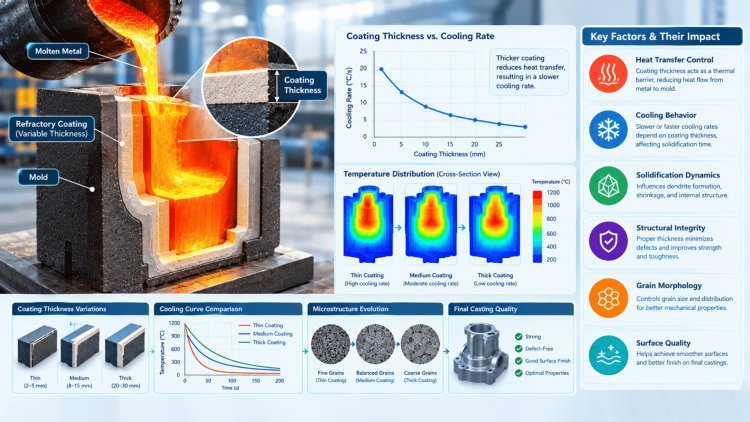
The Thermal Barrier:
Physics of the Interface
Refractory coatings occupy a deceptively thin but critically important zone between the liquid metal charge and the mold substrate. Their primary function is thermal regulation — governing how quickly, and in which direction, heat migrates from the solidifying casting into the mold environment. The physics operating at this interface are complex: coating thickness, density, porosity, and material composition all interact to determine the net thermal resistance presented to the advancing solidification front.
Thermal Resistance Exists Between Metal and Mold
Four Properties Define Interface Resistance
Thermal Resistance & Heat Flux Control
Coating thickness is the single most influential variable in determining heat flux across the mold-metal interface. Thicker coatings increase thermal resistance — measured as the ratio of coating thickness to its thermal conductivity — effectively slowing the rate at which latent heat is extracted from the solidifying metal.
This controlled retardation of cooling promotes longer liquid-state residence times, which can be advantageous for complex geometries requiring extended fluidity but must be carefully managed to avoid excessive grain coarsening.
Increasing Thickness Changes Cooling Behavior
Controlled heat extraction can extend liquid-state residence time, improving the filling of intricate and geometrically complex castings.
Grain Structure and
Solidification Kinetics
Insulating coatings, by allowing the die to operate at comparatively lower bulk temperatures, paradoxically create the thermal gradients necessary for refined grain nucleation.
When the mold surface is well-insulated, the temperature differential between the outer casting skin and its core drives directional solidification. Rapid heat extraction at the surface promotes fine equiaxed or columnar grains at the skin, while the core — cooled more slowly — may exhibit coarser structure.
Different Cooling Rates Create Different Structures
Coating Selection Becomes a Metallurgical Lever
Interface Integrity and Metal Penetration
Beyond thermal management, the coating acts as a physical barrier preventing liquid metal from infiltrating the mold's pore network — a defect known as metal penetration or burn-on.
The refractory layer must maintain structural coherence under extreme thermal shock as the melt contacts it. The coating must therefore balance insulation with barrier integrity throughout the entire solidification cycle.
Structural Integrity Must Survive Thermal Shock
When the Coating Is Too Thin
Balance Insulation and Barrier Integrity
The Interface Controls the Outcome
A Thin Interface Layer
Controls Heat Flow,
Structure, and Integrity.
Refractory coatings function as far more than a protective skin between mold and metal. Their thickness, density, porosity, and composition collectively determine the thermal resistance imposed on the advancing solidification front and therefore regulate heat flux across the interface. Increased resistance slows cooling and extends liquid-state residence time, while controlled thermal gradients govern grain nucleation and directional solidification throughout the casting. At the same time, the coating serves as a critical structural barrier against metal penetration and burn-on, resisting metallostatic pressure and severe thermal shock during mold filling and freezing. Successful coating design therefore requires a careful balance: sufficient insulation to shape thermal behavior and microstructure, yet enough mechanical integrity to preserve interface protection throughout the entire solidification cycle. The physics of the interface ultimately determine both casting quality and process reliability.
Determining the optimal coating thickness is not a linear optimization problem—it is a carefully negotiated compromise between competing metallurgical, mechanical, and process requirements. Too little coating sacrifices protection and barrier function; too much undermines the cooling rates needed to achieve target microstructures and cycle time efficiency.
Thinner refractory layers significantly improve mold permeability—the capacity of the coating and substrate to allow evolved gases to escape during mold filling and early solidification. As liquid metal displaces air and generates steam, hydrogen, or pyrolysis gases from organic binders, a permeable coating permits these volatiles to vent through the mold wall rather than becoming entrapped in the solidifying metal.
When coating thickness exceeds the metallurgically optimal range, the consequences cascade through the entire solidification sequence. Prolonged retention of heat in the casting interior extends the mushy zone—the two-phase solid–liquid region—increasing susceptibility to micro-shrinkage porosity as the liquid cannot adequately feed solidification contraction.
The ideal thickness window varies by alloy system, part geometry, section thickness, and required surface finish—making coating thickness a tightly controlled, alloy- and geometry-specific process parameter.
The Balancing Act:
Thickness vs. PerformanceBetter venting, faster cooling, finer grains.
Slow cooling → porosity, coarse grains, cracking.
too thin sacrifices protection and venting; too thick undermines
cooling rates, microstructure, and cycle time efficiency.
Selecting refractory coating materials and choosing the right application method are equally critical decisions in the casting process chain. Material chemistry determines service temperature, chemical inertness, and thermal conductivity, while application technique controls layer uniformity, adhesion, and achievable thickness across complex geometries.
With service temperatures exceeding 1600°C, zircon supports demanding ferrous casting conditions.
Very low wettability by ferrous melts helps resist metal penetration.
Relatively high thermal conductivity compared with other refractory oxides enables rapid, controlled cooling where required.
Formulation note: Zircon is frequently combined with alumina or magnesia for specific thermal profile requirements. Its higher cost than silica-based alternatives may be justified by improved surface finish and defect reduction in critical applications.
Geometry, access, slurry behavior, and target thickness guide the process choice.
Coating density and porosity strongly influence thermal performance. Engineered gas-filled pores can improve insulation without requiring a thicker coating layer.
Gas-filled pores provide much lower thermal conductivity than solid refractory materials.
Hollow microspheres, fibrous reinforcements, and controlled burnout additives create a high volume fraction of gas-filled pores.
Porous coatings can provide superior insulation at a given thickness compared with dense equivalents, enabling thinner layers.
Reduced mechanical strength requires careful handling and application to prevent coating damage before casting.
The objective is to achieve the required insulation with a thinner coating while preserving permeability for gas venting. Porosity must therefore be balanced against mechanical durability and handling requirements.
Reliable refractory coating performance depends on matching material chemistry and thermal properties with the geometry, application process, target thickness, and required mechanical durability. The right combination helps deliver controlled heat transfer and consistent casting quality.
Advanced Materials and Application Methods
Why Zircon Performs
Exceptional Refractoriness
Low Wettability
Controlled Thermal Behavior
Choosing the Application Method
Low-Density & Porous Coatings
How Porosity Changes Performance
Engineered Porosity
Improved Insulation
Mechanical Trade-Off
Material and Method Must Work Together
Controlling the coating-metal interface is the most powerful lever available to the casting metallurgist for managing solidification timing and sequence. By adjusting coating thickness zonally across a mold — applying heavier insulation in areas prone to hot tearing or shrinkage, and thinner coatings where rapid solidification is needed to refine grain structure — engineers can effectively "program" the solidification front to advance in the optimal sequence.
This directional solidification strategy, enabled by deliberate coating design, is the foundation of defect-free, high-integrity casting production for aerospace, automotive, and energy applications alike.
The next frontier in refractory coating technology lies in the integration of real-time sensing and adaptive control systems into the production environment. Eddy current sensors, laser profilometry, and ultrasonic measurement systems are being developed and deployed to measure applied coating thickness in-line and in real-time, flagging deviations before defective molds enter production.
Coupled with machine learning models trained on historical casting quality data, these systems will enable predictive coating specification — automatically adjusting application parameters in response to ambient humidity, slurry viscosity drift, or substrate surface condition. The result will be unprecedented consistency in coating thickness and casting performance.
Strategic refractory coating management delivers tangible economic value well beyond defect reduction. Correctly specified coatings extend mold service life by protecting substrates from thermal fatigue and erosive wear, reducing consumable costs and unplanned downtime.
Optimized cooling rates achieved through precise thickness control shorten solidification cycle times, improve throughput, lower scrap rates, reduce energy consumption per acceptable casting, and contribute directly to sustainability goals. Investment in advanced coating systems consistently delivers strong operational returns.
Upper bound for most ferrous casting applications before coarse grain risks increase significantly.
Maximum service temperature of zircon-based coatings, enabling use in demanding steel and iron applications.
Achievable precision with automated spray application systems operating under statistical process control conditions.
Refractory coating optimization is no longer a secondary process variable. It is a core engineering discipline that directly influences casting quality, productivity, reliability, and profitability. Foundries that combine advanced materials, precision thickness control, real-time measurement, and data-driven process management are positioning themselves for higher-quality castings, lower operating costs, and sustainable competitive advantage in increasingly demanding manufacturing environments.
Interface Control as a Quality Driver
Real-Time Monitoring and Future Optimization
Operational and Economic Impact
Critical Performance Benchmarks
Final Engineering Perspective
What's Your Reaction?