Numerical Convergence in Casting Process Simulation
A deep dive into finite difference methods, mesh dynamics, defect prediction, and automated optimization in modern metal casting simulation — from foundry floor to digital twin.
From Shop Floor Trials
to Virtual Casting
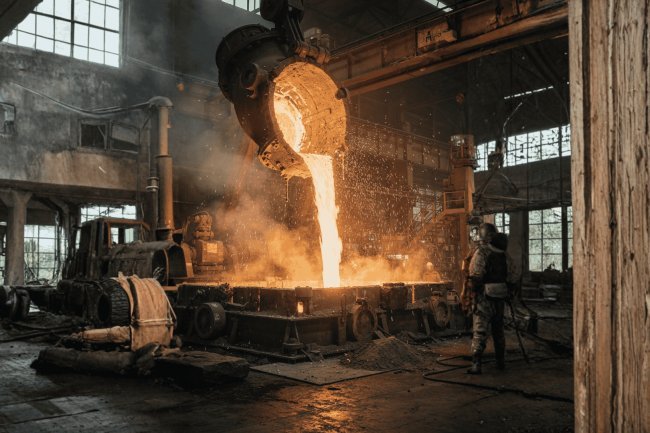
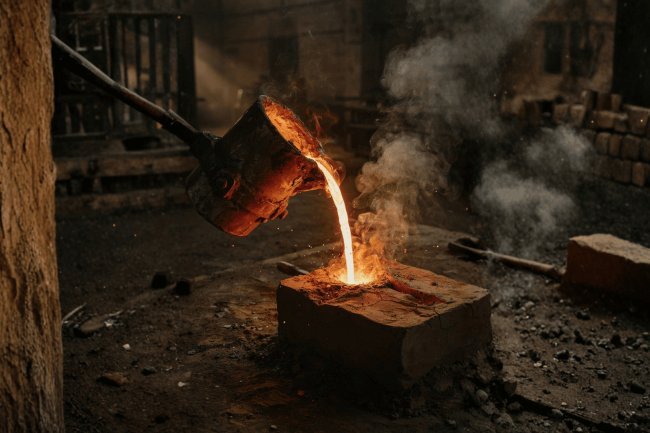
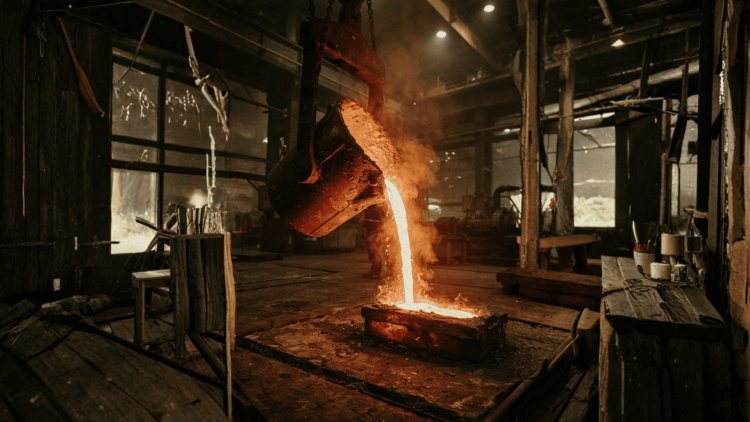
Casting development has undergone a profound transformation. What was once a process dominated by physical trial pours, destructive inspection, and repeated rework is now increasingly driven by virtual experimentation. Modern simulation technology allows engineers to identify thermal problems, feeding deficiencies, and defect-prone regions before production tooling is ever committed, dramatically reducing both risk and cost.
Two Generations of Casting Development
Physical Trial & Error
Design, pour, inspect, identify defects, redesign, and repeat. Every improvement cycle required additional material, labor, energy, and time.
Virtual Validation
Simulate filling, cooling, solidification, and defect formation digitally before manufacturing begins.
Waste and Trial Costs
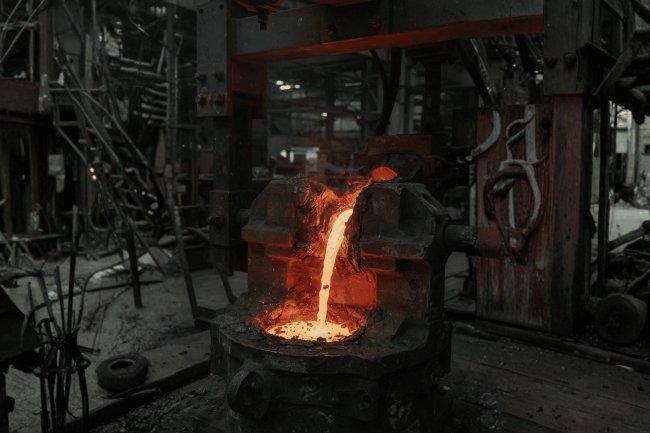
Physical casting trials are expensive because every iteration consumes metal, molding materials, furnace energy, machine capacity, engineering resources, and inspection effort. Unfortunately, many critical defects remain hidden until the casting has cooled and undergone extensive downstream processing.
Traditional Failure Discovery Cycle
Common Hidden Defects
Many casting defects become visible only after significant manufacturing investment has already been made.
Finite Difference Prediction
Finite Difference Methods discretize the casting domain into thousands or millions of computational nodes. At each location, governing equations describing heat transfer, fluid motion, solidification, and phase change are solved numerically, allowing the complete casting process to be recreated digitally.
What Engineers Can Predict Before Production
Virtual Design Iteration
Engineers can evaluate dozens of alternatives digitally before committing resources to tooling and production.
Faster, Better, Cheaper
Simulation-Driven Benefits
Before vs After Simulation Adoption
Traditional Foundry
- Multiple physical trials
- Late defect discovery
- High scrap risk
- Long development cycles
Simulation-Driven Foundry
- Virtual validation first
- Early defect prediction
- Higher casting quality
- Accelerated launch schedules
Predict Before You Produce
Simulation enables engineers to test ideas digitally, understand process behavior, remove defects proactively, and optimize casting quality long before production resources are committed.
The Most Expensive Defect
Is The One Found After Production Starts
The transition from physical trial-and-error development to virtual casting represents one of the most significant advances in modern manufacturing. Finite Difference-based simulation transforms defect prediction from a reactive activity into a proactive engineering capability. By accurately predicting hot spots, porosity, shrinkage behavior, and cooling performance before production, foundries dramatically reduce development costs, accelerate time-to-market, improve first-pass yield, and achieve a more efficient path from concept to finished casting. The result is a smarter development process that replaces repeated shop floor experimentation with informed, data-driven engineering decisions.
The numerical engine converts CAD geometry into coupled thermal and fluid predictions. Understanding how the mesh and physics interact is essential for interpreting results and trusting their accuracy.
High-fidelity simulations for complex castings may involve 5 to 50 million active nodes, typically requiring parallel computing clusters to achieve acceptable run times.
Tracks latent heat release during solidification.
Describes melt flow and momentum transport.
Ensures volumetric shrinkage compensation.
Identifies micro-porosity risk from interdendritic feeding failure using local thermal gradient and cooling rate.
Highlights isolated liquid pools cut off from feeding paths, guiding riser sizing and chilling strategy.
The Core Mechanics:
Meshing and PhysicsDiscretize the geometry into a 3D grid.
Coupled equations at every node
From thermal fields to defect risk maps
Get them right, and simulation becomes a trusted engineering instrument.
The submerged entry nozzle (SEN) delivers turbulent metal flow into the mold cavity at high velocity. This jet impinges on the solidifying shell, creating asymmetric heat transfer and shell thickness variation. Oscillating mold conditions, varying casting speed, and non-uniform flux lubrication contribute to transient flow patterns. Accurate simulation requires fine time-stepping, increasing computational demand compared to static casting.
Inverse segregation occurs when solute-enriched liquid is expelled outward during solidification shrinkage, degrading surface quality. Meniscus freezing, caused by insufficient superheat near the mold top, produces premature solid skins that fold into the strand as defects. Both require coupled solute transport and thermal models for accurate prediction and mitigation.
Classical Galerkin FEM suffers instability when convection dominates diffusion. Stabilized formulations such as SUPG and PSPG add tuned diffusion terms along flow directions, suppressing oscillations without excessive artificial diffusion. These methods improve stability and convergence, enabling realistic simulation of turbulent casting flows within practical time constraints.
Complexity in Continuous Casting
Transient Fluid Flow and Non-Uniform Heat Extraction
Inverse Segregation and Meniscus Freezing
Stabilized Finite Element Formulations
The next evolution in casting simulation is not faster solvers or finer meshes. It is autonomous decision-making. Instead of engineers manually proposing design changes and evaluating results one iteration at a time, optimization engines now search vast design spaces algorithmically, identifying casting configurations that maximize yield, minimize defects, and outperform solutions that would rarely be discovered through intuition alone.
Run simulation, review results, make adjustments, and repeat. Progress depends heavily on experience, intuition, and available engineering time.
Thousands of design alternatives are generated, simulated, ranked, and refined automatically until optimal solutions emerge.
OPTICast represents a major shift from engineer-directed experimentation to automated design optimization. Optimization algorithms continuously generate candidate designs, evaluate manufacturing performance through simulation, and evolve those designs toward increasingly better solutions.
Optimization success depends on clearly defining what "better" means. The solver evaluates every design candidate against objective functions and constraints that reflect engineering and business priorities.
Rather than producing a single answer, optimization often generates a Pareto front showing the best achievable trade-offs between conflicting objectives such as casting yield and defect risk, enabling engineers to select the most appropriate solution for production.
The Era of
Automated OptimizationFrom Human Iteration to Algorithmic Exploration
Engineer-Led Trial & Error
Algorithm-Led Discovery
OPTICast: Beyond Manual Iteration
Typical Optimization Variables
Optimization Engines
Objective Functions
Engineering Constraints
Multi-Objective Optimization
Real-World Yield Transformation
The next generation must connect grain-scale phenomena to component-scale behavior—bridging microns to meters for truly comprehensive process control.
Integration of thermo-mechanical models is one of the most impactful near-term advances available to industrial foundries, improving predictions of fatigue life and machining stability.
The ultimate goal is seamless multiscale integration: dendritic nucleation and growth, solute microsegregation, and eutectic formation computed at the grain scale, then homogenized to inform macroscopic yield strength, elongation, and fatigue resistance.
As computing power grows and multiscale model accuracy matures, this push-button vision is increasingly within reach.
Future Frontiers:
Multi-Scale PrecisionPredict stress, cracking, and distortion.
From grain nucleation to component properties
Automated simulation-driven optimization
From macro fields to microstructure-aware control
It is smarter physics—from grains to components, automatically optimized.
What's Your Reaction?