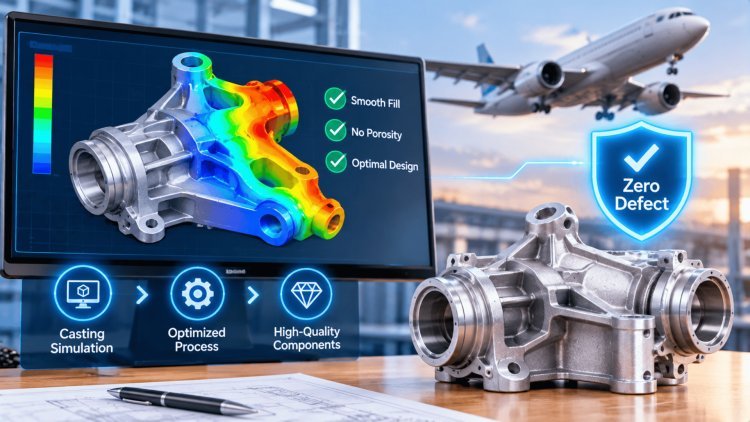
Casting Simulation for Aerospace Actuator Components: Zero-Defect Starts in the Digital Foundry
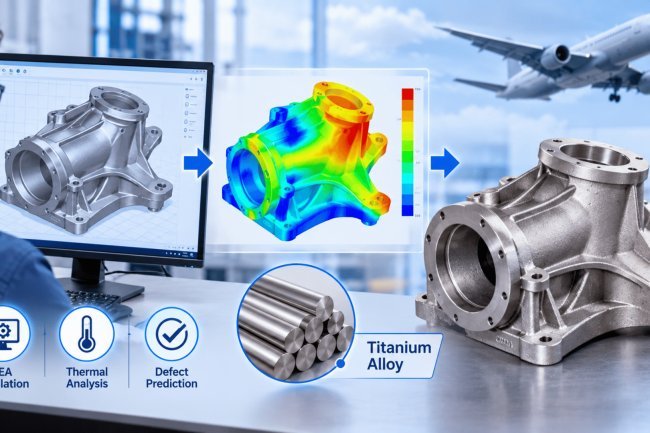
Modern aerospace actuator components demand absolute metallurgical precision. From flight control surfaces to landing gear mechanisms, every casting must perform flawlessly under extreme stress, temperature, and pressure — with zero tolerance for internal defects. This presentation explores how advanced casting simulation technology enables manufacturers to predict, prevent, and eliminate defects before the first mold is ever poured, compressing development timelines and protecting certification schedules.
Aerospace Stakes: Survival, Certification, and the Cost of a Single Flaw
The aerospace industry operates at the intersection of extreme physics and unforgiving regulatory scrutiny. Actuator components must reliably perform across a staggering thermal envelope — from the cryogenic cold of deep space and high-altitude operations (as low as −196°C in liquid oxygen systems) to the intense radiant heat zones adjacent to jet-engine turbine stages (exceeding 1,000°C). No other manufacturing sector demands this combination of material performance, dimensional accuracy, and internal soundness in a single casting.
Material Challenges
Titanium alloys and nickel-based superalloys — the backbone of aerospace actuator castings — exhibit narrow freezing ranges and high susceptibility to hot tearing. These materials solidify quickly and unevenly, creating internal stress concentrations that can initiate cracks invisible to the naked eye but catastrophic in service. A single undetected pore or shrinkage cavity in a flight-critical actuator bracket can lead to component failure, grounding of aircraft fleets, and multimillion-dollar liability exposure.
The Certification Imperative
Aerospace components undergo rigorous qualification protocols — AS9100, NADCAP, and customer-specific first-article inspection (FAI) requirements all demand documented proof of process capability. When defects are discovered during destructive testing or X-ray inspection at the end of a production run, the cost is not merely one scrapped part — it is weeks of rework, re-inspection, and potentially a full re-qualification cycle. The design philosophy must therefore shift from reactive defect detection to proactive defect prediction.
Discover how simulation tools redefine process control
The design goal is unambiguous: predict defects before the first mold is poured, not after scrap is created, re-qualification is triggered, and delivery schedules slip.
Effective casting simulation is not a single-point analysis. It is an end-to-end sequential modeling discipline that mirrors every physical stage of the casting process—from initial mold pre-heating through final metallurgical solidification and stress relief. Each stage produces its own defect mechanisms; predicting and eliminating them requires purpose-built physics solvers working in a coordinated chain.
Predicts how molten metal flows through runner systems, gates, and cavity geometry. Identifies turbulence zones, cold shuts, misruns, and air entrapment before tooling is committed. Critical for complex actuator housings with thin walls and re-entrant features.
Models heat transfer during and after filling to predict solidification sequence, hot-spot formation, and porosity risk zones. Identifies where shrinkage voids will nucleate based on local solidification time and feeding distance—the most common root cause of aerospace casting rejections under X-ray inspection.
Structural simulation calculates thermally induced stress during solidification and cooling. Predicts hot cracking at grain boundaries, cold cracking during knockout, and residual distortion that compromises dimensional tolerance.
This physics-consistent chain prevents the gross errors that arise when each stage is analyzed in isolation—a common limitation of simpler, single-physics tools.
What We Simulate: The Full Casting Journey
That Creates — or Prevents — DefectsPredict flow defects before tooling is committed.
Locate hot spots and porosity risk zones.
Distortion prediction is as critical as porosity mapping.
transforming raw solver output
into actionable engineering decisions.
One of the most powerful — and least understood — capabilities of modern casting simulation is its ability to construct a robust process window: a mapped region of parameter space within which castings consistently meet quality standards. Rather than optimizing a single set of process parameters, engineers simulate dozens or hundreds of parameter combinations, building a data-driven boundary between defect-free production and scrap. This approach is transformative for aerospace actuator programs, where the cost of a single failed qualification batch can exceed the entire simulation investment many times over.
The concept of “time-to-defect” testing in simulation refers to exploring how quickly a process parameter deviation drives the casting outside the defect-free window.
Identifying this boundary virtually, before tooling is committed, is the single most cost-effective risk reduction available to aerospace casting programs.
Visit PoligonSoft simulation tools to see how process windows are built and validated.
PROCESS WINDOW WIDTH
NARROW WINDOW
Narrow process windows require tighter manufacturing controls and more frequent monitoring.
WIDE WINDOW
Wide windows indicate robust processes that tolerate normal process variation without producing scrap.
Traditional casting development relies on iterative physical trials. For aerospace actuator components in titanium or superalloy, each physical trial may cost $5,000–$50,000 in material, labor, and inspection costs alone, before qualification testing is even begun. Simulation replaces the majority of these iterations with virtual experiments that cost a fraction of the physical equivalent, enabling engineers to arrive at first physical trial with high confidence in process parameters.
The result: fewer iterations, faster qualification, and lower total program cost.
Discover casting simulation services tailored to your qualification timeline.
From Virtual Process Window to Qualification: Testing “Time-to-Defect” Before Tooling
Why “Time-to-Defect” Testing Matters
Replacing Trial-and-Error with Data-Driven Sign-Off
The aerospace industry cannot afford to treat casting development as a trial-and-error discipline. The combination of extreme material costs, stringent certification requirements, and zero-defect quality expectations demands a fundamentally different approach — one grounded in physics-based prediction rather than empirical iteration. PoligonSoft's casting simulation environment delivers exactly this capability, transforming the foundry from a place where defects are discovered into a place where they are prevented.
Use PoligonSoft to predict porosity, shrinkage cavities, misruns, hot and cold cracks, and post-solidification warpage across the complete production cycle — from mold filling through final cooling and knockout. Every defect mechanism that leads to aerospace casting rejection is addressable in the virtual domain before a single gram of titanium or superalloy is melted. Explore the full casting simulation tools available for foundry applications.
Programs can begin immediately with a "try" simulation run on existing CAD geometry, or engage PoligonSoft's engineering team for a comprehensive process analysis that delivers actionable gating, risering, and process parameter recommendations. This low-barrier entry point means aerospace manufacturers can experience the value of simulation without committing to a full software implementation before understanding the return on investment for their specific component geometry and alloy system.
By compressing the development cycle through virtual process window development and distortion precompensation, actuator components reach first article inspection readiness significantly faster than traditional iterative development programs. For programs under schedule pressure — a constant in aerospace — this acceleration directly translates to program milestone achievement and customer delivery performance. Access detailed service offerings at Casting Simulation Tools for Foundries.
Explore the full PoligonSoft capability stack — hydrodynamics, thermal, stress, and MIRAGE visualization — purpose-built for aerospace foundry applications.
Partner with the PoligonSoft team for hands-on casting analysis, process window development, and qualification support tailored to your actuator program timeline.
Request a virtual "try" run on your component geometry and receive a defect probability map, process window boundary, and recommended parameter set before tooling is committed.
The digital foundry is not a future concept — it is an available, proven capability. Aerospace programs that adopt casting simulation today are qualifying faster, scrapping less, and delivering sooner than those still relying on physical trial-and-error development.
Qualify Aerospace Actuator Castings Faster — With Fewer Iterations
Predict the Full Defect Spectrum
Start with a "Try" Run or Engineering Analysis
Accelerate Component Readiness
Explore PoligonSoft Capabilities & Services
Simulation Tools
Engineering Services
Process Validation
What's Your Reaction?