Weber Number Effects in Free- Surface Metal Flow
A deep dive into the fluid dynamics governing mold filling, surface stability, and defect prevention in modern metal casting — where physics meets precision engineering.
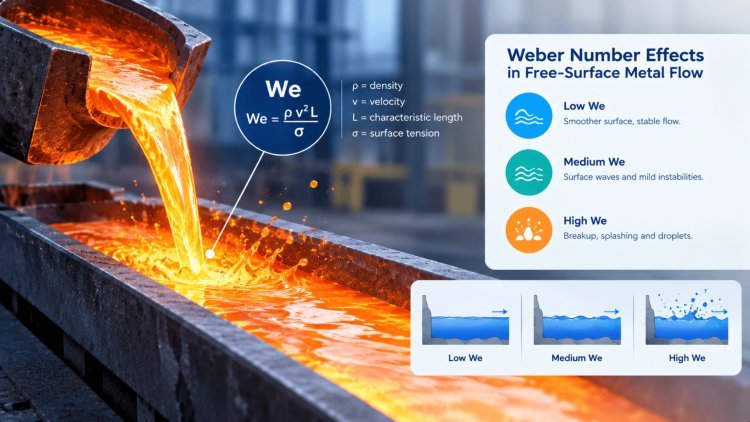
Understanding the Flow Crisis
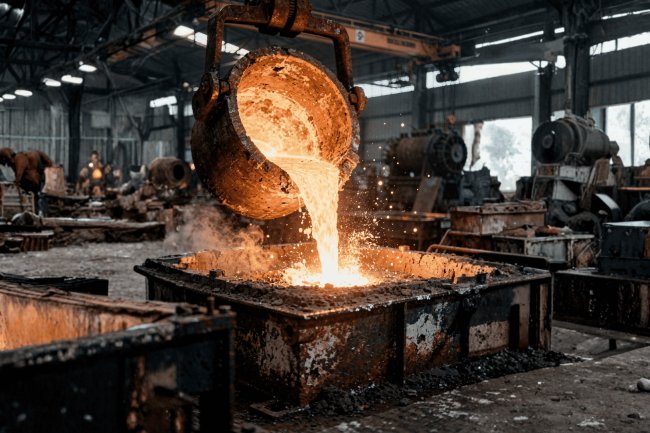
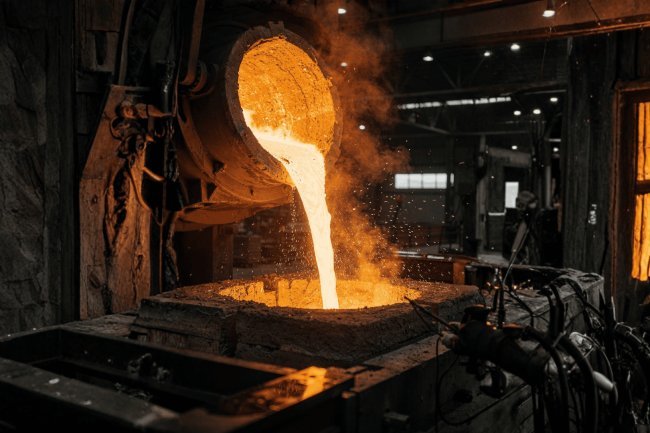
In metal casting, the moment liquid metal enters a mold cavity, a complex battle of forces begins. When metal velocity exceeds critical thresholds, the consequences cascade rapidly — mold erosion, sand grain dislodgement, and catastrophic casting defects that compromise the entire production run. Understanding this "flow crisis" is the first step toward eliminating it.
The Erosion Problem
Mold erosion is not a gradual process — it is an acute failure triggered by excessive inertial energy at the mold-metal interface.
As metal velocity surges beyond design tolerances, turbulent flow generates shear forces powerful enough to dislodge individual sand grains from the mold wall.
Each dislodged grain becomes an inclusion nucleus, seeding porosity, cold shuts, and surface defects that propagate through the solidified casting.
The critical challenge for process engineers is that erosion often occurs within the first few milliseconds of pour — long before any corrective action is possible on the shop floor.
Inertia vs. Surface Tension
The root physics of the flow crisis centers on the competition between two opposing forces: inertial forces, which drive turbulence and surface disruption, and surface tension forces, which act as a stabilizing membrane at the free surface of the melt.
When inertia dominates, the free surface ruptures, folding over itself and entraining air and oxide films into the bulk metal — creating bifilm defects and porosity that no downstream process can correct.
Engineers must therefore design gating systems, pouring rates, and sprue geometry with explicit attention to maintaining this balance throughout the entire fill sequence.
Explore the Flow and Filling module for real-time visualization of these competing forces across different mold geometries and alloy systems.
Air entrainment caused by free-surface rupture is one of the leading causes of premium casting rejection in aerospace and automotive foundries worldwide.
Excessive Velocity
Metal velocities beyond the critical threshold initiate turbulent boundary layer separation at mold walls, triggering rapid erosion cycles.
Shear Force Generation
Turbulent flow fields create concentrated shear zones at the mold-metal interface, providing the mechanical energy necessary to dislodge bound sand grains.
Air Entrainment
Once the free surface ruptures, atmospheric gas is folded into the melt, forming stable oxide bifilms and gas porosity throughout the solidifying casting.
Cascading Defects
Each inclusion and pore acts as a stress concentrator, reducing fatigue life, tensile strength, and pressure-tightness of the final component.
In metal casting, the moment liquid metal enters a mold cavity, a complex battle of forces begins. When metal velocity exceeds critical thresholds, the consequences cascade rapidly — mold erosion, sand grain dislodgement, and catastrophic casting defects that compromise the entire production run. Understanding this "flow crisis" is the first step toward eliminating it.
The Weber number (We) is one of the most powerful dimensionless parameters in free-surface fluid mechanics, capturing the fundamental competition between destabilizing inertial forces and stabilizing surface tension at the melt-atmosphere interface. Its correct interpretation is the difference between a sound casting and a scrap bin full of defective parts.
The Weber number is formally defined as the ratio of inertial forces to surface tension forces acting at a fluid interface:
Where ρ is the fluid density (kg/m³), v is the characteristic velocity of the melt (m/s), L is a representative length scale such as hydraulic diameter (m), and σ is the surface tension coefficient (N/m).
As any of the inertial terms — density, velocity, or length scale — increase relative to surface tension, the Weber number climbs and the free surface becomes progressively less stable.
For typical liquid steel, iron, and aluminum alloys, surface tension values range from approximately 0.5 N/m to 1.8 N/m, making velocity and geometry the primary levers available to the process engineer during gating system design.
Decades of experimental casting research and computational validation have established a critical Weber number threshold of We = 12.3 for free-surface metal flow.
Above this value, the probability of flux entrapment, oxide bifilm formation, and macro-porosity rises sharply — transforming what might be a marginal fill condition into a high-risk defect scenario.
This threshold is not a hard binary switch but a probability boundary.
As the Weber number approaches and exceeds 12.3, the statistical likelihood of surface rupture events per unit area of the free surface increases nonlinearly.
Foundries operating consistently above this value typically report scrap rates 3–5× higher than those maintaining sub-critical flow conditions throughout the fill.
Higher interfacial tension — achievable through alloy chemistry control, melt temperature management, and flux selection — effectively raises the denominator of the Weber number equation, expanding the "safe operating region" for a given gating velocity. Explore Foundry Simulation insights for deep-dives into how interfacial tension is modeled and optimized in modern casting simulation environments.
A Weber number consistently below 12.3 throughout the fill sequence is the single most reliable predictor of a defect-free, first-pour-success casting outcome.
Surface tension dominates entirely. The free surface remains intact and smooth throughout fill. No air entrainment, minimal oxide formation. Ideal for thin-section castings and pressure-tight components requiring zero porosity.
Inertial forces are significant but not yet dominant. Localized surface rippling and minor disturbances occur. Risk is manageable with optimized gating geometry and controlled pouring rates. Most industrial castings operate in this band.
Inertia overwhelms surface tension. Free-surface rupture, splashing, and air entrainment are expected. Flux entrapment and macro-porosity are likely. Immediate gating redesign or velocity reduction is required before any production run.
The Weber number (We) is one of the most powerful dimensionless parameters in free-surface fluid mechanics, capturing the fundamental competition between destabilizing inertial forces and stabilizing surface tension at the melt-atmosphere interface. Its correct interpretation is the difference between a sound casting and a scrap bin full of defective parts.
The Physics of the Weber Number
Definition and Formula
The Critical Threshold: We = 12.3
We < 6 — Stable Regime
We 6–12.3 — Transitional Regime
We > 12.3 — Turbulent / High-Risk Regime
Modern casting simulation has transformed Weber number management from a post-pour diagnostic exercise into a pre-production design discipline. By deploying high-fidelity computational solvers before a single kilogram of metal is melted, foundries can explore hundreds of design variants, identify high-We risk regions with precision, and commit to optimized gating geometry with confidence.
At the heart of PoligonSoft's simulation platform is a high-fidelity Euler flow solver that treats the liquid metal as a continuous compressible fluid governed by the full Navier–Stokes equations, coupled with a free-surface tracking algorithm that resolves the metal–atmosphere interface at sub-millimeter resolution.
One of the most impactful process-level interventions available to foundries operating in the high-We regime is the shift from uphill (bottom-fill) teeming to side teeming processes. In uphill teeming, metal enters at the base of the mold and rises under gravity pressure, producing a relatively quiescent fill—but at the cost of long fill times and potential misrun risk in complex geometries.
The Advanced Metal Casting Engineering guide provides the quantitative data, case studies, and gating design templates needed to optimize your gating geometry rationally—before the first physical pour consumes time, energy, and material.
Mitigating Risk Through Simulation
Sub-millimeter free-surface resolution.
Distribute entry velocity, reduce peak We.
through high-fidelity Euler flow simulation and simulation-guided
side-teeming gating design, achieving 30–50% peak We reduction.
Simulation-first frameworks consistently enable engineers to reach 98% yield optimization targets, eliminating the scrap and rework costs that historically defined casting development cycles.
Maintaining the Weber number below the critical 12.3 threshold throughout the entire fill sequence is the foundational design criterion for defect-free free-surface metal flow.
Optimized side-teeming gating designs, validated through Euler flow simulation, deliver up to 50% reductions in peak Weber number compared to conventional uphill-fill configurations.
The traditional foundry development cycle is brutally expensive: design a gating system based on experience and rules of thumb, pour a trial casting, cut it open, find defects, redesign, repeat. Each iteration consumes pattern tooling costs, melt energy, labor hours, and weeks of calendar time. For complex structural castings in aerospace or heavy industry, this cycle can represent hundreds of thousands of dollars before a single shippable part is produced.
By placing Weber number monitoring at the center of the simulation workflow, foundries fundamentally change this equation. Instead of discovering high-We risk regions in a scrapped casting, engineers identify them on screen — in minutes — and evaluate corrective design changes instantly. The physical pour becomes a validation event rather than an exploratory experiment, and first-pour success rates climb dramatically.
This shift from reactive to predictive manufacturing is not incremental improvement — it is a structural transformation in how foundries compete on quality, speed, and cost. Visit PoligonSoft to start optimizing your casting parameters with the industry's most advanced free-surface simulation platform today.
Import existing gating CAD into the simulation environment and run a baseline Euler flow solve to map current Weber number distribution and identify existing high-risk zones across your mold geometry.
Systematically vary sprue taper, ingate cross-section, runner balance, and pouring rate to drive peak We below 12.3 across the complete fill sequence — leveraging the Advanced Metal Casting Engineering dataset for benchmarking.
Commit to the simulation-optimized design for first physical pour. Monitor real process parameters against simulation predictions and close the feedback loop for continuous improvement across future part families.
"The Weber number is not merely a quality metric — it is a design target. Foundries that engineer to it from day one of the simulation phase don't find defects in castings. They prevent them from ever forming."
Engineering for Zero-Defect Success
From Reactive Testing to Predictive Manufacturing
What's Your Reaction?