Understanding Gas Porosity: From Invisible Flaws to Predictive Power
A deep dive into one of casting's most persistent challenges — how microscopic voids form, why they matter, and how simulation technology is transforming the way engineers design defect-free parts.
The Hidden Enemy:
Gas Porosity
Gas porosity remains one of the most destructive and expensive casting defects in modern manufacturing. Invisible during production yet devastating in service, internal voids can silently compromise strength, fatigue resistance, pressure containment, and long-term reliability across critical industrial applications.
How Gas Porosity Weakens Components
Two Different Mechanisms.
Two Different Solutions.
Gas Entrapment
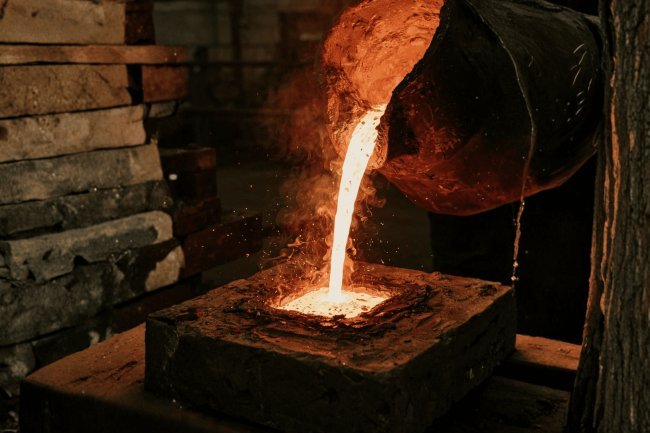
Turbulent mold filling traps air and mold gases within the metal stream before escape paths can form, creating internal void defects during filling.
Dissolved Gas Evolution
Gases dissolved within liquid metal are expelled during solidification as solubility decreases, creating voids throughout the casting structure.
Heat-driven binder pyrolysis generates gases such as carbon monoxide, carbon dioxide, and hydrocarbons. Poor venting can inject these gases into the melt, trapping spherical pores near core surfaces.
Metals contract during solidification. If liquid feed metal cannot reach isolated regions, the remaining liquid contracts inward and produces irregular interdendritic voids.
Bubbles form when local gas pressure overcomes metallostatic pressure and surface tension. Inclusions, oxide films, grain boundaries, and dendritic gaps often provide preferred nucleation sites.
Binder chemistry, core venting, riser and feeder design, melt cleanliness, and controlled solidification are the main levers for reducing porosity.
After nucleation, bubbles may grow, merge, or migrate according to local melt velocity and solidification-front speed, determining their final size and distribution.
The Anatomy of a Defect
Core-Gas Bubbles
Shrinkage Porosity
Nucleation Physics
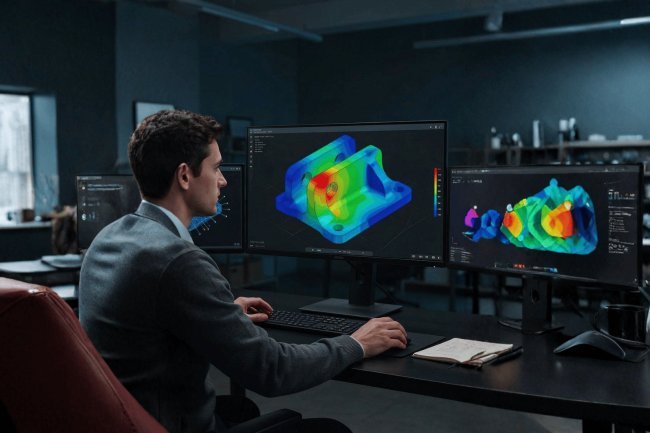
CFD simulation models the complete filling and solidification sequence. Engineers digitally optimize gating, risers, and mold geometry, replacing weeks of physical trials with hours of computation.
Accurate porosity prediction requires coupling fluid dynamics, heat transfer, gas transport, and solidification metallurgy. This integration enables precise defect prediction beyond simplified models.
ProCAST: Commercial platform with modules for investment, die, and sand casting. Predicts shrinkage porosity, gas entrapment, and microstructure evolution with high accuracy.High-Fidelity Casting Simulation
Moving Beyond Trial-and-Error
Multiphysics Coupling
Industry-Leading Tools
OpenFOAM: Open-source CFD platform using VOF methods to track metal-air interfaces. Customizable for advanced gas evolution and bubble transport studies.
Simulation delivers value only when it solves real manufacturing challenges. Metalcast S.A.'s experience demonstrates how virtual casting analysis transformed a persistent quality problem into a measurable operational and financial success.
A critical aluminum valve-body casting used in hydraulic systems was experiencing approximately 25% rejection. Every failed part consumed raw materials, melting energy, machining capacity, labor, and delivery commitments without generating customer value.
Multiple modifications to the gating system and riser design failed to significantly improve quality because the actual defect mechanisms remained hidden.
Conventional inspection identified faulty parts but could not explain precisely where the defects originated or why they developed.
Case Study:
Transforming Production At Metalcast S.A.Company Overview
A 25% Rejection Rate
Why The Scrap Rate Was So Costly
Physical Trial & Error
Unknown Root Cause
ProCAST Revealed Two Hidden Defect Sources
High-performance computing enables finer spatial and temporal resolution, revealing dendritic structures, thin walls, and micro-scale gas behavior that simplified models may miss.
Machine-learning models trained on simulation data can match live sensor patterns to defect signatures and flag porosity risks before parts leave the mold.
Reinforcement learning can explore pouring temperature, fill speed, and cooling settings, using sensor feedback to continuously reduce scrap risk.
Post-production sorting accepts defects as inevitable. Simulation-driven design instead identifies and removes defect mechanisms before physical trials, reducing waste and shortening development cycles.
Foundries that combine simulation, AI, and in-process monitoring will set tomorrow’s benchmarks for consistency, development speed, material efficiency, and quality performance.
The move from reactive inspection to proactive, simulation-driven design is not an incremental upgrade; it is a fundamental redefinition of how manufacturing quality is achieved.
The Future of Zero-Defect Casting
Supercomputing Models
AI Defect Prediction
Autonomous Optimization
What's Your Reaction?