Simulation of Tool Steel Cast Components
In modern foundry and manufacturing, the ability to predict — before a single ounce of molten metal is poured — how a tool steel component will solidify, shrink, and perform is nothing short of transformative. PoligonCast sits at the forefront of this revolution, delivering advanced casting simulation solutions that reduce scrap rates, compress lead times, and elevate first-pour success across demanding industrial applications.
Why Tool Steel
Demands Simulation
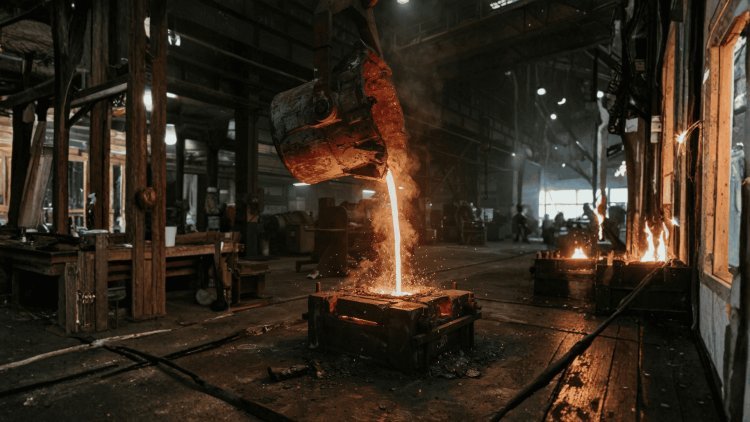
Tool steels, including grades such as H13, D2, P20, and M2, are engineered for extreme service conditions: high hardness, wear resistance, and thermal fatigue strength. These very properties that make them indispensable in dies, molds, and cutting tools also make them notoriously difficult to cast without defects.
Engineered for Severe Service
High Performance Creates High Casting Risk
Porosity, hot tearing, shrinkage cavities, and residual stress concentrations are endemic risks in tool steel castings. The demanding thermal and metallurgical behavior of these materials means small process errors can produce defects that compromise expensive finished components.
Trial-and-Error Is Exceptionally Expensive
Traditional tooling corrections are extraordinarily costly because the expense extends beyond the casting itself. High alloy content, complex heat treatment, precision machining, and tooling investment compound the financial impact of every unsuccessful iteration.
Simulation Eliminates Guesswork
Simulation digitally validates mold design, gating systems, and process parameters before committing to physical production.
PoligonCast deploys a multi-physics simulation environment that models every critical phase of the casting process — from mold filling dynamics to solid-state stress evolution.
By combining flow, thermal, structural, and microstructure analysis, PoligonCast models the critical stages that shape tool steel casting quality and performance.
Core Simulation Capabilities at PoligonCast
A Connected View of the Casting Process
3D CAD import, tool steel grade definition, and thermophysical property assignment from validated alloy databases.
Iterative simulation runs optimize pouring temperature, fill rate, riser design, and cooling channel configuration.
Color-mapped risk indices for porosity, hot tearing, and residual stress are reviewed with foundry engineers to refine the design.
A simulation-backed process specification is released to the foundry floor, dramatically increasing first-pour success rates.
PoligonCast clients consistently report 30–50% reductions in scrap rate and significant savings on machining and heat treatment rework when simulation is applied at the design stage.
The Digital Workflow
1. Geometry & Material Setup
2. Process Parameter Optimization
3. Defect Risk Mapping
4. Validated Process Release
Increasing geometric complexity and tighter tolerance requirements make repeated physical experimentation progressively more expensive and difficult to justify.
PoligonCast partners with foundries, OEM suppliers, and tool manufacturers to embed simulation capability directly into their engineering workflows, delivering measurable ROI from the very first project engagement.
The value of simulation extends across the complete manufacturing lifecycle, from early engineering decisions through tooling qualification and stable production.
Our engineers combine materials science with simulation mastery, understanding not just software outputs, but the underlying metallurgy of tool steel behavior.
We leverage leading casting simulation platforms, calibrated against real foundry data, ensuring predictions translate accurately to production outcomes.
From concept design review through post-pour validation, PoligonCast supports every stage, making simulation an integrated quality system, not a one-time service.
Embed metallurgical knowledge, validated simulation capability, and full-cycle engineering support directly into your foundry workflow to reduce physical trials, accelerate tooling qualification, and improve production outcomes.
For modern tool steel manufacturing, simulation-driven process development is becoming essential to controlling scrap, qualification time, physical trial requirements, and schedule risk. PoligonCast combines deep metallurgical expertise with industry-proven simulation platforms calibrated against real foundry data, extending support from initial concept review through post-pour validation. This full-cycle approach transforms simulation from an isolated analysis activity into an integrated quality system capable of delivering measurable manufacturing value from the earliest stages of development through stable production.
Strategic Value for
Foundries & Manufacturers
ErrorPredict Before Production
Simulation Inside the Engineering Workflow
Simulation ROI at a Glance
Less Waste. Faster Qualification. Fewer Trials.
Why Partner with PoligonCast
Deep Metallurgical Expertise
Industry-Proven Software Stack
Full-Cycle Partnership
One Continuous Engineering Partnership
Turn Simulation Into
Measurable Manufacturing ROISimulation Creates Value
When It Becomes Part Of
The Engineering System.
What's Your Reaction?