Human-AI Collaboration in Simulation-Driven Casting Process Engineering
How artificial intelligence, advanced simulation, and decades of foundry expertise are converging to reshape the future of metal casting — from manual intuition to autonomous, self-optimizing production systems.
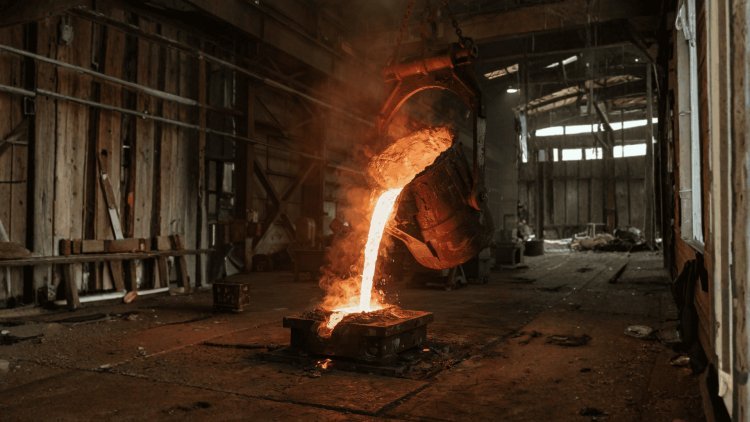
The Era of
Manual Control
For over a century, casting quality and process control have been driven by human expertise. Skilled metallurgists, engineers, and operators built the foundry industry through experience, intuition, and practical problem-solving. While this knowledge remains invaluable, modern manufacturing complexity is exposing the limitations of manual control systems.
A Century Of Human Expertise
Still Rely Primarily On Manual Control
Most casting operations continue to depend heavily on human-driven process decisions, visual inspection, experience-based adjustments, and trial-and-error process refinement.
The Traditional Decision Loop
The Core Bottlenecks
Physical Prototype Dependency
Development decisions depend on producing physical samples first. Time, energy, material consumption, and labor costs must be invested before engineering learning can occur.
Slow Iterative Design
Every modification requires a new mold update, casting cycle, inspection review, and engineering assessment. Design improvements are measured in days or weeks rather than hours.
Traditional Development Cycle
Knowledge Silos
Critical expertise often exists only in the minds of experienced personnel, making knowledge difficult to scale and vulnerable to workforce turnover.
Reactive Quality Control
Defects are usually found after they occur, leading to scrap, rework, schedule delays, and unnecessary cost escalation.
Virtual casting simulation began the shift from empirical trial-and-error to digitally informed engineering, allowing foundries to explore process behavior before committing to physical tooling.
Digital experiments compress early process development by reducing the need to commit immediately to physical tooling, shortening both cost and time-to-first-pour.
Modern Computer-Aided Engineering platforms support multidisciplinary design optimization by evaluating fluid flow, heat transfer, solidification kinetics, residual stress, and distortion together.
Simulation can forecast local grain size, dendrite arm spacing, porosity distribution, and secondary-phase formation, allowing performance requirements to be addressed precisely where they matter within the casting.
Leading foundries report faster development alongside improved first-time-right quality—a dual benefit that strengthens the case for digitalization.
Simulation: The First Digital Leap
Experiment before building.
One environment. Many interacting physics.
Material properties are not uniform.
decisions before molds, evidence before metal.
AI functions as a "virtual engineer," learning from thousands of production cycles. By analyzing machine parameters, alloy compositions, environmental conditions, and scrap records, machine learning models uncover hidden relationships between inputs and quality outcomes.
AI-powered systems predict optimal machine settings in real time, dynamically adjusting shot profiles, die temperatures, pressures, and cooling sequences. This shifts quality assurance from reactive inspection to proactive prevention, reducing scrap and rework costs.
ML models process thousands of variables simultaneously, identifying complex parameter interactions invisible to human analysis.
Predictive algorithms generate early warnings of defect conditions such as shrinkage porosity, cold shuts, and misruns before production begins.
Machine learning models improve with every cycle, becoming more accurate and robust as they accumulate real operating data.
AI systems encode and preserve expert knowledge, creating a living institutional memory that scales across shifts and facilities.
The Rise of the Virtual Engineer
AI as a Learning System
Real-Time Predictive Control
Key Capabilities of the Virtual Engineer
Pattern Recognition at Scale
Defect Prediction Before Occurrence
Continuous Self-Improvement
Human–AI Knowledge Transfer
The next evolution of casting engineering is no longer focused on optimizing materials, manufacturing processes, or component design independently. By combining Integrated Computational Materials Engineering (ICME) with Artificial Intelligence, manufacturers can simultaneously optimize alloy chemistry, process parameters, and structural geometry within a single intelligent digital framework.
Material selection, process design, and structural optimization occur separately.
Materials, manufacturing, and geometry evolve together inside one digital ecosystem.
Integrated Computational Materials Engineering (ICME) creates a digital thread connecting material chemistry, process physics, manufacturing behavior, and structural performance. Rather than optimizing isolated activities, ICME models the entire engineering lifecycle as one connected system.
AI enables ICME to move beyond prediction into optimization. Rather than evaluating dozens of engineering possibilities, machine learning and optimization algorithms can evaluate millions of alloy, process, and topology combinations to discover superior solutions.
Massive single-piece automotive and aerospace castings require simultaneous optimization of alloy behavior, die design, process controls, and structural topology. The scale of this challenge exceeds what traditional engineering workflows can practically evaluate.
ICME-AI systems help engineers place material only where structural analysis proves it is necessary. This reduces component mass, decreases raw material consumption, lowers manufacturing energy demand, and minimizes environmental impact across the entire lifecycle.
Co-Design:
Integrating ICME and AIEngineering Evolution
Sequential Decisions
Simultaneous Optimization
What Is ICME?
The ICME Digital Thread
AI As The Optimization Engine
AI Searches For Pareto-Optimal Solutions
Giga-Casting & Lightweight Structures
Designing For Lower Carbon Footprints
Casting process engineering is moving toward self-improving foundries where human expertise and artificial intelligence operate as partners in a continuous cycle of optimization and innovation.
Human experts use simulation and early ML tools, with reactive control and emerging prediction.
ICME–AI co-design platforms and real-time process control scale across high-volume operations.
Whole-foundry digital twins support continuous experimentation and simulation-validated improvements.
AI balances quality, throughput, energy, and carbon while human engineers direct system-level priorities.
Human expertise does not disappear; it moves upward. Engineers define objectives, interpret AI-generated insights, weigh competing values, and guide innovation at the system level.
Organizations that delay simulation, AI integration, and data infrastructure risk becoming structurally unable to meet future demands for quality, speed, and sustainability.
The Autonomous Future
Engineers become system architects.
A strategic transformation—not an IT project.
Build the leadership foundation now.
The time to act is now.
What's Your Reaction?