Simulation-Based Parameter Screening for Castings
How virtual process exploration compresses development cycles, eliminates costly trial-and-error, and delivers quantified process windows before a single tool is cut.
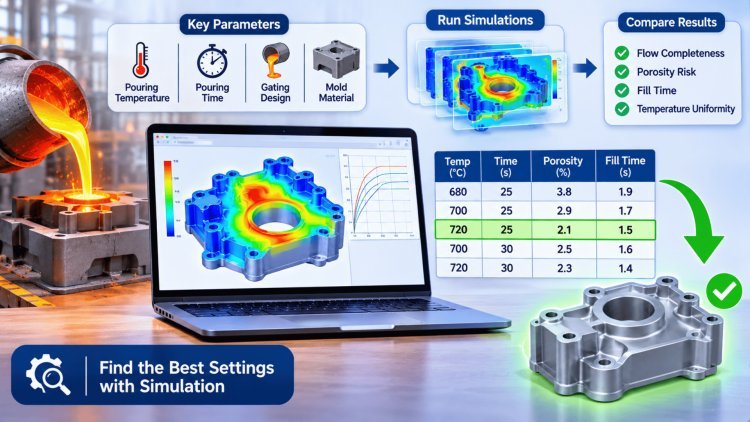
From "Will It Work?" to Production Readiness
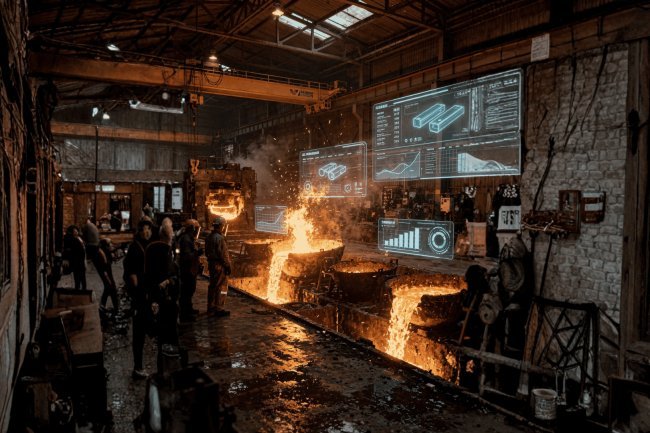
Traditional casting development has long relied on accumulated shop-floor intuition, iterative physical trials, and expensive tooling rework. Each failed pour or scrapped sample costs time, material, and engineering bandwidth. Digital qualification fundamentally changes this equation — shifting the discovery phase into a controlled virtual environment where failure is free and insight is rapid.
Simulate First, Build Once
This philosophy — simulate first, build once — is what separates modern foundries achieving first-good-part outcomes from those still cycling through costly physical iterations.
Effective simulation-based screening is not a single run—it is a structured sweep across the design space, systematically varying the parameters that most influence fill quality, feeding adequacy, and thermal behavior. The virtual lab approach treats each simulation as an experiment in a designed matrix, capturing how outputs change as inputs are perturbed across realistic production ranges.
Systematically vary gate location, runner cross-section area, and ingate distribution pattern to control fill front progression and minimize turbulence. Poorly placed gates generate oxide films, entrapped air, and velocity spikes that nucleate defects.
Sweep riser diameter, height, and position across the feeding-critical sections of the casting geometry to find the minimum feeding setup that eliminates macro-shrinkage risk. Over-risering wastes yield and energy; under-risering creates internal voids.
Sweep pouring temperature and pour rate simultaneously to map the two-dimensional process window where fill is complete without premature solidification. Too cold and the metal freezes before filling thin sections; too hot and oxide inclusions proliferate and grain structure coarsens.
The Virtual Lab: Screening
the Right ParametersControl fill front, minimize turbulence.
Find the minimum feeding setup.
Map the feasible operating corridor.
eliminates one physical trial iteration—
compressing weeks of foundry experimentation
into hours of compute time.
The most powerful output of simulation-based screening is not a single pass/fail verdict — it is a spatial, probabilistic understanding of where and why defects will form, and how sensitively that risk responds to each controllable parameter. This transforms simulation from a verification tool into a true engineering decision engine.
Predict solidification direction, thermal gradients, macro-shrinkage void locations, and hot spots directly tied to feeding adequacy. Modulus-based solidification analysis reveals which geometric features are last to freeze and therefore most vulnerable to centerline porosity.
Gradient maps expose regions of excessive thermal stress accumulation, flagging hot-tear and crack risk before the first pour.
Use standardized simulation setups paired with parameter sensitivity studies to identify which inputs drive the most quality variance. A one-degree change in pour temperature may have negligible effect on shrinkage but a large effect on cold-shut risk in thin walls.
Knowing the sensitivity ranking allows process engineers to allocate control effort wisely — tightening tolerances on high-impact parameters while relaxing specifications on low-impact ones, reducing overall control cost without increasing defect risk.
Move beyond simple pass/fail verdicts with spatial probability maps for porosity, oxide inclusions, cold shuts, and misruns. These maps quantify the likelihood of a defect at every node in the casting mesh, allowing engineers to compare design alternatives on a risk-weighted basis rather than relying on experience-based judgment alone.
High-risk zones can be re-engineered — through geometry change, gating revision, or alloy selection — with the effect of each intervention immediately visible in the updated map.
Spatial risk index tied to local modulus and feeding distance
Fill-front temperature at junction — mapped against section thickness
Thermal gradient + constraint index across solidification interval
Defect Risk Maps That Become Engineering Decisions
Solidification Physics & Thermal Mapping
Sensitivity Studies for Quality Variance Control
Beyond Binary: Spatial Probability Maps
Shrinkage Porosity
Cold Shuts
Hot Tears
The logical endpoint of simulation-based parameter screening is a fully autonomous virtual foundry — a system capable of self-directing its own experiments, interpreting results, and converging on optimal process windows without requiring manual intervention at each iteration. This vision is no longer theoretical; the enabling technologies are available today.
Adopt a simulation-first exploration philosophy to reach first-good-part faster — with a quantified, documented process window that production teams can defend, repeat, and continuously improve.
To explore how virtual parameter evaluation works in practice for your casting application, read PoligonCast: Virtual Evaluation of Alternative Casting Parameters — a detailed walkthrough of how simulation sweeps are structured and interpreted across real casting geometries.
For the broader strategic vision of where this technology leads, see Building the Autonomous Foundry Through Process Simulation, which outlines how coupled physics loops and DoE automation are converging into a self-directing virtual development environment.
When you are ready to put these methods to work, PoligonCast Casting Simulation Tools for Foundries provides the purpose-built platform for structured parameter screening, defect risk mapping, and end-to-end process qualification.
Toward an Autonomous, End-to-End Virtual Foundry
Virtual Evaluation of Alternative Casting Parameters
Building the Autonomous Foundry Through Process Simulation
PoligonCast Casting Simulation Tools for Foundries
What's Your Reaction?