Temperature-Dependent Material Properties in Casting Simulation
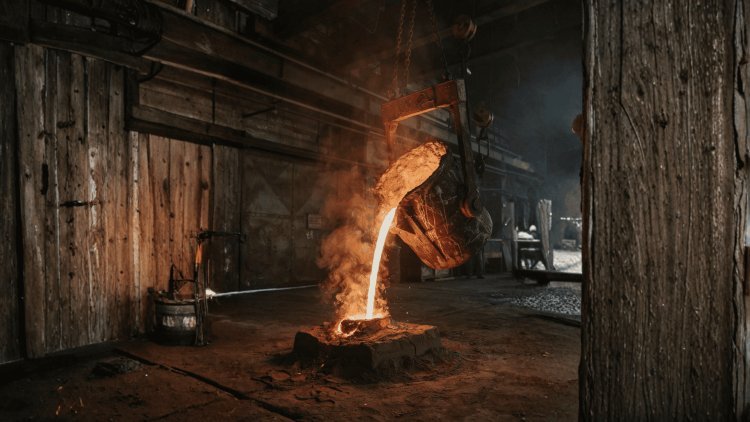
In modern foundry and manufacturing, the accuracy of casting simulation hinges on one critical variable: how materials behave as temperature changes. From liquid metal poured at over 1,400°C to a solidified component cooled to room temperature, every phase of the thermal cycle alters a material's density, viscosity, thermal conductivity, and mechanical strength. PoligonCast's advanced simulation platform captures these dynamic property shifts with precision — enabling engineers to predict defects, optimize process parameters, and deliver higher-quality castings with fewer physical trials.
Why Temperature-Dependent
Properties Are Non-Negotiable
Static material assumptions are among the most common sources of simulation error in casting engineering. A metal's thermal conductivity, specific heat, density, and viscosity are not constants. These properties shift significantly as temperature changes and as the material transitions between liquid, semi-solid, and solid states. Ignoring these variations produces inaccurate predictions of mold filling, premature solidification, hot spots, and shrinkage porosity.
Three Critical Property Groups
Why Constant Properties Create Error
Thermal Conductivity
Thermal conductivity governs the rate at which heat moves through molten metal, the developing solid shell, and the surrounding mold system. It directly influences cooling rates, thermal gradients, and the progression of solidification.
Conductivity can vary significantly between liquid and solid phases. Treating it as a constant causes the simulation to transfer heat incorrectly and distorts predictions of where and when the solidification front develops.
Thermal Conductivity Influences
Specific Heat Capacity
Specific heat capacity determines how much thermal energy the material absorbs or releases for each degree of temperature change. Because this property varies with temperature, it directly affects the predicted rate at which molten metal cools throughout the casting cycle.
Phase transformation introduces an additional requirement: latent heat must be represented accurately. During solidification, substantial energy is released even while temperature may change relatively little. Neglecting this contribution produces incorrect thermal histories and solidification-time predictions.
Phase Change Is an Energy Event
Accurate casting models must account for both sensible heat associated with temperature change and latent heat associated with liquid-to-solid phase transformation.
Thermal Energy Evolution
Density & Viscosity
Density and viscosity strongly influence the fluid dynamics of molten metal during mold filling. Both properties change as temperature decreases, meaning the flow characteristics of metal entering the mold are continuously evolving during the filling sequence.
Temperature-dependent viscosity is particularly important because it determines resistance to flow. As molten metal cools, increasing viscosity can alter velocity profiles, change turbulence behavior, reduce filling capability, and contribute directly to premature freezing.
Density & Viscosity Influence
Temperature Changes the Entire Fill
What Static Properties Can Get Wrong
Alongside the Casting
A physically realistic simulation continuously updates material behavior as temperature and phase state change, ensuring that both filling and solidification calculations remain representative of the real process.
Create Dynamic Accuracy
Casting behavior changes continuously from pouring through final solidification. Simulation inputs must reflect that same physical evolution if predictions are expected to remain trustworthy.
A Dynamic Casting Process
Cannot Be Accurately Modeled
With Static Material Properties.
Temperature-dependent material properties are fundamental to trustworthy casting simulation. Thermal conductivity determines how rapidly heat moves through liquid and solid regions, specific heat governs temperature evolution, latent heat controls energy release during phase transformation, and density and viscosity shape mold-filling behavior. Treating these values as constants disconnects the numerical model from the physical process and can distort predictions of fluid flow, solidification timing, thermal hot spots, gas entrapment, oxide formation, and shrinkage porosity. Accurate simulation therefore requires material data that evolves continuously with temperature and phase state, ensuring that the model reflects the same changing physics experienced by the real casting.
Accurate casting simulation must track material behavior continuously — from superheat through solidification to final cooling. PoligonCast integrates temperature-dependent property datasets at each simulation timestep, resolving the material state dynamically rather than interpolating from a single average value. This approach captures critical phenomena that simpler models can miss.
Temperature-dependent properties are updated throughout the simulation, helping capture changing thermal conditions and their effects on casting quality.
Alloys solidify across a temperature range — not at a single point. Mushy zone behavior, dendrite formation, and interdendritic feeding depend on precise liquidus-to-solidus property mapping.
PoligonCast: Resolves the solidification range using high-fidelity thermophysical data libraries.
The release of latent heat during solidification dramatically slows local cooling rates. If a simulation engine underestimates this effect, it can mispredict solidification times enough to undermine riser and gate design decisions.
Why it matters: Accounting for latent heat helps represent the thermal delay that occurs as the metal changes phase.
The heat transfer coefficient at the mold-metal interface is temperature-dependent and changes as an air gap forms when the casting contracts away from the mold wall.
PoligonCast: Models this evolving boundary condition to predict surface chilling and hot tear susceptibility more accurately.
As castings cool below the solidus, differential thermal contraction generates residual stresses. Temperature-dependent elastic modulus and yield strength are essential for predicting warpage, cracking, and dimensional non-conformance in final parts.
By accounting for phase-change behavior, latent heat, evolving mold-metal heat transfer, and temperature-dependent mechanical properties, PoligonCast supports a more complete understanding of casting behavior from the molten state through final cool-down.
Modeling the Full Thermal Lifecycle
Solidification Range Modeling
Latent Heat Integration
Mold–Metal Interface Dynamics
Stress & Distortion at Cool-Down
Capture the Entire Thermal Story
PoligonCast couples thermal, fluid-flow, and stress fields simultaneously. Each timestep updates with the correct material state, eliminating staggered-solve errors and aligning results with physical trials.
Pre-built thermophysical property curves for ferrous, aluminum, and copper alloys are sourced from peer-reviewed data and proprietary testing programs, ensuring accurate simulation inputs.
Engineers can input proprietary alloy data directly, enabling simulation of novel compositions without waiting for external database updates.
Evaluate how uncertainty in a single property — such as thermal conductivity at the solidus — propagates into defect risk across the full casting geometry, enabling proactive defect prediction.
PoligonCast integrates validated data, custom alloy support, and real-time sensitivity analysis to deliver defect predictions that match industrial casting conditions.
Temperature-Dependent Simulation Implementation
Dynamic Coupled Solve
Validated Material Databases
Custom Alloy Input Support
Real-Time Sensitivity Analysis
Foundries that invest in temperature-dependent material property modeling gain a decisive edge: fewer physical prototype iterations, more reliable riser and gating designs, lower scrap rates, and faster time-to-production for complex, high-value castings. As alloy compositions grow more sophisticated and part geometries more demanding, static-property simulation simply cannot deliver the accuracy modern manufacturing requires.
Static-property simulations can misrepresent heat flow, fluid behavior, solidification timing, and shrinkage development. Temperature-dependent thermophysical models provide a more realistic representation of these processes, allowing engineers to identify potential quality problems before production.
More accurate predictions allow risers, gates, feeders, cooling conditions, and process parameters to be optimized with greater confidence, reducing the probability that defective castings progress into production.
Typical improvement seen when replacing static-property models with dynamic thermophysical simulation across production runs.
Casting qualification becomes significantly faster when engineers can trust simulation results before committing material, tooling, and production resources. Instead of validating every design decision through a physical trial, teams can eliminate unsuitable configurations virtually and move only the most promising solutions into production testing.
This reduces the number of physical prototype iterations required before first-article approval and helps complex casting programs progress from initial design to qualified production much faster.
Reduction in physical trial iterations required before first-article approval when simulation accuracy is high.
Accurate reproduction of solidification-front progression is one of the most meaningful validation measures for a casting simulation platform. It demonstrates that the solver is representing thermal transport, phase transformation, latent heat, and evolving material properties with sufficient fidelity to reproduce measured casting behavior.
PoligonCast's coupled thermal-flow solver achieves sub-percent deviation from measured solidification front positions in validation benchmarks.
PoligonCast's coupled thermal-flow solver achieves sub-percent deviation from measured solidification front positions in validation benchmarks.
Constant material properties cannot represent the substantial changes occurring as alloys cool, flow, transform phase, and solidify.
Temperature-dependent properties enable the numerical model to evolve alongside the real casting process and preserve predictive accuracy.
As alloy systems and casting geometries become more sophisticated, foundries that model real temperature-dependent behavior can qualify processes faster, reduce waste, improve tooling decisions, and reach production with greater confidence.
PoligonCast's simulation platform is engineered for foundry engineers who demand physical accuracy, not approximations. Contact our team to evaluate your alloy system and casting process today.
Property-accurate simulation turns thermophysical fidelity into measurable manufacturing advantage. By representing how conductivity, specific heat, density, viscosity, and phase behavior evolve with temperature, foundries gain more reliable insight into mold filling, solidification, feeding, and defect formation. That improved predictive capability supports fewer physical trials, better riser and gating decisions, lower scrap rates, and faster process qualification. As casting complexity continues to increase, accurate temperature-dependent modeling becomes more than a simulation feature. It becomes foundational infrastructure for competitive, high-confidence foundry engineering.
The Competitive Advantage of
Property-Accurate SimulationThe Business Case for Property Accuracy
Lower Scrap Through Better Prediction
Scrap Rate Reduction
Accuracy Creates Production Value
Faster Process Qualification
Faster Process Qualification
Shorter Qualification Loop
Solidification Accuracy
Solidification Accuracy
Competitive Advantages of Property Accuracy
Static vs. Property-Accurate Simulation
Fixed Assumptions
Physics That Evolves
Property-Accurate Simulation at a Glance
Better Physics Creates Better Economics
Physical Accuracy, Not Approximations
Simulation Accuracy
Is No Longer Just Technical.
It Is Competitive.
What's Your Reaction?