Casting Simulation for Aircraft Fuel System Components
Building a defect-avoidance workflow that moves from design intent to certification ready casting — powered by PoligonSoft's FEM-based virtual foundry. In an industry where a single undetected porosity cluster can compromise fuel delivery integrity under altitude pressure cycles, simulation is no longer optional. It is the backbone of modern aerospace qualification.
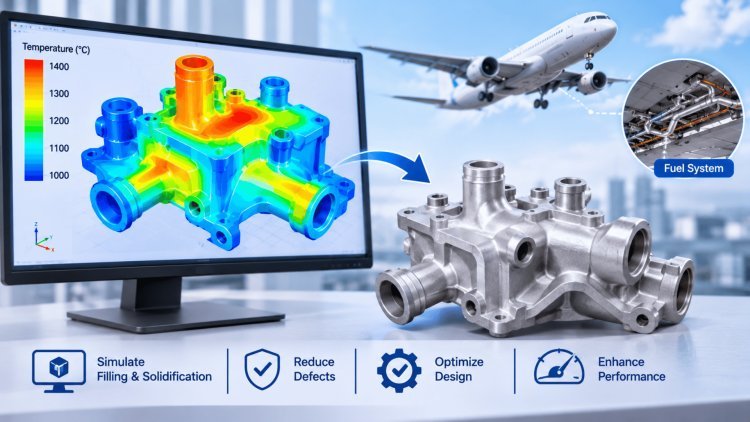
Virtual Foundry Workflow
Mold and charge pre-heat modeling to ensure correct thermal boundary conditions before filling begins.
Hydrodynamic solver captures melt flow, turbulence zones, and air entrapment risk in the gating system.
Thermal solver tracks heat extraction rates and freezing fronts to locate shrinkage and porosity precursors.
Stress solver evaluates residual stress, warpage, and hot-tearing risk during pattern removal and straightening.
The Physics Chain
Flow behavior, velocity fields, turbulence and air entrapment
Heat transfer, solidification sequence and feeding behavior
Residual stress, distortion, hot tearing and warpage
Why Coupled Physics Matters
The three core solvers — hydrodynamic, thermal, and stress mechanics — operate in coupled mode, meaning outputs from the fill phase directly inform the solidification model, and solidification gradients feed the stress analysis. This physics chain mirrors the real foundry sequence without the cost of physical iteration.
To explore how this workflow applies across industrial casting sectors, visit the Casting Simulation in Industry overview on the PoligonSoft platform. The complete digital workflow transforms manufacturing from a sequence of expensive physical experiments into a structured engineering process where geometry, process conditions, and defect risks are validated before production begins.
PoligonSoft's physics-driven approach goes beyond simplified flow visualization. Each solver domain resolves the specific failure mechanisms that disqualify aerospace castings at first-article inspection — before any physical tooling is committed. Understanding what each module predicts, and why that prediction matters for fuel system components, is the foundation of a credible virtual qualification strategy. Learn more about the full simulation capability at Casting Simulation for Foundries.
Predicts velocity fields, turbulence intensity, and air/gas entrapment during melt filling. For complex fuel-system geometries with thin-wall passages and sharp directional changes, turbulent filling generates oxide films and trapped gas pockets that become subsurface porosity after solidification. The solver identifies problematic gating arrangements and runner geometries before tooling is cut, allowing redesign at zero hardware cost.
Tracks heat extraction rates, freezing front progression, and solidification time gradients throughout the casting volume. Hot spots — regions that remain liquid after surrounding metal has solidified — are the primary source of shrinkage porosity. The thermal solver maps these hot spots with high spatial resolution, enabling engineers to adjust riser placement, chilling strategy, and wall thickness transitions to eliminate isolated liquid pools before they become defect sites.
Evaluates thermally induced stress fields, hot-tearing initiation risk, and residual stress/warpage after cooling and mold removal. Fuel system housings with asymmetric cross-sections are particularly vulnerable to differential thermal contraction, which can generate tensile stresses exceeding the material's hot strength — resulting in hot tears or cold cracking. The stress solver identifies critical locations and predicts final distortion, enabling die geometry compensation before first pour.
What the Software Actually Simulates
Hydrodynamics — Fill Integrity
Thermal Physics — Solidification Mapping
Stress Mechanics — Structural Integrity
Aircraft fuel system components—manifolds, valve bodies, pump housings, and structural brackets—operate in a uniquely demanding environment: sustained vibration, cyclic pressure loading, wide temperature swings from ground to altitude, and exposure to aviation fuels and hydraulic fluids. No porosity, no cold shuts, no residual distortion is not an aspirational goal—it is a certification requirement.
Al-Li alloys deliver exceptional strength-to-weight performance critical for aerospace weight budgets, but they impose severe casting challenges. Their narrow freezing range means solidification fronts advance rapidly and unevenly. Lithium's high chemical reactivity demands inert-atmosphere or vacuum processing to prevent oxide and hydride inclusions.
Porosity & shrinkage: riser adequacy and chilling strategy are validated against predicted hot-spot maps for Al-Li's specific thermal conductivity and latent heat values. Misruns & cold shuts: fill simulation identifies sections where melt-front velocity drops below the minimum needed to maintain a continuous liquid interface before solidification begins—a risk amplified by Al-Li's faster freeze kinetics.
Digital qualification compresses first-article inspection schedules by moving defect discovery from the physical trial stage—where tooling modifications cost weeks and tens of thousands of dollars—to the virtual environment, where parameter changes are instantaneous.
Aerospace Reality Check: Why Fuel-System
Castings Need Zero-Defect ConfidenceStrength-to-weight comes with severe casting challenges.
Three coupled defect domains.
Move defect discovery into the virtual environment.
not an aspirational goal, but a certification requirement.
The path to certification-ready aerospace castings no longer requires exhausting physical iteration cycles. Run your fuel-system casting qualification virtually first, then validate with fewer, smarter, targeted physical pours — each one informed by simulation-predicted outcomes rather than engineering intuition alone. This is the new standard for aerospace foundry qualification, and PoligonSoft's FEM-based platform is built specifically to support it.
PoligonSoft generates structured simulation reports with traceable inputs, boundary conditions, solver settings, and defect risk maps — formatted to support AS9100 quality management documentation and first-article inspection packages. Audit reviewers receive quantitative defect probability maps, not qualitative assertions.
Simulation accuracy is only as good as its material database. PoligonSoft's thermal and mechanical property libraries are calibrated against measured foundry data, including temperature-dependent conductivity, latent heat, solid fraction curves, and yield strength — specifically for aerospace aluminum alloys including Al-Li grades. Calibrated inputs reduce the number of physical validation trials required to achieve process sign-off.
Rather than eliminating physical validation entirely, simulation targets it. By resolving the dominant defect risks virtually, the remaining physical trials are designed to confirm predicted outcomes — not to discover unknown failure modes. This targeted approach reduces scrap rates on first-article hardware and compresses the overall qualification timeline without compromising the integrity of the validation record.
Ready to move from trial-and-error to simulation-driven qualification? Explore the full capability framework at Casting Simulation for Foundries, review how these workflows apply across aerospace and industrial sectors at Casting Simulation in Industry, and dive into the specific challenges of aluminum-lithium alloys in the deep-dive resource Simulation of Aluminum-Lithium Aerospace Castings: From Risk to Reliability.
The standard for aerospace casting qualification has shifted. Virtual first, physical confirmation second — this is the workflow that compresses schedules, reduces scrap, and builds the audit trail that certification demands.
Conclusion: Convert Trial-and-Error into Virtual Qualification
Audit-Ready Digital Outputs
Calibrated Material & Thermal Inputs
Fewer, Smarter Physical Pours
What's Your Reaction?