Virtual Manufacturing of Structural Aluminum Castings
How digital simulation is transforming the way foundries design, validate, and produce high-performance aluminum components — before a single mold is made.
Why Virtual Manufacturing Matters

When Failure Isn't an Option
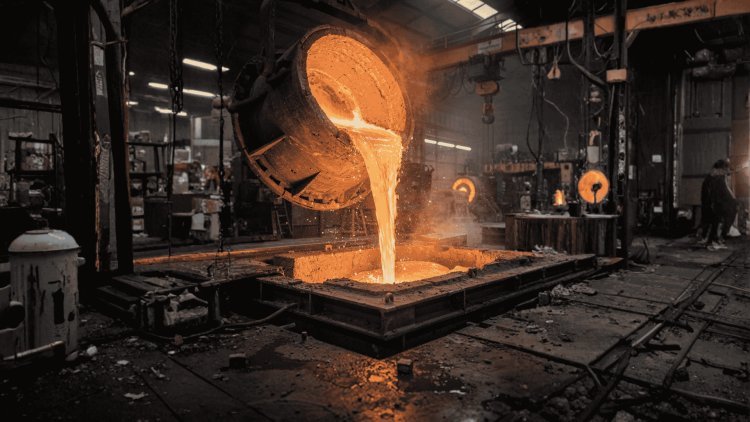
Structural aluminum castings are used in aerospace, automotive, and defense applications where reliability is critical. Traditional development methods rely on repeated tooling modifications, physical trials, and costly process adjustments. These approaches increase project timelines, consume resources, and introduce significant manufacturing risk before production even begins.
Virtual manufacturing transforms risk into predictable engineering decisions.
The Digital Manufacturing Journey
What Virtual Manufacturing Predicts
- Defect formation before production
- Gating system performance
- Mold filling behavior
- Material flow characteristics
Business Impact
- Shorter development cycles
- Reduced tooling revisions
- Lower scrap and rework
- Improved first-cast success rates
Simulate metal flow to eliminate cold shuts, misruns, and air entrapment before tooling is cut.
Predict shrinkage porosity and hot spots to optimize riser placement and cooling channels.
Evaluate residual stresses and distortion to ensure dimensional accuracy of structural parts.
Core Simulation Capabilities
Mold Filling Analysis
Solidification Modeling
Thermal Stress Analysis
This end-to-end digital process allows PoligonCast engineers to iterate rapidly — catching critical defects in simulation rather than on the shop floor, saving time and tooling costs at every stage.
The Virtual Foundry Workflow
Casting Design Simulation
Process Optimization
Production Validation
Production
Structural aluminum alloys such as A356, A380, and 319 are widely used in high-performance castings because they combine low weight, excellent castability, corrosion resistance, and strong mechanical properties. These characteristics make them ideal for demanding automotive, aerospace, and defense applications.
Virtual manufacturing enables engineers to predict alloy behavior before production. Microstructure evolution, secondary dendrite arm spacing (SDAS), cooling behavior, and mechanical property distribution can all be analyzed digitally across complex casting geometries.
Delivers structural performance while significantly reducing mass, making it ideal for automotive lightweighting and aerospace applications.
Supports complex structural geometries with improved manufacturability and lower defect rates through simulation-guided process design.
Provides long service life and reliable performance in demanding structural, environmental, and outdoor operating conditions.
PoligonCast combines material science and simulation technology to optimize alloy performance before manufacturing begins—improving structural reliability, reducing development risk, and accelerating production readiness.
Structural Aluminum: Material Advantages
Engineered for Lightweight Structural Performance
Simulation Unlocks Material Intelligence
High Strength-to-Weight
Superior Castability
Corrosion Resistance
How Virtual Manufacturing Maximizes Material Performance
Identify porosity, shrinkage, and inclusions before production begins — reducing scrap and rework costs.
Fine-tune gating, risering, and die temperature parameters digitally for first-time-right casting quality.
Correlate simulation predictions with CT scanning and mechanical testing for certified structural integrity.
PoligonCast: Simulation-Driven Excellence
Defect Prediction
Process Optimization
Quality Validation
Advanced casting simulation helps turn complex structural aluminum challenges into production-ready realities.
Deep process expertise aligns tooling, metallurgy, and validation for reliable outcomes.
End-to-end digital solutions support faster development and better production control.
The Future of Foundry Engineering
Simulation-Driven Design
Foundry Engineering
Digital Manufacturing
What's Your Reaction?