Building the Connected Foundry of the Future
The foundry industry stands at a pivotal crossroads — where centuries-old metallurgical craft meets cutting-edge digital intelligence. PoligonCast explores how connectivity, simulation, and smart manufacturing are reshaping the modern foundry.
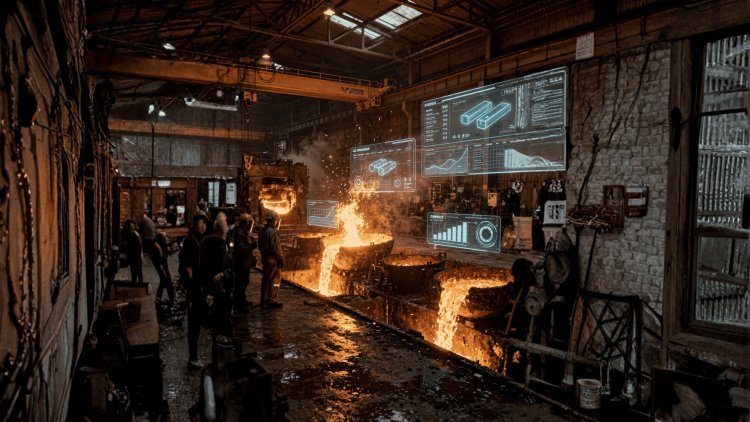
Why Connectivity Is the New Core Competency
Connectivity ensures every department works from the same live information, eliminating delays, reducing errors, and improving collaboration throughout the casting process.
Real-Time Decisions
Live production data enables rapid decision-making and immediate response to process changes.
Reduced Scrap
Connected simulation and production systems help predict and prevent defects before they occur.
Connectivity Is No Longer Optional
The most successful foundries no longer view design, simulation, production, and quality as separate functions. By connecting every stage into a unified digital ecosystem, organizations gain real-time visibility, stronger process control, lower operational costs, and the agility required to compete in the era of smart manufacturing.
Seamless data flow from design to delivery across every foundry system.
Advanced virtual modeling predicts defects before metal is ever poured.
Real-time monitoring of temperature, pressure, and critical process variables.
Predictive analytics and AI transform raw production data into actionable insights.
The Four Pillars of the Connected Foundry
Digital Integration
Casting Simulation
IoT & Smart Sensing
Data-Driven Decisions
Foundry
Visualize metal filling behavior to eliminate turbulence, air entrapment, and incomplete mold filling before production starts.
Analyze heat transfer and solidification patterns to reduce shrinkage, porosity, and dimensional instability.
PoligonCast places simulation at the beginning of the engineering process, ensuring every design decision is validated digitally before physical tooling, production, or quality inspections begin.
PoligonCast's simulation-first approach enables foundries to reduce development cycles, minimize costly tooling modifications, and achieve superior casting quality from the very first production run. By replacing trial-and-error with predictive engineering, simulation becomes the foundation for smarter, faster, and more profitable manufacturing.
Simulation at the Heart of Innovation
Flow Simulation
Thermal Modeling
Higher First-Pass Yield, Fewer Tooling Iterations
IoT sensors and automation
Real-time data and MES integration
AI optimization and predictive maintenance
The journey to a fully connected foundry is progressive. Each stage builds on the previous one—from equipping machines with intelligent sensors, to integrating operational data, to deploying AI that continuously improves quality, productivity, and throughput across the entire manufacturing process.
From Smart Machines to Intelligent Workflows
Smart Machines
Connected Processes
Intelligent Foundry
Continuous Digital Evolution
Connected quality loops identify deviations instantly, preventing defective parts from progressing through downstream manufacturing stages.
Digital process control reduces material waste, lowers energy consumption, and minimizes the environmental footprint of casting operations.
Connected systems transform operational data into actionable intelligence, enabling continuous improvement in quality, efficiency, sustainability, and customer satisfaction.
Foundries that embrace connectivity move beyond incremental improvements and create lasting competitive advantages. By combining zero-defect manufacturing, sustainable operations, and intelligent decision-making, organizations achieve superior operational performance while strengthening profitability, customer trust, and market leadership.
Quality, Sustainability & Competitive Advantage
Zero-Defect Manufacturing
Sustainable Operations
Quality and Sustainability Become Competitive Weapons
PoligonCast: Engineering the Future, Today
What's Your Reaction?