Casting Simulation for Satellite Components
Space missions demand absolute perfection — a single undetected defect in a cast structural or propulsion component can silently compromise an entire mission. Modern casting simulation gives engineers the predictive power to find, eliminate, and certify away defects before the first metal is ever poured. This presentation explores how physics-driven simulation transforms aerospace casting from a high-stakes gamble into a rigorous, qualification-ready engineering discipline.
The Satellite Stakes: One Hidden
Defect Can End the Mission
Satellite components operate in one of the most punishing environments imaginable. Unlike ground-based hardware that can be serviced or replaced, an on-orbit failure means mission loss — often after years of development and hundreds of millions in investment. The unforgiving physics of space demand that every cast part be internally sound from day one.
Extreme Thermal Cycling
Satellite structures endure relentless swings between cryogenic cold in shadow and intense radiant heat near power and propulsion stages.
Temperatures can range from −150 °C to over +150 °C within a single orbit.
Any small internal flaw — a micro-shrinkage void, a cold-shut, or a residual stress concentration — can nucleate a fatigue crack under repeated thermal loading and become a service-ending failure long before the design life is reached.
Certification Pressure & Late-Discovery Cost
Aerospace qualification programs are structured around documented evidence of part integrity.
The traditional approach of "we'll check after production" via X-ray or CT scanning creates a critical risk: late inspection findings can invalidate an entire production batch and restart costly qualification cycles from scratch.
Each restart adds months to the schedule and significant cost to a program that may already be under extreme budget and delivery pressure.
Simulation shifts defect discovery to the virtual stage — where changes are cheap.
The Failure Chain
A single internal porosity cluster found after final qualification can force a full re-qualification cycle, adding months and significant cost to a satellite program.
In satellite manufacturing, defect detection after production is already too late. Success depends on predicting shrinkage, porosity, thermal stress, and structural discontinuities before tooling is built and before metal is poured. Simulation-driven validation transforms casting quality from a reactive inspection process into a proactive engineering discipline, protecting mission schedules, certification pathways, and ultimately the success of the spacecraft itself.
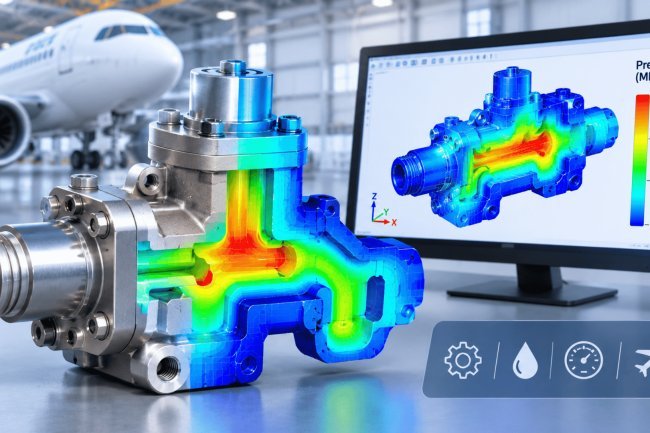
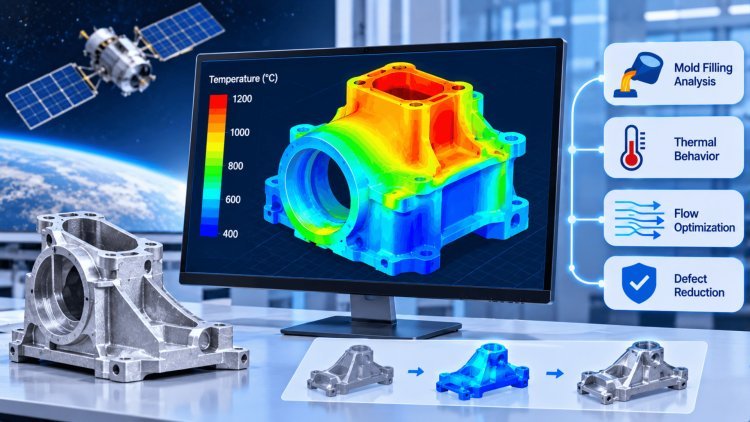
Effective casting simulation for satellite-grade components goes far beyond colorful fill animations. The engineering value lies in accurate, physics-based prediction of defect formation mechanisms — giving process engineers actionable insight to redesign gating, adjust thermal management, and lock down dimensional control before any tooling is committed.
The filling stage determines whether the mold cavity is completely and cleanly filled with sound metal. Simulation must predict the exact locations where misruns (incomplete fill fronts), air entrapment (trapped gas pockets), and turbulence-driven oxide inclusions form.
These defects are strongly gating-geometry dependent — identifying them virtually allows engineers to redesign runner systems, add vents, or modify fill rates without committing to expensive tooling modifications. Poor filling is the root cause of a large proportion of casting scrap in complex aerospace geometries.
As metal transitions from liquid to solid, uneven heat extraction creates hot spots — regions that remain liquid longest and are therefore last to feed. When feeding pathways are inadequate, these hot spots become shrinkage voids and porosity zones that reduce load-bearing cross-section and fatigue life.
Simulation maps the full solidification sequence and quantifies porosity risk — enabling targeted riser and chill placement to steer heat extraction where it is needed most.
Even a geometrically sound casting can fail qualification due to hot cracking (solidification cracking at grain boundaries under tensile stress during the mushy zone), cold cracking (solid-state cracking as thermal gradients drive stress beyond yield), and residual distortion that pushes final dimensions outside the tight tolerances demanded by satellite structure interfaces and optical alignment requirements.
Stress prediction closes the loop — connecting thermal history to mechanical outcome and flagging at-risk features before the first pour.
What Simulation Must Predict — Not Just Visualize
Hydrodynamic Filling Prediction
Defects to Predict
Thermal Solidification Prediction
Thermal Analysis Focus
Stress & Cracking Prediction
Mechanical Risks
The defining difference between a visualization tool and a true engineering predictor is solver continuity. When filling, solidification, and stress analyses are run as disconnected simulations, errors and assumptions accumulate at every handoff—and the predicted defect risk at the end of the chain diverges from physical reality.
Initial thermal state of mold, cores, and die established before metal contact.
Euler solver tracks free-surface flow, turbulence, and air entrapment throughout cavity fill.
Fourier solver computes thermal field, porosity risk, and hot-spot mapping through the mushy zone.
Hooke solver predicts residual stress, hot/cold cracking risk, and final dimensional distortion.
Because solver outputs connect directly, defect risk accumulates consistently across the entire process cycle. This integrated approach eliminates the "gap errors" that cause isolated solvers to miss coupled defect mechanisms unique to complex satellite component geometries.
The "One Chain" Advantage:
Sequential Physics Builds True Defect RiskEstablish the initial thermal state.
Track free-surface flow and air entrapment.
Compute thermal field and porosity risk.
Predict residual stress and distortion.
where the output of each stage
becomes the precise input to the next.
The ultimate engineering payoff of simulation is not a better picture of what can go wrong — it is a proven, defensible process window that delivers first-good-part outcomes, compresses qualification timelines, and dramatically reduces the scrap and rework cost that erodes program margins in aerospace casting programs.
By systematically simulating parameter variations — pouring temperature, fill rate, die temperature, chill configuration, alloy selection — engineers can map the full defect-free boundary of the process space before committing to a single physical trial.
This design-of-experiments approach in simulation identifies which parameters most strongly influence porosity, cracking, and distortion, and defines the tolerance bands within which the process remains robust. The result is a process specification grounded in physics rather than folklore — and one that can be presented directly to qualification authorities as evidence of process understanding.
The traditional aerospace casting development cycle — pour → X-ray → adjust → repeat — can consume dozens of iterations and months of calendar time before a clean part is achieved.
Each physical trial requires tooling setup, material, labor, inspection, and reporting overhead.
Simulation-driven development replaces most of these iterations with virtual ones, reserving physical trials for final validation of a simulation-optimized process. The result is dramatically fewer scrapped parts, shorter time-to-first-good-part, and a documented simulation-to-physical correlation record that strengthens the qualification dossier.
Simulation-driven programs routinely achieve qualification in a fraction of the iterations required by traditional pour-and-inspect methods
Virtual parameter sweeps replace physical trial-and-error, cutting scrap, material cost, and schedule risk significantly
Simulation runs directly on production CAD geometry, ensuring that virtual predictions map precisely to the real part
Ready to apply physics-driven casting simulation to your satellite component program? Start directly from your real CAD geometry with PoligonSoft casting simulation — the same end-to-end workflow described throughout this presentation — and explore how virtual evaluation of alternative casting parameters can accelerate your path to a defect-free, fully qualified aerospace casting.
PoligonSoft's integrated Euler–Fourier–Hooke solver chain is specifically designed for the complex, high-consequence casting challenges found in aerospace and satellite component manufacturing.
From Virtual Process Window to Faster Qualification — and Fewer Scrapped Parts
Build a Robust Process Window Virtually
Replace Trial-and-Error with Simulation-Driven Sign-Off
What's Your Reaction?