From Simulation Noise to Engineering Insight
Modern engineering organizations generate vast volumes of simulation data — stress contours, displacement fields, fatigue maps — yet struggle to convert that raw output into decisions that move products forward. This presentation explores how systematic analytics, visualization, and AI-augmented workflows are transforming the way engineering teams extract value from CAE field data. From standardizing simulation pipelines to deploying machine learning for predictive modeling, the path from noise to insight is now more achievable than ever.
The Hidden Cost of
CAE Results
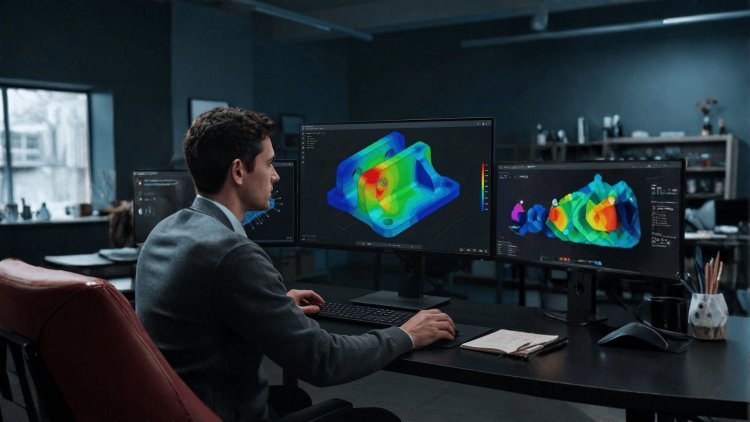
Modern simulation platforms can generate extraordinary quantities of engineering data, but computational power alone does not create engineering value. As simulation throughput continues to increase, organizations face a new challenge: transforming vast quantities of raw CAE output into actionable insight. The true bottleneck is no longer running simulations. It is understanding them quickly enough to drive confident engineering decisions.
The Modern CAE Analytics Challenge
The Overload Problem
A single product development program may involve hundreds of structural, thermal, vibration, fatigue, manufacturing, and optimization studies. Each analysis produces large quantities of data that require interpretation before meaningful engineering action can occur.
Typical Simulation Outputs
The Productivity Imbalance
In many engineering organizations, more time is spent reviewing, filtering, organizing, and comparing results than generating simulations themselves.
Decision Bottlenecks & Consequences
As design exploration grows from a handful of variants to hundreds of potential solutions, the burden of manual comparison increases dramatically. Engineers often find themselves navigating endless spreadsheets, presentation decks, screenshots, and reports simply to identify the best-performing design candidate.
What Happens When Analytics Is Missing?
Engineering Consequences
The Knowledge Capture Gap
Every simulation run generates valuable engineering knowledge. Yet most organizations store outputs as isolated reports rather than reusable intelligence. Lessons learned remain trapped in folders, presentations, or individual memory instead of becoming part of a searchable engineering knowledge system.
Spent Comparing Variants
Manual review, filtering, ranking, and comparison of simulation variants often consume far more engineering effort than expected, becoming a major contributor to program delays.
The Transformation Pipeline
Is The Real Product Of Simulation
Simulation itself creates data. Analytics creates understanding. The organizations that successfully bridge that gap gain dramatically more value from every computational model they run.
Running More Simulations
Does Not Automatically Create
Better Engineering Decisions.
The modern CAE challenge is no longer computational scarcity but analytical scalability. Engineering teams can generate hundreds or thousands of simulation results, yet still struggle to identify the optimal design path. The true competitive advantage lies in converting raw stress fields, temperature distributions, fatigue predictions, and optimization studies into structured engineering knowledge. Organizations that invest in analytics, automated post-processing, variant ranking, knowledge capture, and decision-support systems transform simulation from a reporting tool into a strategic asset. Analytics is not an overhead cost. It is the force multiplier that unlocks the full value of every simulation run performed across the enterprise.
Turning raw simulation output into engineering insight requires a structured, repeatable workflow that connects data generation to design decisions.
Standardizing mesh quality, boundary conditions, material models, and output requests ensures results from different engineers, programs, or time periods can be meaningfully compared.
Correlation analysis reveals which design parameters most strongly influence key performance indicators. Outlier detection flags anomalous runs that may indicate setup errors or novel behaviors.
Interactive dashboards make simulation accessible to program managers, test engineers, and executives who lack specialist CAE training—surfacing the metrics that matter without requiring direct access to solver files.
Connect analytical findings directly to geometry dimensions, material choices, and manufacturing constraints—creating a closed loop between simulation and product definition.
The Analytics Workflow
TransformationComparability begins with consistency.
Unlock patterns invisible to manual inspection.
Democratize results across the organization.
Translate insight into measurable improvement.
is its ability to turn simulation into design improvement.
Engineers manually compared 50 rib geometry variants using spreadsheets, recording stress, deflection, and mass. This process took 2–4 days, was error-prone, and often missed critical variable interactions, leaving performance gains undiscovered.
Simulation data management platforms ingest solver results automatically, generating response surfaces in minutes. They reveal non-obvious optima, quantify parameter sensitivity, and flag constraint violations without manual data entry.
The analytics-driven approach consistently surfaces designs overlooked by manual methods, delivering lighter, stronger products with shorter development cycles.
Scaling Success: Multi-Variant Optimization
The Manual Approach: Days of Diminishing Returns
The Analytics Approach: Insight in Minutes
The evolution of simulation analytics is entering a new phase. High-performance computing dramatically increased the volume of engineering data that organizations can generate, but artificial intelligence is transforming how that data is interpreted, reused, and converted into engineering value. The next generation of Simulation Data Management platforms will not simply store results. They will actively understand, analyze, predict, and learn from them.
AI-powered Simulation Data Management systems move beyond simple file storage and search. They understand engineering language, interpret simulation context, and help engineers locate relevant information instantly from massive simulation repositories.
"Show me all suspension designs where peak von Mises stress exceeded 400 MPa under lateral load."
AI agents reduce the administrative burden associated with simulation review, allowing senior engineers to focus on design decisions rather than searching, sorting, and documenting results.
Machine learning surrogate models learn from historical simulation databases and estimate key engineering responses almost instantly. Instead of waiting hours or days for a full solver run, engineers can obtain rapid performance estimates during design exploration.
The AI-Augmented Future
Three Transformational AI Capabilities
AI Agents Inside SDM Systems
Natural Language Engineering Queries
AI Agent Responsibilities
More Engineering Judgment
Predictive ML Surrogate Models
Traditional vs Surrogate Evaluation
Where Surrogates Deliver Maximum Value
Knowledge Reuse at Scale
The tools, methodologies, and AI capabilities described here are available today. Organizations that act decisively to build simulation-driven analytics cultures will compound competitive advantages that become increasingly difficult for laggards to close.
Stop treating individual simulation runs as isolated tasks that begin and end with a results report. Establish governance, tooling, and team norms that ensure simulation results are systematically captured, tagged, and made available for future analytics.
Invest in Simulation Data Management platforms with integrated AI and analytics. Before launching a new study, query the existing library to determine whether comparable work has already been done.
Instrument products in service and feed real-world load histories back into simulation environments to continuously validate and refine models.
Strategic Call to Action
Every run is a data point in a knowledge graph.
Eliminate redundant modeling, focus on exploration.
Close the loop between reality and simulation.
are those that best transform simulation output into organizational knowledge,
and knowledge into competitive product decisions.
What's Your Reaction?