Simulating Steady-State Foundry Production
Modern foundry operations demand more than experience and intuition — they require precise, physics-driven insight before a single drop of molten metal touches a mold. Steady-state simulation transforms how foundries approach process design, defect prevention, and yield optimization by delivering virtual certainty where physical trials once ruled.
The First Pour Is Never
the First Chance
Long before steel meets tooling, the most consequential decisions in foundry production are already being made. Start-up conditions — initial thermal states, gating geometry, filling velocity, and feeding configuration — are locked in during the engineering phase, and every one of them governs the variability you will face downstream. Misruns, inconsistent thermal behavior, and residual stress risk are not random occurrences; they are the predictable consequences of decisions made before the first pour.
Virtual Foundry Evaluation
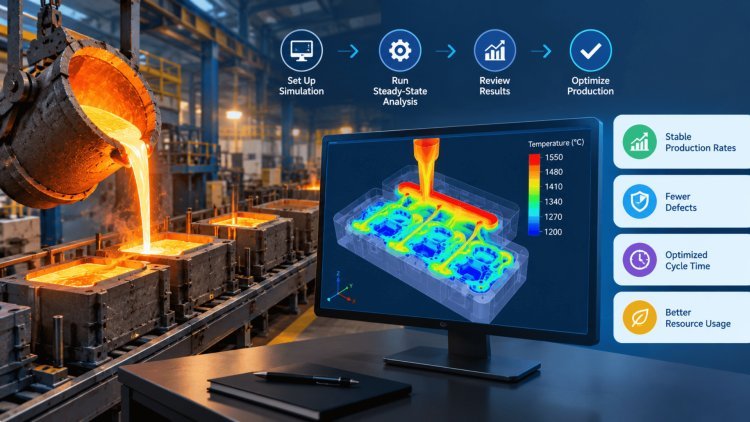
PoligonSoft positions simulation as a virtual foundry evaluation conducted before any physical tooling is committed.
This means your engineering team interrogates filling dynamics, solidification patterns, and stress concentrations in a controlled digital environment — where failure costs nothing and learning is immediate.
Explore the full methodology at PoligonSoft's foundry platform to understand how virtual evaluation fits into your pre-production workflow.
Why Start-Up Decisions Matter Most
The start-up phase of any casting run is inherently transient — temperatures are not yet stabilized, die surfaces are warming, and the process has not reached its equilibrium rhythm.
Simulation captures this transient window with precision, exposing exactly which parameters push the process toward stable output and which create the cycle-to-cycle inconsistency that erodes yield over time.
Identify misrun risk zones before tooling is cut
Predict thermal gradients during ramp-up cycles
Evaluate stress concentrations under first-cycle conditions
Reduce reliance on costly physical trial iterations
Virtual foundry evaluation means you learn fast without paying for physical trials — the most expensive classroom in manufacturing.
Long before steel meets tooling, the most consequential decisions in foundry production are already being made. Start-up conditions — initial thermal states, gating geometry, filling velocity, and feeding configuration — are locked in during the engineering phase, and every one of them governs the variability you will face downstream. Misruns, inconsistent thermal behavior, and residual stress risk are not random occurrences; they are the predictable consequences of decisions made before the first pour.
Reliable steady-state production is not governed by a single variable — it emerges from the coordinated interaction of fluid dynamics, heat transfer, and mechanical stress. PoligonSoft's simulation framework addresses all three physics domains simultaneously, providing an integrated picture of what the process is doing and why defects form when they do.
The power of this three-domain approach lies in its integration: thermal outcomes influence stress predictions, hydrodynamic filling affects solidification, and stress results feed back into process parameter optimization. No single physics domain tells the full story — but together, they define the path to a stable, defect-free steady state.
Hydrodynamics
Filling behavior influences solidification.
Thermal Analysis
Thermal outcomes influence stress predictions.
Stress Analysis
Stress results feed back into process parameter optimization.
No single physics domain tells the full story — but together, fluid dynamics, heat transfer, and mechanical stress define the path to a stable, defect-free steady state.
Three Physics, One Steady Process
How the Three Physics Domains Work Together
Yield improvement through simulation is not a one-time event — it is a structured, repeatable engineering loop that compounds its benefits with every iteration.
Run multi-physics models under both nominal and worst-case boundary conditions to expose defect mechanisms.
Conduct targeted physical trials informed by simulation findings, reducing the number of trials needed.
Refine gating, feeding, thermal management, and process parameters based on combined virtual and physical data.
Lock in the optimized process, document the gains, and feed learnings back into the next simulation cycle.
From Cycle-to-Cycle Chaos to First-Pass Yield
The Yield Improvement Loop
Simulate
Experiment
Optimize
Improve
Reaching steady-state output is not solely an engineering challenge — it is an operational and data integration challenge. The most technically sophisticated simulation program will underdeliver if its insights remain siloed in the engineering department, disconnected from the planning decisions and shop-floor execution that determine whether the optimized process is actually run as designed.
Foundries that reach and sustain steady output connect their simulation environment with Enterprise Resource Planning (ERP) and Manufacturing Execution Systems (MES) to create a unified data layer. Engineering decisions — validated process windows, approved parameter ranges, simulation-derived quality gates — flow directly into planning and scheduling logic, eliminating the gap between what engineering approved and what production runs.
This integration means that when simulation identifies a change to gating geometry or thermal management, that change propagates through planning, material procurement, and quality inspection criteria automatically — not through a slow chain of manual updates and verbal handoffs.
With simulation insight embedded in operational systems, decision-making at every level becomes faster and more consistent.
Process engineers make parameter changes with quantified confidence.
Production supervisors run to documented, simulation-validated windows rather than tribal knowledge.
Quality teams trace a defect back through the full process lifecycle — from simulation assumption to actual run conditions — with complete data traceability.
The result is a measurable reduction in rework costs, scrap rates, and customer-facing defects, alongside a strengthened audit and compliance posture for regulated supply chains. Discover how PoligonSoft structures this full-lifecycle approach for foundries of all scales.
The steady-state playbook is ultimately a commitment to treating foundry production as an engineered system rather than a skilled craft. Simulation provides the physics-based foundation. ERP/MES integration provides the operational continuity. And a structured yield improvement loop — simulate, experiment, optimize, improve — provides the mechanism for continuous advancement.
For foundries ready to move from reactive firefighting to proactive process control, the next step is engaging with the full suite of Advanced Metal Casting Engineering modules that translate simulation capability into production-floor results.
The steady state is achievable — and it begins with the decision to model it before you make it.
Hydrodynamics, thermal, and stress — modeled simultaneously for complete process insight.
Typical first-pass yield gains reported when virtual prototyping replaces physical-only iteration cycles.
Unified ERP/MES + simulation data layer eliminating the gap between engineering and production.
Control the Whole System
ERP/MES Integration for a Single Source of Truth
Faster, Consistent Decisions Across the Lifecycle
The Path Forward: Simulate, Integrate, Sustain
Physics Domains
Yield Improvement
Source of Truth
What's Your Reaction?