Generative Design and Its Role in Simulation-Driven Casting Development
How the convergence of artificial intelligence, topology optimization, and physics based simulation is transforming metal casting from a trial-and-error craft into a precision-engineered science — compressing development timelines from months to days.
The Manual Era:
The Cost of Iteration
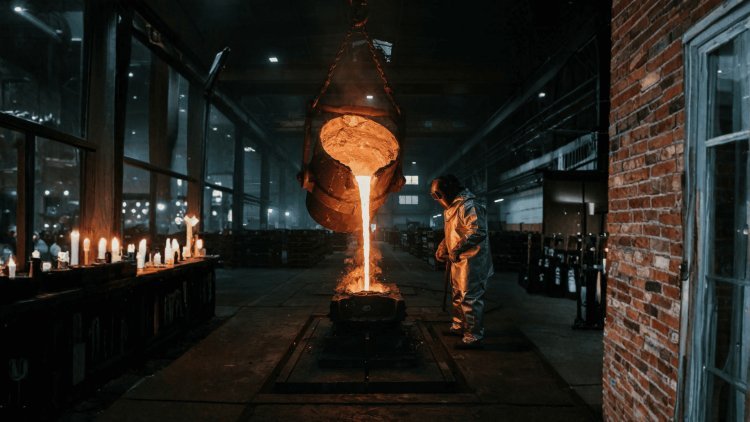
For decades, casting development operated on a brutally inefficient loop: design a component, commission a mold, pour metal, inspect the result, identify the failure, and begin again. This cycle — repeated four, six, or even ten times per component — consumed enormous resources at every turn. What looks like a straightforward engineering problem in the abstract becomes, in practice, a months-long gauntlet of expensive physical trials.
The Traditional Development Loop
The Hidden Costs Nobody Saw
The Hidden Tax Of Each Iteration
Every design cycle carries compounding costs that rarely appear on a single line item: machinist time to adjust tooling, metallurgist hours to analyze failure modes, delays that ripple into downstream program schedules, and the opportunity cost of talent tied up in rework rather than innovation. In high-volume automotive or aerospace casting programs, these costs can run into the hundreds of thousands of dollars per component family.
The Structural-Castability Disconnect
Perhaps the most frustrating failure mode of the manual era was the structural-castability disconnect. A structural engineer would optimize a component geometry for load-bearing performance — minimizing weight while maximizing stiffness — only to hand off a design that was fundamentally incompatible with the realities of molten metal flow. Thin walls that cooled too quickly, sharp internal corners that trapped gas, and complex geometries that created irresolvable shrinkage porosity meant that high-performance designs routinely failed during physical casting trials. The two engineering disciplines worked in sequential isolation rather than simultaneous collaboration, and the gap between them was paid for in time and money.
Sequential Engineering Workflow
The Reality Of Physical Trial Development
Repeated Trial Cycles
Design, manufacture, test, fail, and repeat — often six or more times per component.
Lost Development Time
Each cycle consumes weeks of calendar time and significant expert labor hours.
Sequential Evaluation
Structural optimization and foundry constraints evaluated sequentially, never concurrently.
Late Defect Discovery
Physical defects like porosity and cold shuts discovered only after costly metal pours.
The Greatest Cost Was
Not Scrap — It Was Iteration
The manual era forced manufacturers to learn about casting behavior only after expensive physical trials were completed. Every defect became a lesson purchased through time, labor, tooling, and material waste. The transition to virtual engineering emerged not simply as a productivity improvement, but as a fundamental solution to the cost of repeated experimentation.
Casting simulation moved process development from physical trial-and-error to virtual validation and optimization—making solidification physics accessible at the engineering desktop.
Tools such as SOLIDCast and Click2Cast allow engineers to visualize cavity filling, cooling sequence, and likely defect locations before metal, tooling, and labor are committed.
Voids caused by shrinkage or dissolved gas.
Atmospheric gas pockets locked inside the casting.
Incomplete fusion where metal fronts meet too cold.
Simulation-guided automation can vary the channels, runners, and risers that control metal entry and compensate for shrinkage, turning the iteration loop into an optimization engine.
Engineers can rapidly test gating geometry, pouring temperature, and alloy selection, then discard weak hypotheses before they consume tooling, metal, or labor.
The Simulation Shift
Interrogate Castability Before Pouring
Three costly defects, caught digitally
instead of reworkFrom validation to optimization
Dozens of trials, no physical pour
to the engineering workstation.
Autonomous optimization platforms like MAGMASOFT evaluate thousands of parameter combinations overnight. They treat casting variables as a high-dimensional design space, navigating it statistically to uncover solutions beyond human intuition — transforming engineering into a new mode of inquiry.
Yield and porosity objectives often conflict. Genetic algorithms maintain populations of candidate solutions, applying simulated selection toward the Pareto frontier. Engineers receive a map of optimal trade-offs, enabling informed decisions based on downstream priorities.
Foundry expertise must be formalized into quantitative constraints. Alloy behavior, geometry risks, and cooling sensitivities are encoded as boundary conditions and penalty terms. This ensures algorithmic solutions remain physically manufacturable while leveraging decades of tacit knowledge.
The Era of Autonomous Optimization
Machine-Driven Design Iteration
Genetic Algorithms and Multi-Objective Trade-offs
Encoding Expert Knowledge as Constraints
The most recent evolution in simulation-driven casting development integrates artificial intelligence and generative design directly into the component creation workflow — fundamentally dissolving the boundary between structural engineering and process engineering that defined the manual era. Platforms like Altair are pioneering workflows in which topology optimization, CAE analysis, and casting simulation operate not as sequential handoffs but as simultaneous, mutually constraining design engines.
Structural, CAE, and manufacturing teams evaluate designs independently and sequentially.
Performance, quality, manufacturability, and casting constraints are solved simultaneously.
Altair's AI-powered generative design workflow begins with a defined load case and a target mass reduction, then uses topology optimization to identify where material is structurally essential and where it can be removed. Critically, this optimization does not operate in a manufacturing vacuum — casting simulation constraints are embedded directly into the generative process, steering the algorithm away from geometries that would create irresolvable solidification defects. The result is a component geometry that is simultaneously structurally efficient and foundry-compatible, without requiring a human engineer to reconcile the two requirements after the fact.
The automotive industry's adoption of megacasting — the production of large, structurally complex aluminum components like rear underbody structures in a single high-pressure die casting shot — represents one of the most demanding applications for simulation-driven generative design. These components span hundreds of millimeters across multiple structural load paths, integrate dozens of geometric features, and must meet stringent dimensional and mechanical tolerances. The metal flow, thermal gradients, and solidification behavior in a megacast component are orders of magnitude more complex than a conventional casting, making simulation-driven design not merely advantageous but essential.
The defining capability of the AI-generative frontier is the ability to simultaneously evaluate a design candidate across multiple, previously siloed engineering domains. A single generative design iteration can now assess nonlinear crash performance (ensuring the component absorbs and redirects energy correctly in an impact event), material quality indicators from solidification simulation (porosity distribution, microstructural predictions), and casting manufacturability metrics (fill balance, thermal die loading, ejection feasibility) — all within a single automated workflow. This concurrent multidisciplinary evaluation compresses what was once a sequential, multi-team, multi-month review process into hours of compute time.
Generative design represents more than automation. It fundamentally changes how engineering decisions are made by allowing structural requirements, manufacturing realities, material behavior, and quality objectives to be evaluated simultaneously. What once required multiple teams and months of iteration can now be explored through intelligent computation in a fraction of the time.
The AI and
Generative Design FrontierThe New Design Paradigm
Sequential Handoffs
Concurrent Optimization
How AI Reshapes Casting Development
Topology Optimization Meets Casting Simulation
AI-Driven Optimization Workflow
Megacasting: The Complexity Challenge
Why Megacasting Demands Simulation
Multidisciplinary Concurrent Analysis
One Design • Multiple Evaluations
AI Eliminates The Gap
Between Design And Manufacturing
Simulation-driven generative design is compressing casting development from months of physical iteration to days of virtual exploration—a structural shift in industrial competitiveness.
The emerging model optimizes a component in the context of a specific facility—its equipment capabilities, thermal behavior, alloy inventory, and production schedule. The digital twin expands from the casting process to the entire value chain.
Organizations that make simulation and generative design core engineering capabilities—not specialist tools isolated within a small CAE team—can compress time-to-market, lower development cost, and deliver more consistent quality.
The New Reality
The iteration loop collapses.
not incremental improvementReconfigurable Digital Manufacturing
A different competitive posture
Build the capability today. Set the pace tomorrow.
What's Your Reaction?