Predicting Segregation in Cast Steel Components
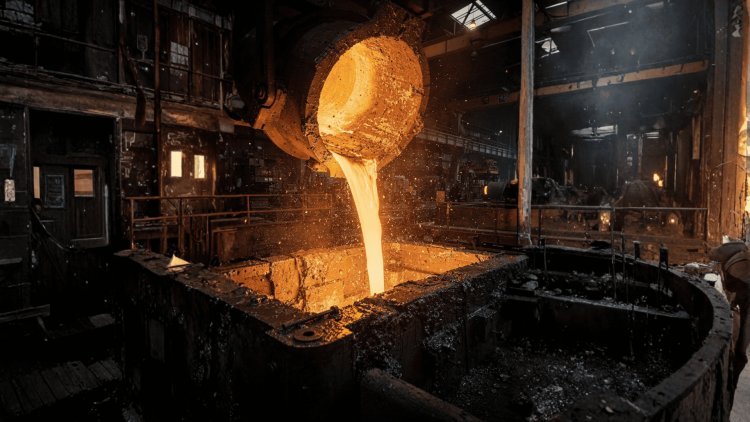
In modern foundry and manufacturing, controlling material quality is everything. Segregation — the uneven distribution of alloying elements during solidification — remains one of the most critical defects in cast steel, directly impacting mechanical performance and structural integrity.
What Is Segregation?

Uneven Chemical Distribution
During solidification, alloying elements do not always distribute uniformly throughout the casting.
Grain-Level Variation
Occurs at the microscopic scale between dendrite arms during rapid solidification. Alloying elements become concentrated in localized regions, creating chemical differences within the grain structure itself.
Casting-Scale Gradients
Occurs across larger regions of the casting due to fluid flow, thermal gradients, and solidification shrinkage. This creates visible compositional differences from one area of the component to another.
Why Segregation Matters
Even small compositional variations can significantly influence the final performance of a steel casting. Segregation may contribute to inconsistent mechanical properties, localized hardness variations, reduced fatigue resistance, cracking susceptibility, and challenges during heat treatment. Understanding and controlling segregation is therefore essential for producing reliable, high-quality cast components.
Primary Types
Microsegregation and macrosegregation represent the two major forms of chemical non-uniformity in cast steels.
Predict Segregation Before It Appears
Advanced casting simulation enables engineers to evaluate segregation tendencies during the virtual design stage. By identifying areas prone to elemental concentration early, foundries can optimize gating systems, feeding strategies, and solidification behavior before production—reducing risk and improving casting integrity.
Segregated zones exhibit reduced toughness, hardness variation, and susceptibility to cracking under load.
Undetected segregation leads to costly post-production failures, rework, and customer returns.
Early prediction enables foundries to adjust alloy composition, pouring temperature, and cooling rates proactively.
Why Prediction Matters
Mechanical Failure Risk
Quality Rejection Costs
Process Optimization
Segregation severity is governed by a combination of metallurgical and process variables. Understanding these drivers is the first step toward simulation-based control.
Element composition directly influences solute redistribution during solidification.
Cooling rates, thermal gradients, and solidification behavior determine segregation intensity.
Carbon and Manganese are the most influential elements controlling segregation behavior. Even small compositional changes can significantly alter solute distribution, making precise chemistry control and simulation essential for consistent casting quality.
Key Drivers of Segregation
Alloy Chemistry
Process Conditions
Critical Alloying Elements
Advanced simulation software combines multiple physical phenomena into a single predictive framework capable of identifying segregation risks before production begins.
Thermal, flow, and composition models operate together for accurate segregation prediction.
Locate regions vulnerable to chemical concentration and property variation.
Improve gating, feeding, and solidification strategies using predictive insights.
Make informed engineering decisions before committing to production.
Segregation risk maps provide foundry engineers with a powerful decision-making tool. By predicting elemental redistribution before a single pour is made, simulation enables smarter design choices, improved casting integrity, reduced development cycles, and greater confidence in final component performance.
Simulation-Based Prediction of Segregation
Three Models. One Predictive Engine.
Coupled Physics
Identify Risk Zones
Optimize Design
Validate Digitally
Turn Metallurgical Risk Into Engineering Knowledge
PoligonCast combines advanced simulation tools with deep foundry engineering expertise to predict and mitigate segregation across complex geometries.
Tailored simulations for each casting geometry and alloy grade.
Iterative analysis of gating, risering, and cooling strategies.
Simulation outputs benchmarked against physical inspection data.
PoligonCast's Approach
Integrated Digital Solutions
Component-Specific Modeling
Process Parameter Optimization
Validated Results
Predicting segregation is no longer a post-production concern—it is a design-stage imperative. With simulation-driven insights, foundries can deliver cast steel components that consistently meet the most demanding mechanical and structural requirements.
PoligonCast partners with manufacturers to eliminate defects before they form—transforming advanced simulation intelligence into reliable casting excellence, higher productivity, and long-term manufacturing confidence.
Engineering Quality from the Start
Simulation
Engineering
Casting Excellence
Partner with PoligonCast
What's Your Reaction?