Reduced-Order Models for Rapid Casting Simulation
Modern foundries face an ever-tightening paradox: casting simulation demands exhaustive physics fidelity, yet design cycles demand speed. This presentation explores how Reduced-Order Models (ROMs) dissolve that contradiction — compressing days of computation into milliseconds without sacrificing engineering reliability.
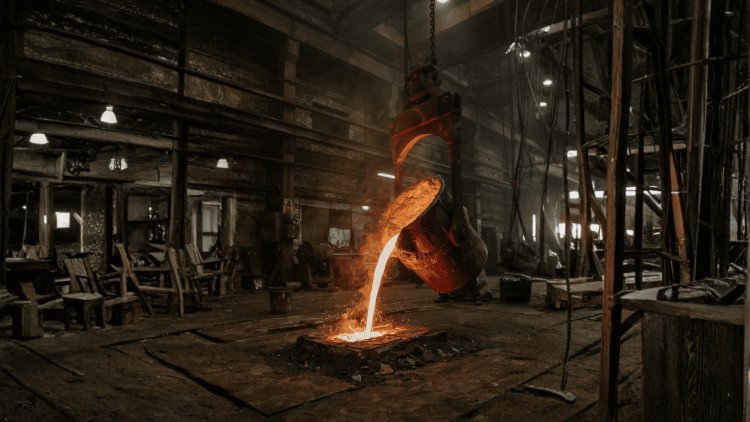
The Core Bottleneck:
"Physics-First" Casting Simulation Is
Too Slow for Design Loops
High-fidelity casting simulation remains the gold standard for predicting mould filling, solidification behaviour, thermal gradients, and defect formation. Yet the very physics that make these models trustworthy also make them computationally expensive, creating a persistent conflict between simulation accuracy and engineering speed. In modern development environments, this tension has become one of the largest barriers to rapid design iteration.
Three Drivers Behind the Bottleneck
Sensitivity to Unknown Inputs
Casting simulations are highly sensitive to physical parameters that cannot be measured directly under production conditions. Small changes in these parameters can have a significant effect on thermal histories, solidification behavior, microstructure evolution, and final defect formation.
One of the most influential variables in casting simulation, yet one of the most difficult to measure directly.
Why IHTC Matters
Traditional Calibration Workflow
Of Solver Runs
A full parameter sweep across realistic IHTC ranges may require numerous high-fidelity simulations before engineers gain confidence in a gating, cooling, or process design decision.
The Lead-Time Trap
Additive manufacturing and rapid patternmaking technologies have dramatically reduced tooling preparation time. Sand casting molds and investment casting patterns can now be produced in days rather than weeks, shifting the bottleneck away from manufacturing preparation and toward simulation turnaround time.
Modern Speed Mismatch
When Simulation Becomes the Bottleneck
A Fundamentally Different Strategy
Simply adding larger computing clusters delivers diminishing returns. The future demands computational approaches capable of preserving engineering reliability while dramatically reducing the number of expensive full-physics simulations required during design optimization.
The New Simulation Imperative
The challenge is no longer simply achieving accurate prediction. The challenge is achieving accurate prediction fast enough to influence engineering decisions within modern product development cycles.
The Problem Is No Longer
Whether We Can Simulate Casting.
It Is Whether We Can Simulate Fast Enough.
High-fidelity physics-based casting simulation delivers exceptional predictive accuracy, but its computational cost increasingly conflicts with the speed demanded by modern manufacturing. Difficult-to-measure parameters such as the interfacial heat transfer coefficient require repeated calibration cycles, while advances in rapid patternmaking compress production timelines to the point where simulation becomes the dominant bottleneck. The industry imperative is therefore clear: maintain the reliability of physics-based modeling while adopting new computational strategies that dramatically increase throughput. Future success will belong to organizations that can combine accuracy with speed, transforming simulation from a verification step into a real-time engineering decision system.
Reduced-Order Models (ROMs) identify the low-dimensional subspace in which a casting system's dynamics actually live, confining all computation to that compact representation. For thermal and flow fields that evolve in structured, correlated patterns, this reduction can be dramatic.
Projection-based ROMs separate an expensive offline stage from a cheap online stage. In the offline stage, a library of high-fidelity simulation snapshots is generated across a representative parameter space—varying mould temperatures, pouring speeds, alloy compositions, or cooling channel configurations.
Once the reduced basis is established, the governing PDEs—Navier–Stokes for mould filling, or the heat equation for solidification—are projected onto this low-dimensional subspace using Galerkin projection or the more robust Least-Squares Petrov–Galerkin (LSPG) formulation.
Once the reduced system is assembled offline, evaluating it for a new set of parameters—a different pouring temperature, modified cooling channel diameter, or adjusted mould preheat—requires only milliseconds to seconds on a standard workstation, compared to hours for the full model.
Thermal and flow fields in casting evolve in patterns dictated by geometry and boundary conditions, producing strong spatial correlations that POD can capture with very few modes.
By training the offline stage across a representative parameter space, the reduced basis remains valid across families of design variants, enabling rapid what-if studies and optimization loops.
Reduced-Order Models:
"Solve What Matters"Expensive once, cheap forever.
Project PDEs onto the reduced basis.
Milliseconds to seconds per query.
— delivering orders-of-magnitude speedups while preserving predictive fidelity within the trained subspace.
Residence Time Distribution (RTD) analysis characterizes mixing quality and flow patterns in continuous casting tundishes. When a Galerkin-projection ROM is applied, it reproduces experimental RTD curves with near full-order CFD accuracy — capturing tracer appearance time, peak height, and decay tail behavior. This confirms that the ROM retains essential flow dynamics, including recirculation zones and dead volumes critical to tundish design optimization.
Reduced operators vary with parameters like viscosity and inlet velocity. Radial Basis Function (RBF) interpolation maps between pre-computed operator values, enabling smooth parameter transitions without recomputing full-order models — achieving true online independence from the CFD solver.
Proper Orthogonal Decomposition (POD) applied to velocity and temperature snapshots compresses the system dramatically. In tundish flow, the first 21 POD modes capture 99.99% of total snapshot energy, reducing millions of CFD degrees of freedom to a compact, stable reduced-order model. Backward Euler integration ensures unconditional stability for stiff thermal coupling terms.
Projection ROMs achieve full CFD-level accuracy at a fraction of computational cost, enabling real-time evaluation of casting-like transient flows.
RTD curve matching validates that ROMs capture transient turbulence and thermal coupling — not just averaged flow behavior.
ROMs enable rapid tundish design optimization and flow control evaluation, bridging academic theory with industrial casting applications.
Projection-based reduced-order models are redefining transient casting analysis — delivering structured mathematical precision, validated physical fidelity, and computational speed that make real-time optimization a practical reality.
Accuracy Through Structured Mathematics
RTD Validation in Tundish Flow
Operator Interpolation and POD Details
RBF-Based Operator Interpolation
POD Energy Capture
Computational Efficiency
Physical Fidelity
Industrial Relevance
Projection-based reduced-order models deliver remarkable speed when governing physics are well understood and the parameter space has been adequately sampled. Real casting environments, however, rarely satisfy these assumptions. Interfacial heat transfer coefficients remain uncertain, alloy thermophysical properties vary with composition, and tooling condition evolves throughout production. Hybrid digital twins address these realities by combining the reliability of physics-based reduced-order models with the adaptability of machine learning.
Hybrid Twins: When the Physics Isn't Fully Known,
Learn the "Ignorance" FastThree Foundations of a Hybrid Twin
Architecture of a Casting Hybrid Twin
The progression from full-physics simulation through projection ROMs to hybrid twins unlocks qualitatively different engineering capabilities—culminating in the ability to make informed, physics-grounded decisions about casting process variables in real time, on the shop floor, while metal is still flowing.
One of the most powerful near-term applications of ROM-enabled speed is solving the inverse heat conduction problem in real time. In a physical casting machine, arrays of thermocouples embedded within the mould measure temperature histories at fixed spatial locations.
Beyond parameter estimation, ROM surrogates open the door to closed-loop process control—adjusting cooling water flow rates, pouring temperatures, or injection pressures in response to real-time thermal measurements, guided by ROM predictions of how the solidification front will evolve under alternative control actions.
Each stage is a necessary foundation for the next—together defining a credible pathway from batch-oriented simulation to truly adaptive casting.
Real-Time Payoff:
Actionable Control VariablesIdentify heat flux in seconds, not hours.
Embed the model in the machine.
A coherent, implementable pathway.
— it is the ability to control the casting process with physics-grounded intelligence
at the speed of the machine itself.
What's Your Reaction?