Recirculation Zones During Mold Filling
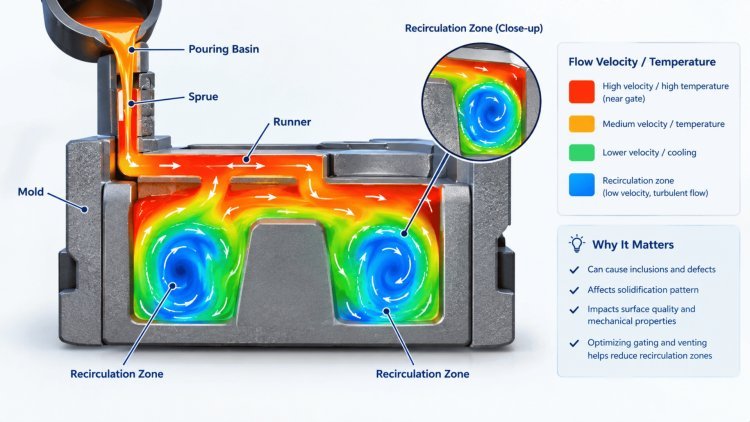
In the world of precision casting, the path molten metal takes through a mold is rarely smooth. Hidden within complex cavity geometries, recirculation zones — swirling, turbulent pockets of flow — silently dictate the difference between a flawless casting and a catastrophic reject. Understanding these zones is not merely an academic exercise; it is a critical engineering discipline that determines yield rates, mechanical integrity, and foundry profitability. Recirculation occurs when the bulk flow separates from the mold wall, creating enclosed vortices where metal velocity is locally reversed. These zones trap gases, promote oxide formation, and subject refractory surfaces to repeated thermal and mechanical stress. Despite being invisible to the naked eye during the pour, their consequences appear unmistakably in post-solidification inspection — as porosity, cold shuts, inclusions, and premature fracture under service loads. This presentation explores the fluid dynamics governin
The Hidden Cost of Turbulence
Recirculation zones are among the most insidious sources of casting defects precisely because they are invisible during the pour itself. Their damage accumulates silently — in the form of doubled oxide films, eroded sand grains, and trapped gases — only revealing themselves during destructive testing or, worse, in-service failure.
Oxide Film Doubling
When molten metal's naturally-forming surface oxide is folded back on itself inside a recirculation vortex, it creates a bifilm defect — two unbonded oxide layers with a gap between them.
This gap acts as a pre-existing crack, dramatically reducing tensile strength, fatigue life, and elongation at fracture. Bifilms are widely recognized as the primary root cause of unexplained scatter in mechanical property testing of aluminum and magnesium alloys.
Sand Erosion & Refractory Damage
Excessive local velocity within recirculation zones — frequently exceeding critical threshold values of 0.5 m/s for unbonded sand — causes individual sand grains to dislodge from mold walls.
These grains are then carried into the solidifying casting, creating hard inclusions that destroy machinability and cause tool breakage downstream.
Similarly, refractory coatings on permanent molds experience accelerated erosion, reducing tool life and increasing maintenance costs significantly.
Air Entrainment & Porosity
Recirculating flow creates low-pressure cores that draw atmospheric gases and mold-evolved volatiles into the metal stream. Once entrained, these gas bubbles are swept deep into the mold cavity before they can escape, freezing in place as spherical or irregular pores during solidification. Porosity reduces effective load-bearing cross-section and serves as a stress concentration site under cyclic loading.
Cold Shuts & Misruns
In severe cases, recirculation zones slow the effective fill front velocity enough that two converging metal streams arrive at different temperatures and fail to fuse properly, creating a cold shut — a plane of weakness with essentially zero bonding strength. Cold shuts are non-repairable and necessitate scrapping the entire casting, representing total material and energy loss.
Thermal Fatigue of Tooling
Repeated thermal cycling concentrated at recirculation hot spots accelerates die heat-checking — a network of surface cracks that eventually transfer their pattern onto casting surfaces as fins and veins. Die replacement costs and unplanned downtime from thermal fatigue represent major hidden costs in high-volume die casting operations.
Learn how PoligonCast Engineering systematically identifies these high-risk zones through computational analysis before the first pour — converting what was once discovered through costly trial-and-error into a predictable, preventable engineering variable.
Recirculation zones are among the most insidious sources of casting defects precisely because they are invisible during the pour itself. Their damage accumulates silently — in the form of doubled oxide films, eroded sand grains, and trapped gases — only revealing themselves during destructive testing or, worse, in-service failure.
Advanced CFD solvers discretize the mold cavity into millions of computational cells and iteratively solve conservation equations for mass, momentum, and energy at each time step. The result is a complete, three-dimensional map of the metal's velocity vector at every point in the cavity — revealing recirculation eddies, jetting streams, and stagnant pockets that no physical observation method could detect.
Reveal recirculation eddies, jetting streams, and stagnant pockets throughout the mold cavity.
Identify regions of negative gauge pressure where gas evolution and shrinkage porosity are most likely to nucleate.
Crucially, these simulations account for temperature-dependent viscosity changes as the metal cools during filling, capturing the evolving flow behavior that static analyses entirely miss.
Coupled solidification solvers then predict how the freeze front interacts with the still-liquid bulk, identifying last-to-freeze regions and feeding pathway adequacy.
Two dimensionless parameters serve as quantitative gatekeepers for fill quality.
The ratio of inertial forces to surface tension — predicts the onset of surface fragmentation and droplet formation.
When We exceeds critical values, the free surface breaks up, dramatically increasing oxide generation rates and bifilm content.
Characterizes the transition from laminar to turbulent flow.
High Re values in runner systems and in-gates predict chaotic, unpredictable flow patterns that dramatically increase air entrainment risk.
By computing these numbers locally throughout the fill sequence, simulation identifies the precise geometric features that must be redesigned to restore controlled, laminar flow.
Explore the detailed methodology behind Mold Erosion Modeling in Casting Simulation to understand how physics-based simulation eliminates catastrophic defects and extends tooling life — and see how these principles integrate into a complete virtual process validation workflow.
Defect Risk Mapping
Dimensionless Analysis
Solver Execution
Geometry Meshing
Velocity Vector Fields & Pressure Distributions
Coupled Solidification Solvers
Dimensionless Numbers as Defect Predictors
Weber Number
Reynolds Number
Identifying the Geometry Behind Flow Instability
Sharp Corners
Sudden Expansions
Misaligned In-Gates
Explore the Detailed Methodology
Physics-based CFD simulation provides unparalleled accuracy in predicting recirculation zones and fill quality—but its computational cost has historically limited its use to a handful of design iterations. Artificial intelligence is now breaking that barrier, enabling foundries to explore thousands of design variants in the time it previously took to evaluate one.
Machine learning surrogates—trained on libraries of previously computed CFD simulations—learn to predict flow outcomes from geometric and process parameters without re-solving the full Navier–Stokes equations. These surrogate models, once trained, execute in milliseconds rather than hours, enabling automated design-space exploration across hundreds of geometric variables simultaneously.
Convolutional and recurrent neural networks trained on simulation output data learn to automatically classify fill sequences as defect-prone or defect-free based on learned spatial and temporal flow patterns. These networks flag geometries exhibiting recirculation signatures—characteristic velocity reversal patterns, persistent low-pressure zones, and surface fragmentation events—without requiring an expert engineer to manually interpret each simulation.
Ensemble methods such as random forests and gradient boosting machines excel at identifying the most influential geometric and process parameters driving recirculation risk. By training on large simulation databases, these models produce feature importance rankings that tell engineers exactly which runner dimensions, ingate angles, overflow positions, and injection velocities have the greatest leverage over fill quality.
Discover how Machine Learning Applications in Mold Filling Prediction are accelerating development cycles—reducing the time from initial design concept to validated, pour-ready tooling by up to 70% in leading foundry operations.
AI-Powered Optimization
Milliseconds instead of hours.
Automatic defect-prone geometry flagging.
Feature importance drives targeted refinement.
enabling thousands of design variants in the time
it previously took to evaluate one.
The journey from reactive, trial-and-error casting development to proactive, simulation-first virtual prototyping represents the most significant operational transformation available to modern foundries. Recirculation zones — once accepted as an inevitable byproduct of complex geometry and the physics of turbulent metal flow — are now fully predictable, quantifiable, and eliminatable through the integrated application of CFD simulation and AI-powered optimization.
Every casting rejected due to recirculation-related defects represents 100% material waste, plus the fully-loaded labor and energy costs of melting, treating, pouring, and inspecting a part that cannot be shipped.
Simulation-first workflows systematically eliminate the root causes of these rejects — bifilm inclusions, porosity, cold shuts — directly increasing yield rates and reducing the metal-to-part ratio.
In high-value aerospace and automotive applications, even a 2–3% yield improvement generates seven-figure annual savings.
The foundries that will lead their industries through the next decade are those investing today in simulation literacy, AI integration, and data-driven process control.
The technology is mature, the ROI is documented, and the competitive advantage is measurable.
Start your journey toward zero-defect foundry operations today — and explore the full depth of casting simulation science at PoligonCast's technical blog, where physics meets production reality.
Conclusion: Zero-Defect Foundries
Yield & Material Efficiency
Foundry
What's Your Reaction?