Simulation of Start-Up Conditions in Casting Production
Before the first pour, before the first die closes, before steel ever meets tooling — the decisions made during process start-up define whether a casting will succeed or fail. Simulating these conditions with precision is no longer a luxury; it is the engineering foundation of modern, defect-free foundry production.
What “Start-Up Conditions” Actually Control
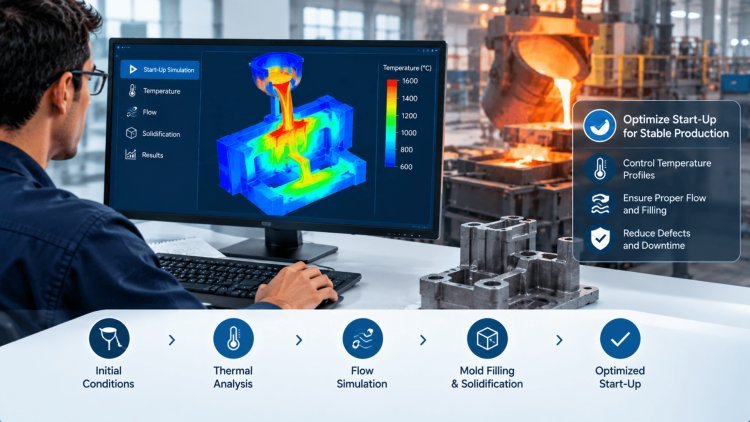
Start-up is not simply the moment production begins — it is the critical window during which every downstream quality outcome is seeded. The thermal, mechanical, and fluid states established in the first cycles of operation propagate forward through the entire production run. Miss the start-up window and you are chasing defects for the lifetime of the tool.
No single physical phenomenon governs casting quality in isolation. Melt flow couples to heat transfer; heat transfer drives solidification; solidification controls stress; stress determines crack risk. The PoligonSoft platform addresses this reality with a tightly integrated solver stack in which each module feeds validated state variables into the next — creating a continuous, physics-consistent simulation chain from start-up initialization through final part properties.
Melt Flow & Mold Filling
Solves the full Navier-Stokes equations governing melt velocity, temperature distribution, pressure fields, and evolving solid fraction during the filling stage.
All during the transient start-up filling event.
Heat Transfer & Solidification
Governs conduction, convection, and radiation across the mold-metal system throughout the entire thermal cycle.
Role: The critical engine for start-up thermal validation.
Stress, Strain & Crack Risk
Applies linear and nonlinear elasticity to compute residual stress fields, plastic deformation zones, and crack likelihood indices throughout the cooling and heating cycle.
Links start-up thermal history and Fourier solver gradients to mechanical failure risk at ejection and in service. Warpage prediction supports dimensional conformance planning.
Structure / Grains Module
Closes the loop between process start-up and final material properties by linking the thermal history computed across all prior solver stages to predicted grain morphology, phase distribution, and mechanical property maps.
Engineers can assess whether the start-up protocol produces the microstructure required for the part's in-service load cases — without cutting a single test bar until the virtual validation is complete.
Multi-solver coupling (Euler → Fourier → Hooke) is what separates physics-based simulation from simple filling checks. Each solver's output becomes the next solver's boundary condition, ensuring the entire start-up sequence is evaluated as a unified, coupled system.
The PoligonSoft Modeling Stack
From Physics to Defects — A Unified Multi-Solver Architecture
Integrated Multi-Solver Workflow
Euler Solver
Captures
Fourier Solver
Computes
Hooke Solver
Mechanical Predictions
Heat Treatment +
Material Property Assessment
Unified Physics-Based Simulation
The most expensive moment to discover a start-up-driven defect is after tooling has been cut, qualified, and put into production. Simulation moves that discovery upstream—into the engineering office, where changes cost time rather than steel.
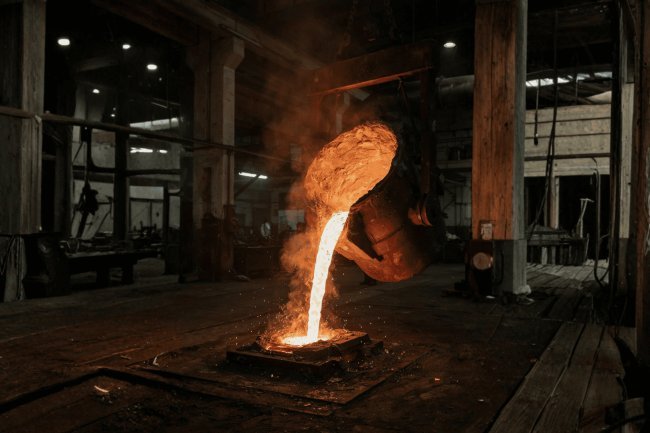
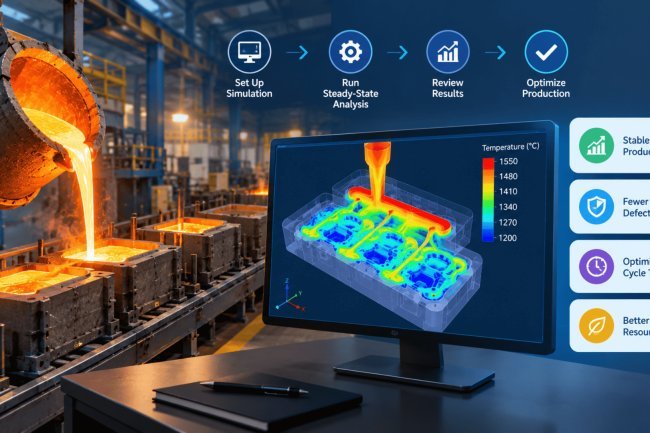
High-speed filling visualization reveals the full three-dimensional melt trajectory from gate entry through last-to-fill regions. Turbulent jets, back-filling zones, and air-entrapment pockets are mapped in real time, showing exactly where misruns and cold shuts will form if the start-up gate velocity or die temperature profile is not corrected.
Solidification hot spots are located by tracking where temperature lags behind the surrounding geometry during start-up cycles. These thermally isolated regions are precisely where shrinkage cavities nucleate and grow as the last liquid contracts without access to feed metal.
Multi-solver runs—Euler-Fourier for flow-solidification coupling, or the full Euler-Fourier-Hooke chain for dimensional and crack risk assessment—enable engineers to draw a direct, quantified line between start-up parameter choices and end-of-line quality outcomes.
Start-Up Failures You Can See
Before Steel Meets ToolingMisruns and cold shuts mapped in real time.
Hot spots located before shrinkage nucleates.
every start-up variable becomes a lever with a measured,
predictable effect on the finished casting.
The foundries that win on quality, lead time, and cost in the next decade will not be the ones who run the most physical trials — they will be the ones who run the fewest, because they have already found the right answer in the virtual environment. Start-up simulation is the entry point to this capability, but the destination is a fully optimized, continuously improving virtual foundry process. Take the first step at PoligonSoft Simulation.
A single simulation run answers a single question. A systematic parameter study — sweeping die temperatures, injection velocities, preheating durations, and feeder geometries across hundreds or thousands of combinations — maps the entire viable process window and identifies the robust operating zone where quality is maintained even when process variables drift.
Replace reactive troubleshooting with proactive process design. The virtual environment has no scrap rate, no tooling wear, and no production downtime.
Virtual foundry comparison allows engineering teams to evaluate fundamentally different process routes — gravity vs. low-pressure, single vs. multi-cavity, varied gating architectures — side by side on quantified quality metrics.
Scrap risk, rework probability, cycle time, and yield are all computed before a single machining order is placed. Capital allocation decisions are made on engineering evidence rather than experience-based assumptions, reducing the financial risk of tooling investment dramatically.
Modern casting simulation must match the pace of modern product development. Cloud deployment eliminates the hardware bottleneck that historically forced foundries to queue simulation jobs overnight or invest in expensive dedicated workstations.
Distributed solver execution cuts turnaround time by up to 60%, enabling multiple design iterations within a single engineering day. Cross-functional teams — design, process, quality — collaborate on shared live results, compressing the cycle from prototype concept to production-ready process. Explore the full offering via Casting Simulation Services.
The best time to fix a casting defect is before the mold is built. The second best time is now — with simulation. Visit PoligonSoft to begin your virtual foundry journey.
From One-Off Checks to Virtual Foundry Optimization
???? Stop One-Off "Will It Work?" Checks
⚖️ Compare Production Routes Before Tooling Commitment
☁️ Cloud-Based Real-Time Collaboration
What's Your Reaction?