Production Changeover Analysis Through Simulation
How physics-driven prediction is replacing guesswork on the foundry floor — eliminating scrap, reducing downtime, and unlocking a new era of precision manufacturing.
The Hidden Cost of
the Best Guess
Every production changeover is a decision point — and for most foundries, that decision is still driven by experience, intuition, and trial-and-error. What looks like a reasonable starting parameter on paper can translate into thousands of dollars of scrap, rework, and unplanned downtime once the die heats up and metal begins to flow. The "best guess" approach carries a compounding cost that rarely shows up in a single line on the balance sheet, but accumulates silently across every shift, every campaign, every new alloy introduction.
The Problem with Intuition
Traditional changeovers rely on operator experience and tribal knowledge.
While invaluable, this approach turns every new production window into a live experiment — with real material, real energy, and real time on the line.
Turbulence, air entrapment, and premature solidification remain invisible until a casting is sectioned and scrapped.
Reactive shop-floor fixes instead of proactive engineering
Scrap and rework trials consume hours of productive capacity
Root cause analysis is slow, expensive, and often inconclusive
The Simulation Advantage
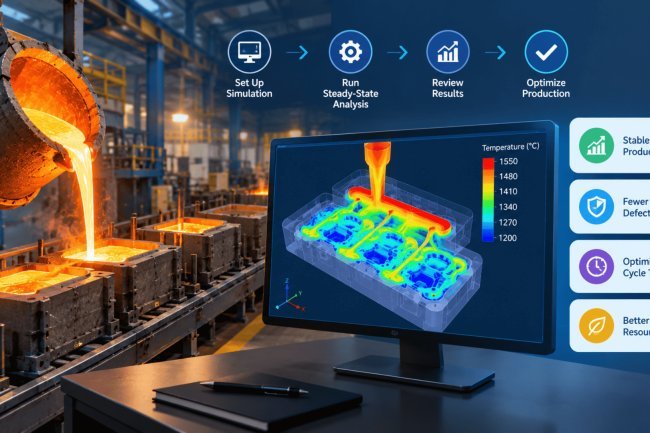
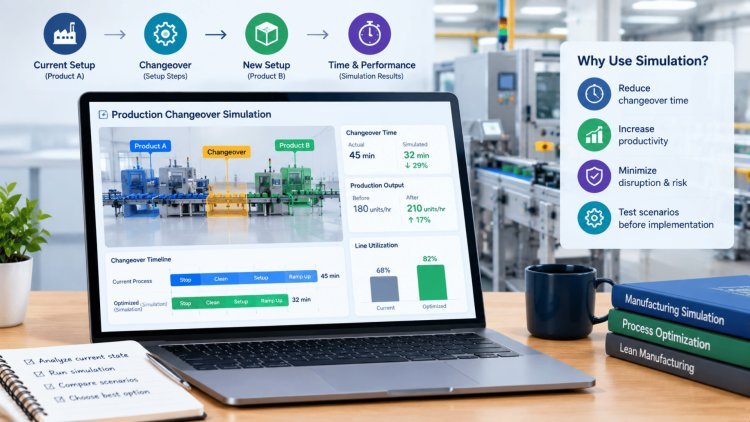
Physics-driven Casting Simulation Tools shift the entire decision upstream — before a single die is cut or a single shot is poured. By modeling molten metal flow, thermal gradients, and solidification behavior in a virtual environment, engineers can:
Visualize turbulence and air entrapment in the gating system before tooling is committed
Predict cold shuts, misruns, and oxide inclusions at the design stage
Test dozens of parameter combinations in hours rather than shifts
Arrive at the first trial with a data-validated process window — not a starting guess
Moving from reactive to predictive changeover management is not a technology upgrade — it is a fundamental shift in how foundries compete on quality and cost.
Scrap Reduction
Eliminate first-off losses by validating fill behavior virtually before production begins.
Faster Qualification
Compress changeover qualification from days to hours with simulation-guided trials.
Cost Certainty
Replace expensive live experiments with controlled virtual ones that cost a fraction of physical trials.
Every production changeover is a decision point — and for most foundries, that decision is still driven by experience, intuition, and trial-and-error. What looks like a reasonable starting parameter on paper can translate into thousands of dollars of scrap, rework, and unplanned downtime once the die heats up and metal begins to flow. The "best guess" approach carries a compounding cost that rarely shows up in a single line on the balance sheet, but accumulates silently across every shift, every campaign, every new alloy introduction.
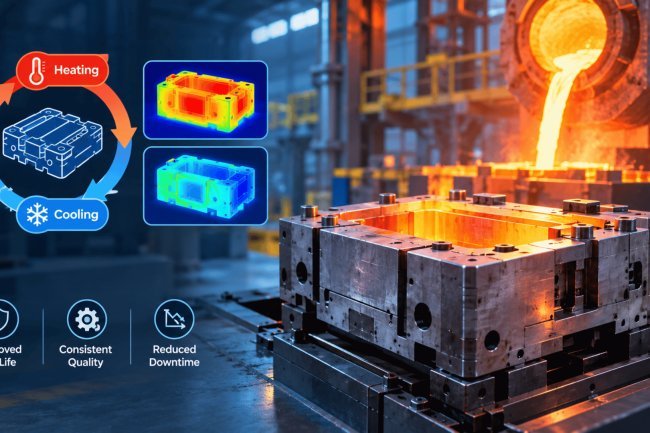
Simulation reveals how gating geometry, overflow placement, and shot speed collectively alter the solidification sequence throughout the casting. By mapping the full thermal history — from initial fill through final freeze — engineers can identify regions at risk of hot tears, warpage, and residual stress long before a tool is ever machined. Mold temperature control strategies can be validated and refined in the virtual environment, dramatically reducing the trial cycles required to stabilize a new part.
Identify hot spot formation and last-to-freeze zones with precision
Optimize cooling channel layout to achieve directional solidification
Predict and prevent warpage through balanced thermal management
Shrinkage porosity is one of the most persistent and economically damaging defects in casting production. Its root cause — insufficient feeding during solidification contraction — is notoriously difficult to isolate without quantitative tools.
Simulation allows engineers to compare alternative production routes side by side, isolating the exact combination of thermal and flow variables that drive porosity formation.
Compare gating designs quantitatively across multiple scenarios
Visualize shrinkage probability maps overlaid on part geometry
Validate process changes virtually before committing to tooling modifications
See the Die Casting Simulation process in action to understand how mold temperature control and injection parameters interact to define your defect risk.
Thermal History & Solidification Mapping
Shrinkage Porosity Isolation
Three Essential Views of the Casting Process
Simulation models are most powerful when they are anchored to reality. The gap between a virtual model and actual production behavior has historically been the Achilles heel of computational engineering. Digital twin technology closes this gap by continuously synchronizing the virtual environment with live foundry data—creating a living model that evolves as the process evolves.
A robust Digital Twin for casting production integrates multiple data streams—machine sensor outputs, alloy composition certificates, mold temperature logs, and ambient environmental readings—into a unified virtual process model.
One of the most operationally significant applications of the digital twin is early anomaly detection. By establishing baseline thermal signatures and mechanical response patterns for each production configuration, the system can flag deviations that indicate emerging problems—before they produce scrap or cause unplanned downtime.
From Digital Twins to
Predictive StabilityMultiple data streams, one virtual model.
Early anomaly detection, before scrap or downtime.
a living model that evolves with the process,
turning reactive repair into condition-based predictive maintenance.
The final frontier of simulation-driven changeover analysis is autonomy. When machine learning is layered onto a validated digital twin, the system gains the ability to not just predict outcomes — but to discover optimal solutions that human engineers may never have explored. The results from early adopters of this integrated approach are transforming expectations for what is achievable in foundry performance.
Documented industry results from integrating real-time production feedback with simulation-driven autonomous optimization loops.
Parallel simulations run autonomously to map the solution space and identify the globally stable optimum — not just a local one.
Each virtual experiment runs at near-zero marginal cost compared to live production trials consuming material, energy, and machine time.
Autonomous optimization engines execute hundreds of parallel virtual experiments simultaneously — systematically exploring the parameter space of injection velocity, metal temperature, die preheat, cooling flow, and intensification pressure in combinations that would take months of physical trials.
Each iteration feeds its outcome back into the learning model, progressively concentrating the search around the region of maximum stability and minimum defect probability.
The system does not simply find a working process — it finds the most robust working process, one that remains stable under the natural variation your production environment will inevitably impose.
The technology to achieve these results is available now, and the path to implementation is more accessible than many foundry leaders expect.
Whether you are managing a single die casting cell or a multi-line continuous casting operation, the fundamental approach is the same: replace physical guesswork with virtual certainty before committing to production.
Order a casting simulation to validate your next changeover, secure your scrap targets, and protect your delivery commitments. For a broader view of the tools that power this capability, explore the full simulation product portfolio and see how each module addresses a specific layer of your process challenge.
The 86.9% scrap reduction is not an outlier — it is the logical outcome of replacing probabilistic guesswork with deterministic, physics-driven process engineering at every stage of the changeover cycle.
The Autonomous Future: 86.9% Scrap Reduction
Scrap Rate Reduction
Virtual Experiments
Physical Trial Cost
How Autonomous Learning Loops Work
Your Next Step: Stop Guessing, Start Simulating
Experimentation
Convergence
Validation
Feedback
What's Your Reaction?