Automated Design of Experiments for Foundry Processes
Modern foundry engineering is undergoing a fundamental shift. Where once engineers relied on costly physical trials, iterative guesswork, and hard-won shop-floor experience, a new paradigm is emerging — one powered by autonomous simulation, machine learning surrogates, and statistically rigorous Design of Experiments (DoE). This presentation explores how foundries can move from reactive problem-solving to proactive, digitally verified process windows that eliminate defects before the first drop of metal is poured.
The Real Problem: Foundry Trials
Are Expensive, Slow, and Unreliable
The traditional approach to foundry process development is fundamentally misaligned with modern manufacturing demands. Physical trials consume time, material, and skilled labor — and yet they frequently fail to uncover the full range of risks lurking within a process window. The challenge is not simply one of cost; it is one of structural blindness built into conventional methods.
Simulation as Confirmation Bias
Traditional simulation workflows are often used to confirm what engineers have already decided rather than to explore the design space systematically.
This creates a false sense of confidence while delaying discovery of genuinely optimal — or more robust — operating windows. The result is a process that "works" under ideal conditions but fails unpredictably in production.
Interacting Parameters Create Hidden Risk
Casting quality is not governed by a single variable.
Pour temperature, gating geometry, riser placement, mold coating, and alloy composition all interact nonlinearly.
Changing one parameter to fix a shrinkage defect can silently introduce a hot tear in a different section.
Single-variable thinking misses these interactions entirely — only multi-factor experimental design can expose them.
The Question Has Changed
The engineering question is no longer simply "Will it work?" — it is "What is the best combination of parameters, and how robust is it to variation in raw materials, ambient conditions, and machine drift?"
This reframing demands a DoE-driven approach that maps not just nominal performance but the entire response surface around it.
High-Stakes Geometries Raise the Bar
Large valve bodies, pump housings, and structural castings with thick sections and tight dimensional tolerances represent the highest-risk category.
In these components, defects are not rework items — they are scrap events or, worse, field failures.
The cost of a single failed physical trial in this category can exceed the entire investment in a virtual DoE campaign.
Discover how platforms like PoligonSoft address this challenge through integrated digital validation.
The real limitation of physical foundry trials is not cost alone. It is the inability to systematically explore interacting variables, quantify robustness, and identify failure boundaries before production risk becomes reality.
The traditional approach to foundry process development is fundamentally misaligned with modern manufacturing demands. Physical trials consume time, material, and skilled labor — and yet they frequently fail to uncover the full range of risks lurking within a process window. The challenge is not simply one of cost; it is one of structural blindness built into conventional methods.
Runner cross-sections, ingate placement, sprue design, and filter sizing to control fill velocity and turbulence.
Riser size, shape, and placement to ensure adequate liquid feed metal reaches the last-to-solidify regions.
Pour temperature and pour rate — two parameters with strong coupled effects on oxide formation and thermal gradients.
Mold material selection and coating thickness, which govern heat extraction rates and local solidification time.
Alloy composition variations within specification limits, capturing the effect of heat-to-heat chemistry scatter on solidification behavior.
Predict and eliminate volumetric shrinkage defects in isolated hot spots and thick sections through optimized feeding system design.
Map thermomechanical strain accumulation during solidification to identify geometries and process windows where hot cracking risk is minimized.
Control fill pattern, metal velocity at the mold wall, and thermal conditions to predict and prevent cold shuts, misruns, and surface oxide folds.
Account for thermally induced distortion and stress-driven warpage during solidification and cooling to ensure final part geometry meets tolerance requirements. Learn more at our Foundry Process Engineering resource hub.
The strategic benefit of virtual DoE is profound: risk identification moves from the shop floor to the virtual design office, where the cost of failure is zero and the speed of iteration is limited only by compute capacity.
What Gets Explored
Gating System Geometry
Riser Design
Pour Temperature & Rate
Mold Material & Coating
Alloy Composition Variations
Quality Targets Being Optimized
Shrinkage Porosity
Hot Tear Susceptibility
Surface Quality
Dimensional Accuracy
The Strategic Benefit of Virtual DoE
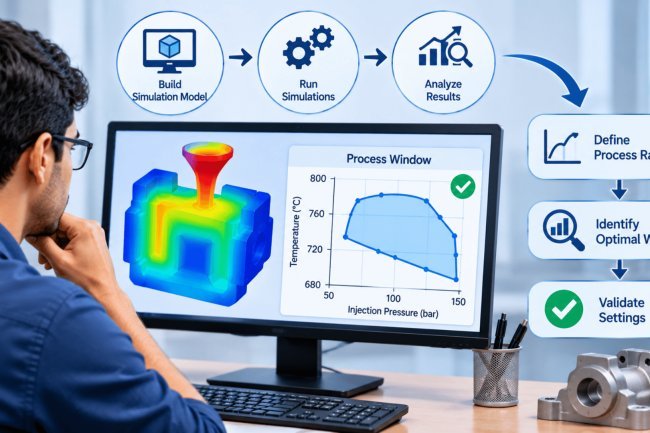
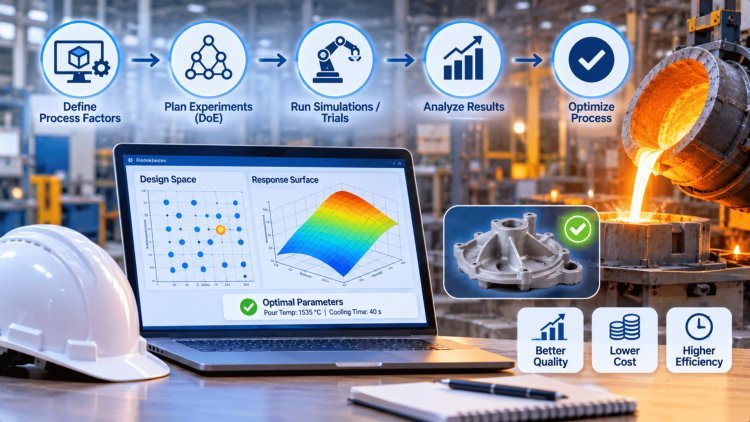
Not Just More Charts—A Repeatable Decision Workflow. Running hundreds of simulations generates enormous volumes of output data. The critical challenge—and the point where many engineering teams stall—is converting that simulation output into actionable, defensible process decisions.
Not all process parameters are created equal. Sensitivity analysis—using techniques such as Sobol indices, Morris screening, or simple Pearson correlation—reveals which input variables drive the most variance in each quality output.
The final and most commercially valuable step is closing the loop: translating the mathematical response surface back into physical design language. This means expressing optimal process windows in terms of specific riser heights, minimum section moduli, maximum allowable fill velocities, and alloy chemistry limits.
When the analytical workflow is executed correctly, the output is not a recommendation—it is a verified process window with defined boundaries, known sensitivities, and quantified confidence.
Turning Results into
Engineering InsightFocus on the levers that matter most.
Close the loop into physical design language.
From recommendation to verified window.
to ranked engineering priorities
and geometric design constraints.
The end-state of automated DoE for foundry processes is not a one-time engineering study — it is a repeatable, scalable digital infrastructure that every new component program can run through from day one. When the workflow is standardized and the simulation environment is validated against physical production data, the foundry gains a durable competitive advantage: faster time-to-production, fewer scrap events, and a defensible engineering record for every released process.
The workflow begins with CAD geometry and material specification, proceeds through automated process parameter definition and virtual trial execution, and concludes with a formal production release sign-off backed by simulation evidence. Each stage feeds the next, creating a closed-loop development system that improves with every component program executed.
The PoligonSoft simulation platform covers all three critical physics domains of the casting process: mold filling analysis to predict turbulence and oxide entrapment; thermal solidification and porosity prediction to map shrinkage risk; and stress-strain analysis to identify hot tear and distortion risk. Together, these modules provide complete process coverage within a single integrated environment.
Electric vehicle powertrain castings — motor housings, inverter brackets, battery tray structures — represent the highest-value application of autonomous foundry simulation. These components combine geometric complexity, tight dimensional tolerances, and zero-defect quality requirements. Digital DoE validation delivers defect elimination, tolerance confirmation, and faster program readiness — compressing development timelines that previously spanned months into weeks. Explore Foundry Process Engineering resources to see how this applies to your component programs.
Ready to move from physical trial-and-error to digital process mastery? The autonomous foundry workflow is not a future concept — it is available today. Visit Autonomous Foundry Simulation to explore case studies, methodology deep-dives, and implementation guidance for your foundry operation.
Conclusion: An Autonomous Foundry Workflow You Can Run on Repeat
End-to-End Process Workflow
PoligonSoft Module Coverage
EV Powertrain Use-Case Payoff
What's Your Reaction?