Robust Optimization of Casting Process Parameters
From Uncertainty to a Robust Process Window — a systematic framework for ensuring casting quality survives real-world variability, not just ideal lab conditions.
What "Robust" Must
Survive in Casting
Achieving a robust casting process means the casting succeeds across a wide range of fluctuating, uncontrollable conditions — not merely at a single "perfect" operating point. In industrial casting environments, process variables drift constantly: furnace temperatures fluctuate, shell preheating is uneven, and pour rates vary between operators and shifts. A truly robust parameter set must accommodate all of these realities without producing rejects.
Key Castability Drivers
In investment casting, the primary process levers that determine whether a part fills correctly and solidifies without defect are tightly coupled. Each must be treated not as a fixed value but as a distribution with realistic bounds.
Governs metal fluidity and fill completeness.
Controls turbulence generation and thermal gradients.
Determines heat extraction rate at the mold wall.
Influences rigidity, permeability, and thermal mass.
The Competing Failure Modes
Too Cold → Fill Defects
Lower pouring and shell temperatures raise the risk of cold laps (premature solidification at the flow front) and misruns (unfilled thin sections). Thin-walled and geometrically complex components are especially vulnerable when superheat is insufficient to maintain fluidity throughout the cavity.
Too Hot → Metallurgical Defects
High pouring temperatures increase dissolved gas pickup, elevate metal–mold reactivity, promote coarser grain structures, and can cause erosion of the ceramic shell. The resulting porosity and surface degradation are equally costly — simply running hotter is not a solution.
A defensible process window must therefore lie between these two failure boundaries — and it must remain inside those boundaries even when parameters drift due to real-world noise.
Finding and validating this window quantitatively is the entire purpose of robust optimization. The goal is not to identify a single perfect parameter set, but to establish a process envelope that consistently produces acceptable castings despite normal variation in temperature, pouring practice, shell conditions, and production environment.
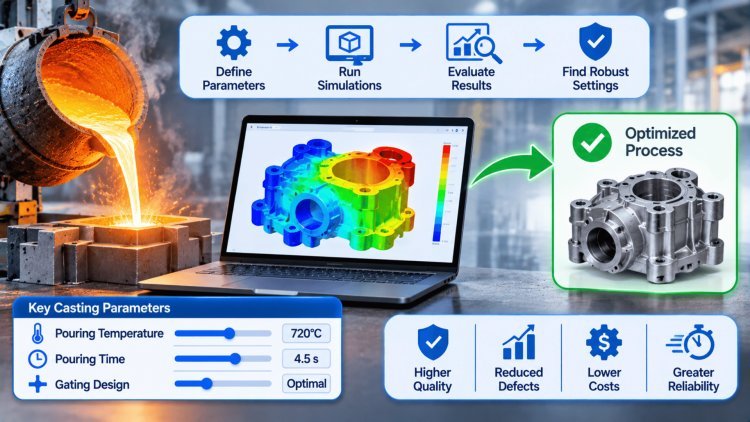
Robust optimization in casting is not a single calculation — it is a structured, multi-stage loop that moves from physics-based simulation through statistical modeling to multi-objective decision support. Each stage builds on the last, progressively replacing uncertainty with actionable knowledge.
Simulate casting with five uncertain process parameters.
Generate candidate parameter combinations systematically.
Fit response surfaces to DOE results for predictions.
Select final robust parameter scheme via multi-objective optimization.
The process begins with a high-fidelity 3D simulation model built in ProCAST®, capturing filling, solidification, and thermal history of the turbine vane geometry. Five key process parameters — including pouring temperature, shell temperature, pouring time, and related variables — are assigned explicit uncertainty bounds reflecting real foundry variability.
Captures filling, solidification, and thermal history of the turbine vane geometry.
Pouring temperature, shell temperature, pouring time, and related variables receive explicit uncertainty bounds.
A deterministic Design of Experiments (DOE) then systematically samples this parameter space, running simulations at structured combinations to map how outputs (porosity, fill quality, microstructure) respond to inputs without yet accounting for noise.
The DOE results seed a Box–Behnken Response Surface Model (RSM), which fits smooth surrogate functions across the parameter space. These surrogates are fast to evaluate and capture interaction effects that single-factor analysis misses.
Fits smooth surrogate functions across the parameter space using DOE results.
The RSM becomes the fitness function for an AMGA, which explores the design space under parametric uncertainty.
The algorithm generates a Pareto frontier of solutions that balance casting quality against robustness to variability.
The final step is selecting the parameter scheme that jointly maximizes both objectives — quality targets met and variance minimized.
The AMGA Pareto approach is critical: it does not deliver one "best" point but a family of robust candidates, giving process engineers a defensible choice rather than a fragile optimum.
Building the Optimization Loop
The Four-Stage Optimization Loop
ProCAST 3D Simulation
Deterministic DOE
Box–Behnken RSM
AMGA Robust Pareto
Stage 1 & 2 — Simulation & DOE Foundation
3D Casting Simulation
Five Uncertain Parameters
Deterministic Design of Experiments (DOE)
Stage 3 & 4 — RSM Modeling & Robust Pareto Selection
Box–Behnken Response Surface Model
Adaptive Multi-objective Genetic Algorithm (AMGA)
Pareto Frontier Generation
Jointly Maximize Both Objectives
A Family of Robust Candidates, Not One "Best" Point
One of the most powerful applications of the robust optimization framework is its ability to assess process robustness entirely in the virtual domain, long before any physical trials are run. Virtual experimentation dramatically reduces the number of costly casting trials required, while providing deeper insight into parameter interactions than physical experiments alone can deliver.
A representative virtual DOE varied three primary factors across physically realistic ranges: shell temperature (900–1100°C), pouring temperature (1530–1630°C), and pouring time (7–16 seconds). Full filling and solidification simulations were run at each design point, capturing predicted defect indicators including cold-lap risk index, macro-porosity fraction, and microporosity distribution throughout the casting volume.
Results revealed that cold-lap risk grows nonlinearly with decreasing pouring temperature and deteriorates rapidly as superheat drops toward the alloy's liquidus. Critically, parameter interactions created significant scatter across nominally "good" settings—a parameter combination that appeared acceptable in a deterministic analysis could produce fill failures under modest real-world variation, underscoring why deterministic optimization alone is insufficient.
Virtual Process Chains: Proving
Robustness Before the First CastA designed matrix across realistic ranges.
Nonlinear risk grows as superheat drops.
identifying robust operating zones and
revealing the parameter interactions
that make nominally optimal settings fragile.
The ultimate deliverable of the robust optimization framework is not a report of optimal parameters — it is a defensible, production-ready process window that engineering teams can commit to with confidence, knowing that quality targets will be met even as real-world conditions fluctuate around the nominal settings.
Re-ranking under noise was performed using an orthogonal "noise" design overlaid on each candidate parameter set.
For each candidate, Taguchi Signal-to-Noise (S/N) ratio and Quality Loss (QL) function scores were computed across the noise combinations.
The candidate with the best combined S/N and QL scores — meaning its quality outputs deviated least across all noise conditions — was identified as the most robust design. This is a mathematically rigorous, industry-accepted method for selecting parameters that perform consistently rather than optimally under ideal conditions.
Establish realistic uncertainty bounds for all key process parameters based on measured foundry variability. Never optimize against a single nominal value.
Use DOE-driven simulation and RSM surrogates to map quality responses across the full parameter space efficiently, capturing all interaction effects.
Apply AMGA or Taguchi-based methods to identify the Pareto front of solutions that balance mean quality against variance — not just maximum quality.
Confirm the selected window via targeted physical trials at the robust setting and at its uncertainty bounds, then commit it to the process control plan.
A defensible robust process window — quality targets met consistently without betting production on a single ideal parameter set that real conditions will never perfectly reproduce.
The Payoff: Decision-Ready Robust Settings Across Real Variability
Taguchi Signal-to-Noise & Quality Loss
Define Parameter Space
Simulate & Model
Optimize Robustly
Validate & Commit
What's Your Reaction?