From Traditional Foundry to Simulation-Driven Smart Manufacturing
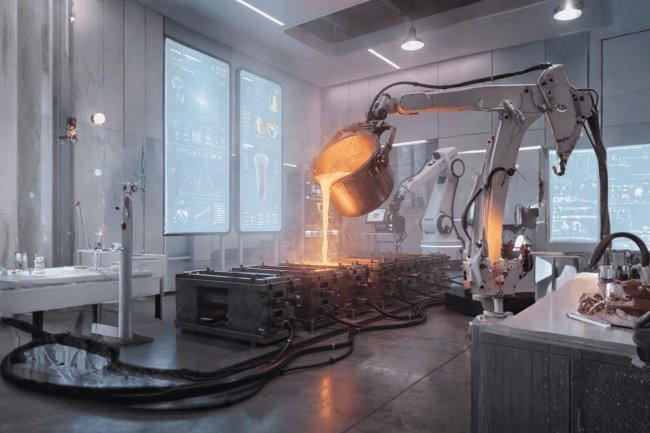
A journey through centuries of metalcasting evolution — from hand-crafted intuition and trial-and-error experimentation to the age of digital twins, AI-driven intelligence, and fully autonomous production systems. This presentation traces the technological milestones that have reshaped what a foundry can be, and charts the path forward for manufacturers seeking competitive advantage in the modern era.
The Era of
Empirical Tradition
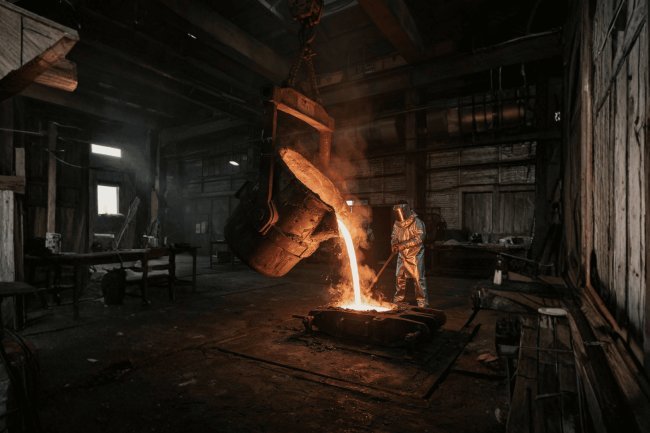
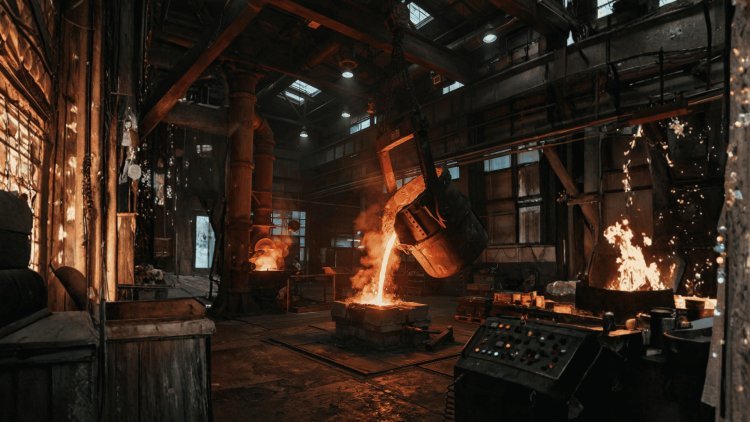
For generations, metalcasting was guided not by algorithms, simulation models, or digital process controls, but by the experience of skilled craftspeople. The foundry relied on observation, intuition, and accumulated knowledge passed from one generation to the next. While this craftsmanship created remarkable products, it also imposed limits on consistency, scalability, and process optimization.
Foundations of Traditional Foundry Practice
Craft Knowledge
Skills acquired through years of practical foundry work.
Human Judgment
Decisions based on experience rather than calculations.
Apprenticeship
Knowledge transferred through mentorship and practice.
Intuition Over Analysis
Gating systems, risers, pouring temperatures, and cooling strategies were developed largely through empirical judgment. Skilled foundrymen monitored metal behavior visually and adjusted process conditions according to practical experience accumulated across decades of production.
Traditional Decision Process
Trial-And-Error Engineering
New casting development depended on repeated physical experimentation. Engineers produced test castings, sectioned components, inspected defects, modified tooling, and repeated the process until acceptable quality levels were achieved.
Traditional Development Loop
Accepted Inefficiencies
Computational simulation transformed metalcasting from a reactive craft into a predictive discipline—replacing expensive physical iteration with rapid virtual experimentation.
Iterations that once required new patterns and multiple pour cycles could be completed in hours on a workstation, improving first-time yield and enabling earlier optimization of gates, risers, and cooling circuits.
Finite-difference phase modeling revealed heat dissipation and likely shrinkage regions.
Volumetric models improved prediction of turbulent flow, trapped gases, and microstructure.
Process-focused software connected simulation to practical design and tooling decisions.
Packages such as MAGMASOFT, ProCAST, and SOLIDCast helped bring advanced simulation within reach of small and mid-size foundries, expanding access beyond aerospace and defense programs.
Simulation outputs enabled evidence-based choices about process parameters, alloy selection, and tooling geometry. The foundry engineer shifted from reactive troubleshooting toward proactive process design across automotive, industrial, and consumer markets.
The Computational Breakthrough
Find failure modes before pouring metal.
Capability became accessible.
The engineer became a proactive designer.
It became the engineering standard for competitive foundry operations.
Industrial IoT sensors embedded in furnaces, conveyors, molds, and environmental systems generate continuous streams of process data. With 5G networks, near-zero-latency transmission enables real-time closed-loop control across the plant floor. Every machine becomes a data node in a plant-wide intelligence network.
Robots handle hazardous and precision-critical tasks — automated pouring, mold handling, grinding, core setting, and inspection. Cobots augment human expertise, while AGVs manage logistics. The result is safer, faster, and more repeatable production.
Machines act as intelligent nodes within a system. A furnace detecting thermal deviation can adjust pour scheduling. Mold sensors can update inspection parameters in real time. This transforms reactive quality control into proactive process management.
Smart foundries handle high-mix, low-volume production economically. Rapid recipe switching, digitally stored parameters, and automated setup validation enable customization without prohibitive costs. This aligns with modern demand for shorter lifecycles and smaller order quantities.
The Rise of the Smart Foundry
IoT and 5G Connectivity
Robotic Automation
Intelligent Process Nodes
High-Mix, Small-Lot Capability
The next frontier of manufacturing intelligence lies at the convergence of artificial intelligence, physics-based simulation, and real-time operational data. Together, these technologies create self-learning production environments capable of predicting problems, optimizing performance, and continuously improving manufacturing outcomes through an ever-strengthening connection between the physical and virtual worlds.
Unlike conventional simulation models that remain static after a study is completed, digital twins continuously synchronize with real production environments. Live sensor feeds keep the virtual replica aligned with actual shop-floor conditions, enabling real-time insights and predictive decision-making.
Digital twins now extend beyond individual castings and production cells, enabling optimization of entire facilities using actual operating conditions instead of idealized planning assumptions.
AI continuously analyzes operational signals from equipment across the foundry. Subtle shifts in vibration patterns, temperature signatures, pressure behavior, and wear characteristics are detected long before conventional monitoring methods would identify an emerging problem.
The Frontier:
AI and Digital TwinsThe New Manufacturing Stack
Simulating The Entire Process Chain
Continuous Digital Synchronization
New Engineering Capabilities
Facility-Level Intelligence
AI-Driven Predictive Maintenance
The convergence of hybrid manufacturing, simulation, predictive maintenance, and AI inspection is redefining how fast, flexible, and intelligent a foundry can become.
Printed cores enable complex internal geometries, topology-optimized conformal cooling can extend die life and reduce cycle time, and CT plus machine vision can close the quality loop at production speed.
Reported improvement from simulation-guided optimization.
Lead-time reduction through digital validation.
Reduction in unplanned-downtime costs through prediction.
Digitally managed parameters and predictive maintenance shorten new-part lead times, extend tooling life, and make rapid changes across part numbers, alloys, and process settings more reliable.
The Autonomous Competitor
Combine processes to expand what can be made.
Compete in high-mix, short-run markets.
More demands, at the same time.
It is the minimum threshold for sustained competitiveness.
What's Your Reaction?