Determining Robust Casting Process Windows
A deep-dive into how foundries define, simulate, and validate the exact parameter ranges that separate defect-free castings from costly scrap — before a single ladle is poured.
What "Robust" Means Before Metal Melts
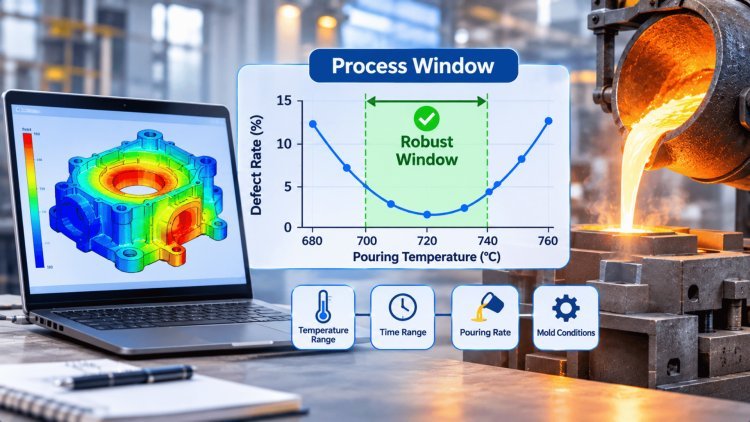
In casting engineering, the word robust carries a very specific and demanding meaning. A robust casting process window is not simply a set of recommended parameters — it is the full, validated range of gating, thermal, and pouring conditions within which a process consistently produces defect-free parts, even when real-world variability introduces drift, fluctuation, or operator error.
Defects like misruns, porosity, hot tears, and warpage do not appear randomly. They emerge at the edges of process windows — when shell temperatures climb too high, when pour rates deviate, when wall thickness transitions create localized hot spots. Identifying those boundaries in advance is what separates a mature process from a reactive one.
The Foundry's Practical Goal
Set process parameters once, validate them thoroughly in a virtual environment, and then confirm that the digital "foundry" accurately predicts real-world outcomes — all before tooling is committed and physical trials begin. This front-loaded discipline eliminates the most expensive phase of casting development: iterative physical trials driven by unknown failure modes.
Parameters That Define the Window
Gating Geometry
Runner sizing, ingate location, and sprue design that govern metal velocity and turbulence
Thermal Conditions
Mold preheat, shell temperature, and die temperature gradients
Pouring Parameters
Temperature, rate, and transfer time from furnace to mold
Alloy Properties
Liquidus/solidus range, fluidity, and thermal conductivity at casting temperature
The process window is not a single point — it is a multidimensional envelope. Robustness is measured by how wide that envelope is and how far the nominal process sits from its failure boundaries.
In casting engineering, the word robust carries a very specific and demanding meaning. A robust casting process window is not simply a set of recommended parameters — it is the full, validated range of gating, thermal, and pouring conditions within which a process consistently produces defect-free parts, even when real-world variability introduces drift, fluctuation, or operator error.
Casting failures rarely stem from a single cause. They emerge from the interaction of fluid flow, thermal gradients, and mechanical stress — three coupled physical domains that must each be understood and controlled within the process window. When any one domain exceeds its tolerance, the entire casting is at risk.
Understanding the interaction between these three failure domains is the foundation of any robust process window determination. A simulation platform that captures all three simultaneously — such as PoligonSoft — gives engineers the complete picture needed to push nominal conditions away from every failure boundary at once.
Where Robustness Breaks
Three Domains. One Process Window.
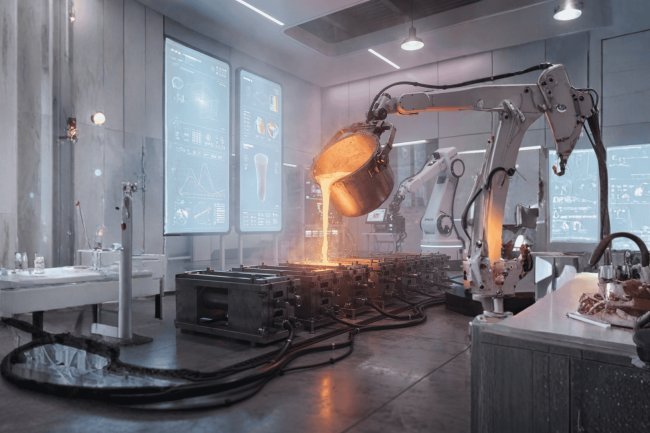
The traditional path to a validated casting process runs through physical trial castings—expensive, time-consuming, and limited in diagnostic resolution. Simulation-driven validation replaces that path with a virtual foundry that replicates filling, solidification, and full thermal history before any physical metal is poured.
Engineers begin by encoding alloy thermophysical properties, mold material conductivity, and interface heat transfer coefficients into the simulation model. Pouring conditions—temperature, rate, and ladle geometry—are parameterized so that sensitivity studies can sweep across the process window boundaries efficiently.
Investment casting is exceptionally sensitive to process window boundaries. Shell temperature at casting time, wall thickness transitions, heat loss during transfer from furnace to shell, and the requirement for directional solidification toward risers all interact to create a narrow, geometry-specific window.
Finding the Window
with Digital Process ValidationSystematic iteration until risk maps converge.
A narrow, geometry-specific window.
and a process window grounded in physics,
not empiricism.
Achieving a validated process window in simulation is not the final destination — it is the entry point to a disciplined, closed-loop manufacturing workflow. The transition from "best fit" to "production-ready" requires that simulation outputs are systematically translated into quality targets, tooling specifications, and ongoing production controls that keep the process operating inside its validated envelope throughout the product lifecycle.
Geometry review, draft angles, wall thickness mapping, and thermal isolation identification. Establish the theoretical process window from part design constraints.
Fill, solidify, and stress-simulate across the full parameter envelope. Converge defect risk maps. Define window boundaries with safety margins.
Translate simulation results into gating hardware, riser geometry, cooling channel placement, and mold material specifications. Eliminate root causes before first pour.
Launch within the validated window with digital twin integration for real-time monitoring, SPC alignment, and continuous quality control feedback.
The most measurable benefit of process-window-driven development is the dramatic reduction in development cycles and scrap/rework costs.
When the root cause of a defect is resolved in simulation — before tooling is cut — the cost of that resolution is a fraction of what it would be after first-article inspection reveals a porosity problem in an already-manufactured die.
Quality targets become precise and traceable: not "minimize porosity" but "maintain shrinkage index below 0.3% across the full pour-temperature range of ±15°C." That specificity is only possible when the process window has been mapped in detail through digital process validation — giving engineers a quantitative foundation for every quality acceptance criterion.
PoligonCast and PoligonSoft provide the complete simulation environment needed to define, validate, and lock in your casting process window — from initial gating design through full solidification and stress analysis. The platform's menu-driven workflow makes it accessible to both simulation specialists and process engineers working on the shop floor.
Model filling, solidification, and stress in a single integrated environment
Generate defect risk maps with actionable parameter sensitivity data
Reduce physical trial castings and reach first-article approval faster
Explore PoligonSoft — Full Platform Overview
Advanced Engineering Modules for Investment & Die Casting
How Digital Validation Reduces Trial Castings
A robust process window is not discovered through trial and error on the shop floor — it is engineered in simulation and then confirmed in production. The foundries that invest in this discipline consistently outperform on yield, dimensional quality, and time-to-market.
From "Best Fit" to
Production-Ready RobustnessDesign Analysis
Simulation Validation
Tooling Optimization
Production Launch
Compressing Development Cycles & Eliminating Scrap
What's Your Reaction?