Modeling High-Temperature Alloy Casting Behavior
In modern foundry and manufacturing processes, understanding how high temperature alloys behave during casting is no longer optional — it is a competitive necessity. As industries push the boundaries of performance in aerospace, energy, and automotive sectors, the demand for components cast from nickel super alloys, titanium alloys, and refractory metals has never been higher. PoligonCast stands at the forefront of this challenge, leveraging advanced casting simulation to predict, optimize, and validate alloy behavior before a single mold is poured.
Why High-Temperature
Alloy Casting Is
Uniquely Challenging
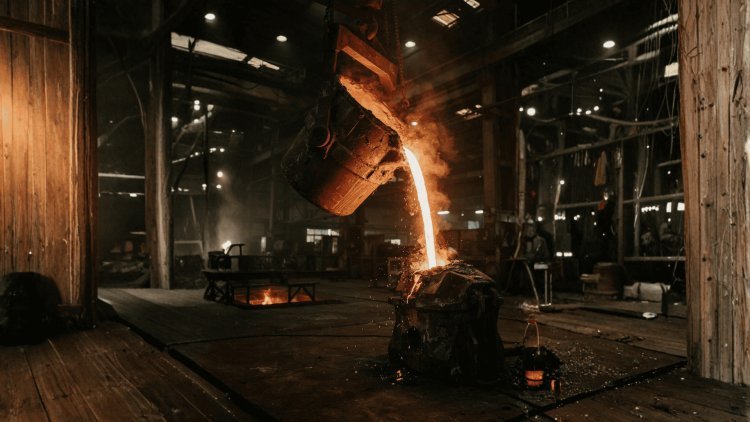
High-temperature alloy casting operates within exceptionally demanding thermal and metallurgical conditions. Phase transformations, solidification shrinkage, hot tearing susceptibility, and residual stress accumulation occur simultaneously, while narrow solidification windows and extreme thermal gradients leave little margin for process error. For nickel-based superalloys and titanium systems, predictive simulation is therefore essential to achieving reliable casting quality.
The High-Temperature Casting Challenge
The Core Problem
High-temperature alloys exhibit complex thermophysical behavior, including phase transformations, solidification shrinkage, hot tearing susceptibility, and residual stress accumulation. These phenomena interact throughout filling, solidification, and cooling, making reliable prediction difficult with simple empirical design methods.
Without simulation, foundries are forced to rely heavily on expensive and time-consuming trial-and-error development. For high-value castings and sophisticated alloy systems, every unsuccessful physical iteration can consume substantial material, tooling capacity, furnace energy, labor, and development time.
Why Traditional Methods Fall Short
Narrow Solidification Windows
High-performance alloys provide limited tolerance for variations in pouring temperature, feeding behavior, and cooling conditions.
Extreme Thermal Gradients
Large temperature differences between different casting regions produce strongly non-uniform solidification and contraction behavior.
Particularly Demanding Material Systems
Critical Failure Modes
Hot Tearing & Cracking
Semi-solid alloy networks can fracture under thermal stress during solidification when feeding and gating are not optimized. As contraction stresses accumulate, weak semi-solid regions may be unable to accommodate deformation, creating hot tears and cracks.
Hot Tearing Development
Porosity & Shrinkage Defects
Volumetric contraction during cooling and solidification creates an ongoing demand for liquid-metal feeding. When isolated regions cannot receive enough additional metal, internal voids form and compromise structural integrity in critical components.
Shrinkage Defect Formation
Residual Stress Distortion
Differential cooling rates cause different regions of the casting to contract at different times and by different amounts. The resulting residual stresses can produce warping and dimensional inaccuracy, particularly in thin-walled aerospace castings where geometric tolerance requirements are extremely demanding.
Thin-Walled Aerospace Castings Are Especially Vulnerable
One Defect Mechanism Influences Another
Feeding behavior, phase transformation, thermal gradients, volumetric contraction, and stress development cannot be treated independently because they continuously interact throughout the casting cycle.
Why Predictive Simulation Matters
High-Value Alloys Demand High-Confidence Engineering
When materials are expensive, processing windows are narrow, and component performance is critical, digital prediction becomes essential for reducing development risk and avoiding costly physical failures.
High-Performance Materials
Leave Less Room
For Manufacturing Error.
High-temperature alloy casting combines phase transformations, solidification shrinkage, hot-tearing susceptibility, extreme thermal gradients, feeding limitations, and residual stress development within a tightly constrained process window. Conventional casting rules developed for simpler materials cannot reliably capture these interacting mechanisms, particularly in nickel-based superalloys, titanium systems, and thin-walled aerospace components. Predictive simulation provides the visibility required to identify cracking, porosity, shrinkage, and distortion risks before production begins, replacing expensive trial-and-error foundry development with controlled, physics-based engineering.
Advanced simulation platforms solve coupled thermal, fluid flow, and stress equations simultaneously to model the full casting cycle — from mold filling through solidification and cooling. At PoligonCast, our simulation workflow integrates validated thermophysical property databases for high-temperature alloys with high-fidelity finite element and finite difference solvers.
Thermal behavior, fluid movement, and mechanical response are interconnected. Modeling them across the casting cycle helps engineers examine how changes during one stage can affect later stages.
The workflow begins with alloy-specific material data across the full temperature range, providing the property inputs needed to model changing material behavior.
Fluid dynamics modeling captures metal movement during the pour and helps identify flow conditions that may contribute to filling-related defects.
The model predicts solidification behavior and feeding patterns, highlighting potential shrinkage porosity, hot spots, and directional solidification fronts.
Structural simulation maps residual stress fields and predicts dimensional deviation, helping engineers assess potential distortion before tooling is committed.
How Casting Simulation Models Alloy Behavior
A Coupled View of the Casting Process
Four Stages of Alloy Simulation
Thermophysical Property Input
Mold Filling Simulation
Solidification & Feeding Analysis
Stress & Distortion Prediction
Turbine blades, combustor liners, and structural airframe brackets cast from nickel superalloys demand near-zero defect rates. Simulation enables directional solidification optimization and grain structure control for fatigue-critical parts.
High-pressure turbine components for gas and steam power plants require dimensional stability at sustained operating temperatures. PoligonCast models creep-resistant alloy behavior to extend component service life.
Lightweight titanium and aluminum-silicon alloy castings for high-performance engines benefit from simulation-guided gating design, reducing scrap rates and accelerating time to production readiness.
PoligonCast simulation has demonstrated 30–45% reduction in casting defect rates and up to 60% fewer physical trial iterations for complex high-temperature alloy components.
Capabilities & Industry Applications
Aerospace & Defense
Power Generation
Automotive & Motorsport
The integration of casting simulation into the digital manufacturing workflow is no longer a luxury reserved for large OEMs. It is a foundational capability for any foundry competing on quality, cost, and delivery in high-performance alloy casting. As alloy compositions grow more complex and geometric tolerances tighten, physics-based simulation is the only scalable path to first-time-right casting results.
High-performance alloy casting is becoming increasingly difficult to manage through empirical methods alone. More sophisticated compositions introduce complex phase transformations and thermophysical behavior, while tighter geometric tolerances reduce the acceptable manufacturing window.
Physics-based simulation provides a scalable engineering framework for understanding these interactions before production begins, creating a pathway toward first-time-right manufacturing rather than repeated physical correction cycles.
PoligonCast continues to develop simulation methodologies that push the state of the art by incorporating machine learning-assisted defect prediction, real-time process monitoring integration, and additive manufacturing hybrid process modeling. These capabilities extend simulation beyond conventional offline analysis toward increasingly connected and intelligent manufacturing workflows.
Machine learning-assisted methodologies can complement physics-based simulation by identifying patterns in process and simulation data associated with defect formation, helping engineers evaluate quality risk more efficiently.
Connecting simulation with real-time process monitoring creates the foundation for continuously comparing predicted behavior with production conditions and using that information to support faster process decisions.
Hybrid process modeling expands digital casting analysis into manufacturing workflows where additive techniques interact with conventional casting processes, creating new possibilities for tooling, process design, and complex component development.
Build decisions around modeled heat transfer, fluid flow, solidification, shrinkage, and material behavior.
Explore process variables digitally and refine the manufacturing strategy before committing to production.
Identify defect-prone conditions early enough to modify tooling, process parameters, or casting design.
For foundry engineers and manufacturing decision-makers, the strategic question is no longer whether digital casting simulation should be adopted. The real question is how quickly simulation can be integrated into development and production workflows to create measurable competitive advantage.
The greatest value emerges when simulation is applied throughout the entire development lifecycle, beginning with feasibility evaluation and continuing through process design, optimization, validation, and production implementation.
Advanced simulation is evolving from a specialist analysis tool into foundational engineering infrastructure supporting quality, cost, delivery, process development, and production validation.
Physics-based simulation, data-driven prediction, real-time monitoring, and advanced manufacturing integration are converging into a new digital casting environment built around earlier insight and higher-confidence decisions.
Partner with PoligonCast to bring advanced casting simulation to your high-temperature alloy production, from feasibility analysis through full production validation.
Digital casting simulation is becoming foundational infrastructure for high-temperature alloy manufacturing. As material systems become more complex and production tolerances tighten, physics-based prediction provides a scalable route toward first-time-right results. The continued integration of machine learning-assisted defect prediction, real-time process monitoring, and additive manufacturing hybrid process modeling expands this capability even further. For modern foundries, adopting advanced casting simulation is no longer simply an opportunity to improve analysis. It is a strategic path toward measurable improvements in quality, process optimization, defect reduction, development speed, and competitive manufacturing performance.
The Future of High-Temperature
Alloy Casting Is DigitalDigital Capability Is Becoming Foundational
From Conventional Development to Digital Manufacturing
Physics-Based Simulation at the Core
Why Digital Simulation Becomes More Important
Pushing Simulation Beyond Traditional Boundaries
Machine Learning-Assisted Defect Prediction
Real-Time Process Monitoring Integration
Additive Manufacturing Hybrid Process Modeling
The Three Pillars of Digital Casting Advantage
From Adoption to Competitive Advantage
Digital Casting Deployment Path
The New Foundry Operating Model
From Reactive Foundry Work to Predictive Manufacturing
Bring Advanced Casting Simulation to Your High-Temperature Alloy Production
The Question Is No Longer
Whether To Go Digital.
It Is How Quickly.
What's Your Reaction?