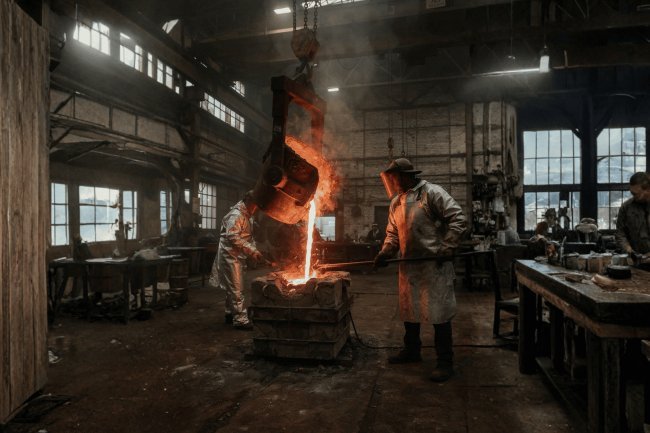
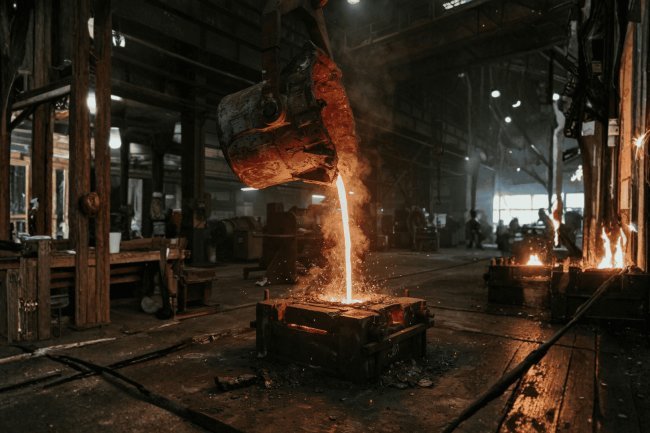
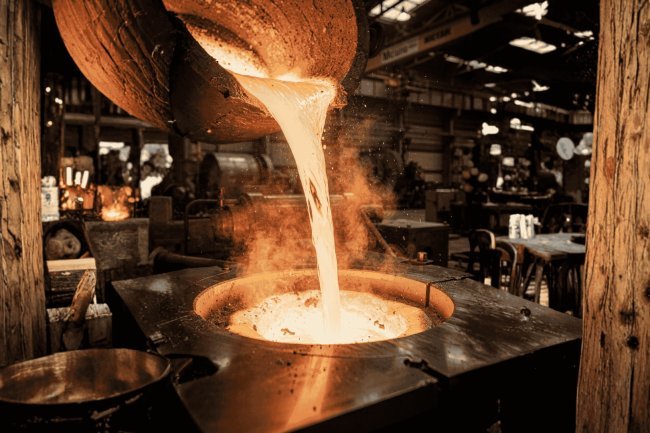
Modeling Brass and Bronze: Precision in Solidification
From ancient casting traditions to cutting-edge numerical simulation, the science of solidifying copper alloys has undergone a profound transformation. This presentation explores the physics of phase transformation, the distinct solidification behaviors of brass and bronze, and how computational modeling is redefining what is possible in alloy design and production quality.
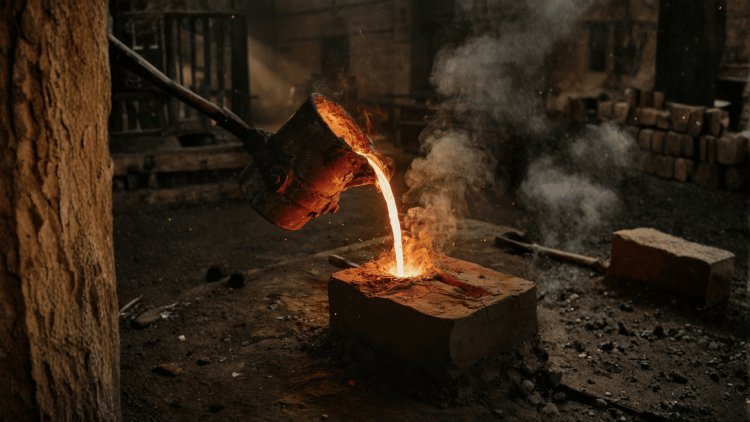
The Fundamentals of
Phase Transformation
Metal solidification is far more complex than a simple transition from liquid to solid. It is a dynamic interaction between heat transfer, solute redistribution, crystal growth, and thermodynamic stability. These mechanisms determine the final microstructure of a casting and ultimately control its mechanical performance, defect susceptibility, and manufacturing reliability.
Four Fundamental Solidification Mechanisms
Heat & Solute Redistribution
As a molten alloy cools below its liquidus temperature, solidification begins at the solid-liquid interface. During this process, many alloying elements are rejected from the newly formed solid and redistributed into the surrounding liquid phase. This phenomenon is controlled by the partition coefficient (k), which determines how solute atoms distribute between solid and liquid phases.
Simultaneously, heat is extracted through the mold system. The rate of thermal extraction governs how rapidly concentration gradients develop and whether the alloy solidifies under near-equilibrium or strongly non-equilibrium conditions.
Solidification Sequence
Primary Phase Formation & Liquidus-Solidus Gap
The temperature interval between the liquidus and solidus temperatures is known as the mushy zone. Within this region, solid and liquid phases coexist simultaneously. The width of this interval directly influences feeding behavior, defect formation, and overall casting quality.
Wide mushy zones often increase susceptibility to shrinkage porosity and hot tearing because liquid feeding becomes progressively more difficult as the interconnected dendritic network develops. Copper alloys such as tin bronzes may exhibit mushy zones exceeding 100°C, making process control especially critical.
The Mushy Zone
Wider solidification intervals increase feeding difficulty, creating favorable conditions for porosity, segregation, and hot tearing if not properly controlled.
Key Consequences of a Wide Mushy Zone
Dendritic Growth & Material Integrity
Most engineering alloys solidify through dendritic growth. Dendrites develop as tree-like crystal structures extending outward from nucleation sites into the liquid melt. Their geometry controls segregation patterns, feeding pathways, and final mechanical performance.
Primary Dendrite Arm Spacing (PDAS) and Secondary Dendrite Arm Spacing (SDAS) are among the most important structural metrics in casting metallurgy. Smaller arm spacings generally indicate higher cooling rates and improved material properties.
Properties Influenced by Dendrite Morphology
Finer Dendritic Structure
Increased cooling rates refine dendrite arm spacing, reduce segregation, and generally improve the mechanical integrity of cast components.
Constitutional Undercooling
Constitutional undercooling occurs when solute enrichment ahead of the advancing solidification front lowers the local equilibrium liquidus temperature. If the actual thermal gradient becomes insufficient to stabilize the interface, the liquid becomes thermodynamically unstable.
This instability causes a smooth planar interface to break down first into cellular structures and eventually into fully developed dendritic growth patterns. The phenomenon is one of the primary drivers of grain morphology in casting alloys.
Morphological Evolution
Controlling Constitutional Undercooling
Engineers manage constitutional undercooling by controlling alloy chemistry, cooling rates, thermal gradients, mold materials, and pouring conditions. Effective control enables microstructure refinement and improved casting performance while reducing sensitivity to defects.
Every Property Starts With Solidification
Heat extraction, solute redistribution, dendritic growth, and constitutional undercooling collectively determine the grain structure and performance of every engineering casting.
Defects, Microstructure,
And Mechanical Properties
Share The Same Origin.
Every casting outcome can be traced back to the fundamental physics of phase transformation. Heat extraction governs thermal gradients, solute redistribution controls local chemistry, constitutional undercooling determines interface stability, and dendritic growth establishes the final microstructure. Together, these mechanisms control porosity formation, segregation behavior, grain refinement, and mechanical performance. A deep understanding of phase transformation therefore provides the scientific foundation for all advanced alloy development, microstructure prediction, and casting process optimization strategies.
One of humanity's oldest engineered materials, Cu-Sn bronze has a casting history stretching back over 5,000 years. Its very wide solidification range creates extensive dendritic development, interdendritic segregation, and demanding feeding conditions.
Tin-rich liquid phases can persist deep into the mushy zone. When feeding is inadequate, these regions become prone to porosity formation.
Brass introduces a different layer of complexity. Zinc has a high vapor pressure and boils at approximately 907°C, close to typical brass pouring temperatures. This makes zinc loss, melt control, and simulation boundary conditions particularly important.
Zinc evaporation can complicate composition control and introduces additional challenges when establishing accurate simulation boundary conditions.
The transformation introduces significant microstructural sensitivity to both composition and cooling rate.
Cooling and composition influence the resulting microstructure and local properties.
Higher strength can be accompanied by reduced cold workability.
Finer interdendritic structures and generally favorable mechanical behavior.
Coarser structures can become more susceptible to porosity.
Interdendritic spacing — both primary and secondary — captures the local solidification history. Modeling this relationship helps connect cooling conditions and composition to the mechanical behavior of the final copper alloy casting.
Tin Bronzes (Cu-Sn)
A Wide & Complex Solidification Range
What Makes Tin Bronze Difficult to Control?
Brass Alloys (Cu-Zn)
Zinc Volatility
Peritectic β → α Transformation
Composition Controls the Final Microstructure
α-Dominant Structure
Duplex α + β
Interdendritic Spacing Is a Solidification Fingerprint
One Copper Base, Two Different Modeling Priorities
Microstructure Is the Fingerprint of Solidification
FDM discretizes the casting domain into a grid and solves the heat conduction equation at each node over time. It predicts temperature distributions, cooling curves, and solidification front progression at the part scale. Modern FDM codes incorporate latent heat release and calibrated Heat Transfer Coefficients (HTCs) for realistic mold-metal interactions.
CA models simulate grain nucleation and growth at the microscale. Each cell evolves based on undercooling, orientation, and neighborhood rules. This method reproduces equiaxed, columnar, and mixed grain morphologies, capturing the columnar-to-equiaxed transition (CET) that influences texture and anisotropy.
Contemporary frameworks couple macroscopic FDM/FEM solvers with microscopic CA or phase-field models. Macro models provide temperature and cooling rates, while micro models return latent heat and effective properties. This two-way exchange predicts grain size distribution, dendritic spacing, phase fractions, and segregation profiles — enabling mechanical property mapping and defect-free casting optimization.
Numerical simulation has evolved from macroscopic thermal predictions to fully coupled multi-scale frameworks, empowering foundries to optimize gating, riser placement, and cooling design before physical trials.
Hierarchical Approaches in Solidification Modeling
Finite Difference Method (FDM)
Cellular Automaton (CA) Models
Coupled Macro-Micro Simulation
A simulation delivers value only when its predictions faithfully represent physical reality. Validation is the systematic process of comparing computational outputs against measured experimental data, transforming simulation from a theoretical exercise into a trusted engineering tool. In modern foundry operations, validation provides the confidence required to use digital predictions for process optimization, defect prevention, and production decision-making.
Thermal history is the most fundamental validation target in any casting simulation. Thermocouples embedded in molds and castings record real temperature-time data that can be directly compared against simulated cooling curves. Agreement between measured and predicted temperatures provides strong evidence that heat transfer, solidification kinetics, and boundary conditions are being modeled accurately.
These comparisons establish whether the simulation captures the essential thermal behavior governing defect formation, feeding performance, and microstructural development throughout the casting cycle.
Measured and simulated cooling curves are compared point-by-point throughout filling and solidification.
Physical cross-sections are compared to predicted grain structures, phase distributions, and defect locations.
Industrially validated models typically aim for liquidus and solidus prediction accuracy within approximately two to five degrees Celsius of measured values.
One of the most comprehensive industrial validation studies was conducted by Oras Oyj, a Finnish manufacturer of premium brass faucets and valve systems. Working alongside simulation specialists, the company developed a predictive solidification model for its gravity die-casting operations.
Rather than accepting default simulation inputs, the engineering team undertook a rigorous calibration program focused on matching measured casting behavior to model predictions through systematic refinement of thermal boundary conditions.
Heat Transfer Coefficients govern the thermal interaction between the casting and the mold. These values are difficult to measure directly because they depend on interface pressure, coating condition, surface roughness, and local air-gap formation throughout solidification.
Distinct simulation runs used during calibration.
Typical industrial target for validated solidification models.
Typical solidification interval for tin bronze alloys.
Validating the
Digital FoundryThree Pillars of Simulation Validation
Thermal Analysis & Benchmark Verification
Critical Validation Checkpoints
What Engineers Compare
Thermal Curves
Metallography
Thermal Validation Target
Oras Oyj: 38 Simulations to Casting Accuracy
Calibration Focus: Heat Transfer Coefficients (HTCs)
Validation Workflow
Iterative Simulations
Thermal Accuracy
Mushy Zone Width
Real-world brass and bronze alloys are rarely binary systems. Commercial alloys may include lead, aluminum, silicon, manganese, or nickel to enhance machinability, corrosion resistance, or strength. Modeling these systems requires thermodynamic databases and solidification kinetics models capable of handling multicomponent phase behavior.
Predict multicomponent phase equilibria for increasingly complex alloy systems.
Connect thermodynamic predictions with solidification kinetics models.
Future simulation tools will increasingly handle macrosegregation in complex alloy systems, revealing how composition varies across the casting and how those variations affect localized corrosion behavior and mechanical response.
Validated solidification models can become the predictive core of real-time process control systems, particularly in continuous casting processes where operating variables can be continuously measured and adjusted.
In continuous casting of brass rod and tube, a validated digital twin can continuously ingest process measurements and predict whether current conditions are likely to produce a sound product or create defect risk.
Defects are discovered after production has already occurred.
Process conditions can be corrected before defects manifest.
The most significant transformation enabled by computational solidification modeling is not merely technical. Validated simulation converts tacit foundry knowledge into quantitative, transferable knowledge that can be applied rapidly to new alloys and geometries.
The integration of thermodynamic databases, coupled macro-micro simulation, and real-time control systems represents the complete digital foundry — a system capable of designing, predicting, and producing defect-free copper alloy castings with unprecedented precision and efficiency.
The Next Generation of Digital Foundry Practice
Advanced Multiphase Models for Complex Ternary Alloys
Commercial Alloy Design Is Becoming More Complex
CALPHAD-Type Databases
Coupled Kinetics
Predict More Than Defects
Real-Time Process Control via Validated Models
Predict Before Defects Manifest
Post-Process Inspection
In-Process Prediction
From Trial-and-Error to Digital Design Mastery
Empirical Art
Computational Mastery
Less Physical Experimentation. More Digital Exploration.
Three Technologies. One Predictive System.
Designing, Predicting & Producing With Unprecedented Precision
What's Your Reaction?