Casting Simulation for Aerospace Titanium Components
Where computational physics meets flight-critical manufacturing — eliminating defects before the first mold is ever poured.
The Titanium Imperative:
Why Simulation Matters
Titanium alloys occupy an irreplaceable position in modern aerospace engineering. Their exceptional strength-to-weight ratio, outstanding corrosion resistance, and ability to withstand extreme thermal cycling make them the material of choice for structural frames, turbine housings, fan blades, and landing gear assemblies. Yet titanium is notoriously difficult to cast. The metal is highly reactive at elevated temperatures, readily absorbing oxygen and nitrogen from the atmosphere, which leads to brittle alpha-case layers and internal contamination. Hot tearing, shrinkage porosity, and misrun defects further threaten structural integrity when process parameters deviate even marginally from optimal conditions.
The stakes in aerospace are absolute. A single failed component can compromise an aircraft, ground entire fleets, trigger regulatory investigations, and result in costs — both financial and human — that no organization can absorb. This reality has made zero-defect manufacturing not merely a best practice but an industry mandate enforced by certification bodies worldwide.
Highly Reactive Metal
Titanium's affinity for oxygen and nitrogen at casting temperatures creates alpha-case contamination and brittle surface layers that compromise fatigue life — defects invisible until catastrophic failure.
Hot Tearing & Porosity Risk
Differential solidification rates within complex geometries induce hot tearing and shrinkage cavities. These internal voids evade visual inspection yet remain stress concentration points under cyclic aerospace loading.
Predictive Engineering as Mandate
Computational modeling through predictive engineering replaces expensive physical scrap cycles with virtual trial runs — catching defects on screen before they appear in the mold, slashing both cost and time-to-certification.
The transition from empirical trial-and-error to simulation-first workflows represents the most significant shift in casting methodology in decades. Foundries that embrace this paradigm are not merely staying competitive — they are redefining what flight-critical quality means in the modern era.
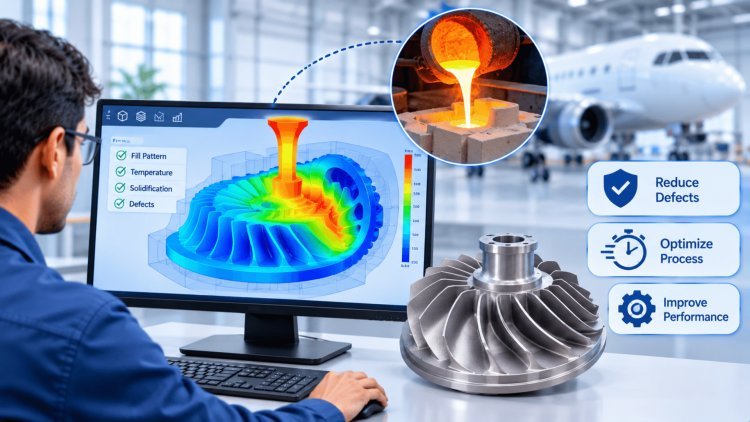
Producing defect-free titanium castings for aerospace demands more than metallurgical intuition — it requires solving the complete, coupled set of partial differential equations governing fluid dynamics, heat transfer, solidification kinetics, and solid-state stress evolution simultaneously. Modern casting simulation platforms purpose-built for this challenge deploy multiple specialized solvers, each targeting a distinct physical domain, then orchestrate them in tightly coupled iterations that mirror reality with extraordinary fidelity.
The Eulerian fluid dynamics solver tracks molten titanium as a continuum, resolving velocity fields, pressure gradients, and free-surface topology throughout the fill sequence.
PoligonSoft solvers implement advanced Volume-of-Fluid (VOF) methods to track the metal-gas interface with sub-cell accuracy, ensuring that even the most intricate internal channels and thin-walled sections are faithfully modeled.
The Fourier-based thermal solver manages the complete heat extraction problem: radiation from molten titanium to shell mold surfaces, conduction through the ceramic investment, and convective boundary conditions imposed by the casting environment.
Precise modeling of investment casting cycles — including mold preheat, pouring temperature, and cooling atmosphere — ensures integrity in thin-walled, large-diameter titanium casings that characterize modern turbine architectures.
Full Navier-Stokes resolution of melt flow including viscosity changes as solidification begins, capturing the mushy zone transition that governs feeding efficiency and final density.
Real-time monitoring of liquidus and solidus front advancement through complex geometry, including latent heat release modeling that directly influences local solidification sequence and hot spot formation.
Thermo-mechanical coupling computes residual stress fields and dimensional distortion during cooling, enabling engineers to precompensate mold geometry and ensure postcast dimensions meet tight aerospace tolerances without corrective machining.
Mastering the Physics of Flight
Specialized Solvers for Aerospace Casting
Euler Solver
Defect Prediction
Fourier Thermal Solver
Thermal Analysis
Beyond Flow and Temperature
Fluid Dynamics Modeling
Phase Transformation Tracking
Residual Stress & Distortion
Coupled Physics in Titanium Casting Simulation
The concept of virtual qualification fundamentally reframes the economics and timeline of aerospace component development. Traditionally, foundries relied on successive physical casting trials—pour, inspect, scrap, adjust, repeat—an iterative cycle that consumed weeks of calendar time, significant material cost, and enormous engineering effort with each iteration.
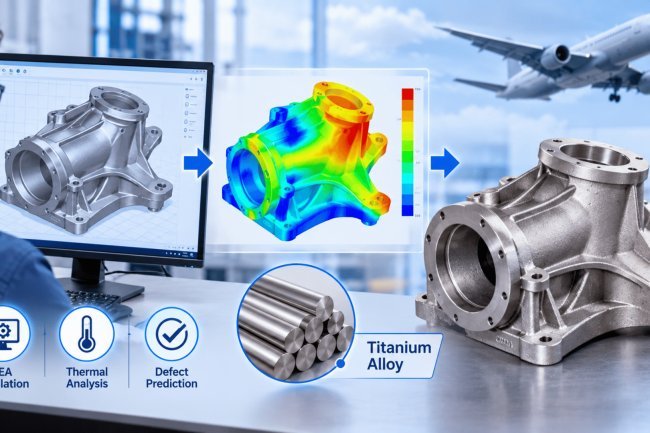
Import CAD geometry, define alloy properties, shell mold parameters, and boundary conditions. Run coupled fluid-thermal-stress simulation to capture complete fill and solidification behavior.
Identify shrinkage zones, cold shuts, porosity clusters, and hot tears in the virtual model. Iterate on gating system design, riser placement, and mold temperature to eliminate predicted defects.
Produce a single optimized physical casting with high confidence. Submit for NDT, dimensional inspection, and metallurgical evaluation—targeting first-article approval without rework cycles.
Rather than investing in full software licensing and internal expertise upfront, foundries can commission targeted simulation studies for specific components, receiving actionable process recommendations that translate directly to yield improvement and scrap reduction.
Virtual Qualification:
The Competitive EdgeCapture complete fill and solidification behavior.
Eliminate predicted defects virtually.
Target first-article approval.
linking design intent to process parameters
to final inspection results.
Advanced centrifugal casting simulation enables production of superior lightweight titanium structures — large-diameter rings, cylindrical casings, and rotational components — that benefit from centrifugal pressure to drive metal into thin-walled sections and suppress porosity.
Simulation captures the rotating reference frame fluid dynamics and solidification kinetics unique to this process, allowing engineers to optimize rotational speed, tilt angle, and pour rate before committing to expensive tooling.
Consistent application of virtual casting processes reduces carbon footprints across the aerospace value chain.
By enabling components optimized for minimum mass while meeting structural requirements, simulation directly contributes to fuel burn reduction over aircraft service life.
Simultaneously, eliminating physical scrap trials reduces raw titanium consumption, hazardous waste from failed castings, and the energy intensity of repeated melt-and-pour cycles — measurable environmental benefits that align with industry sustainability commitments.
Embrace simulation-driven design to ensure your next project is production-ready and flight-certified from the first physical pour.
The digital qualification pathway — simulation, virtual design review, optimized physical trial, first-article inspection — creates an auditable chain of evidence that satisfies the most demanding aerospace quality systems, including NADCAP special process accreditation and AS9100 Rev D requirements.
Typical reduction in casting scrap rates achieved when simulation is introduced into titanium investment casting workflows for aerospace components.
Acceleration of first-article qualification timelines compared to traditional empirical trial-and-error process development approaches.
Potential structural weight reduction enabled by optimized titanium geometries that simulation makes manufacturable with confidence.
The foundries and OEMs that invest in simulation capability today are building an enduring competitive moat.
As certification bodies increasingly expect computational evidence of process robustness in design submissions, simulation transitions from competitive advantage to entry requirement.
The question for aerospace manufacturers is no longer whether to adopt casting simulation — it is how quickly they can embed it at the center of their development and production workflows to remain qualified suppliers for the next generation of flight-critical programs.
The Future of Aerospace Integrity
Centrifugal Casting Simulation
Sustainability Through Optimized Design
Production-Ready & Flight-Certified
What's Your Reaction?