Automated Simulation: The New Era of Casting Design
The manufacturing industry is undergoing a profound transformation. For decades, casting design relied on the intuition of seasoned engineers — skilled professionals who estimated gating systems, risering configurations, and process parameters through experience alone. Today, automated simulation workflows are rewriting the rules. By combining advanced numerical solvers with intelligent optimization algorithms, foundries can now predict defects, maximize yield, and eliminate costly physical trials before a single gram of metal is poured. This presentation explores how automated simulation is reshaping repetitive casting design from the ground up.
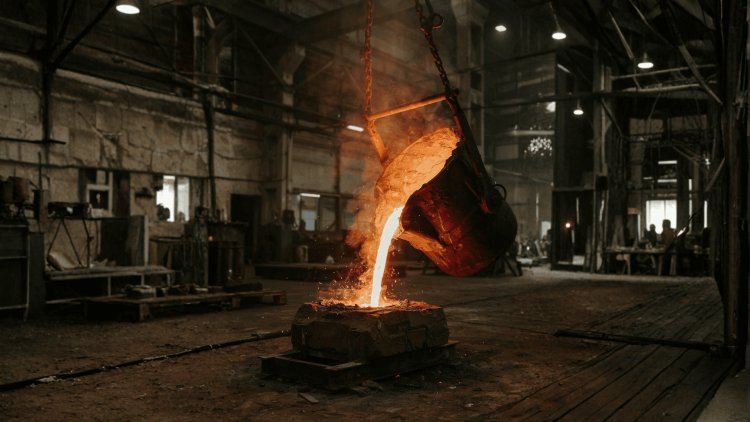
The Legacy Burden:
Manual Trial and Error
For generations, casting development depended almost entirely on experience, intuition, and physical experimentation. While this approach produced many successful castings, it also introduced significant inefficiencies, long development cycles, and unnecessary risk. Understanding these historical limitations highlights why simulation-driven engineering has become such a transformative force across the foundry industry.
Three Major Limitations of the Traditional Approach
Reliance on Expert Intuition
Traditional casting development placed enormous responsibility on experienced foundry engineers. Decisions regarding gate layout, riser sizing, feeding strategy, and process setup were typically based on years of accumulated practical knowledge rather than predictive analysis.
While expert judgment was invaluable, every design remained partly dependent on educated guesswork until metal was actually poured. This created vulnerability whenever expertise was unavailable or when new projects fell outside familiar manufacturing experience.
Critical Decisions Dependent on Experience
A Dangerous Single Point of Failure
The High Cost of Late-Stage Iteration
When an initial casting design failed to perform as expected, improvements could only be made after physical prototypes had already consumed materials, labor, machine capacity, and valuable project time.
Redesigning tooling, modifying risers, adjusting gating systems, and repeating production trials generated cascading delays that accumulated rapidly throughout the development process.
The Compounding Cost Cycle
What Each Iteration Consumed
Hidden Defects Revealed Too Late
Perhaps the greatest weakness of traditional development was the inability to observe internal defects before production. Critical problems often remained hidden until inspection, machining, assembly, or even customer use.
Without predictive analysis, engineers had no reliable mechanism for identifying defect-prone regions during design and tooling development, leaving quality outcomes dependent on physical discovery instead of proactive prevention.
Common Defects Discovered Too Late
The Real Cost of Late Discovery
The End of Reactive Engineering
Modern simulation tools eliminate much of the uncertainty that once defined casting development, shifting defect identification and design optimization earlier in the engineering process.
To Predictive Engineering
The transition from manual trial-and-error to simulation-driven development represents one of the most important technological shifts in the history of foundry engineering.
The Traditional Problem
Was Never Lack Of Skill.
It Was Lack Of Visibility.
Legacy casting development depended heavily on expert intuition, repeated physical experimentation, and delayed feedback from production trials. While experienced engineers often achieved successful outcomes, the process remained slow, expensive, and vulnerable to hidden defects that surfaced only after valuable resources had been consumed. Modern simulation changes this dynamic by providing visibility into mold filling, solidification behavior, and defect formation before production begins. What once required multiple trial pours and costly iterations can now be evaluated digitally, transforming casting development from a reactive process into a predictive engineering discipline.
Modern casting simulation replaces reactive guesswork with proactive, physics-based analysis. By digitally modeling the entire casting process before any physical tooling is committed, engineers can identify and eliminate defects at the earliest — and least costly — stage of design.
At the heart of today's casting simulation platforms are two foundational numerical approaches that model the critical stages of casting development.
The practical power of simulation lies in its ability to replace conjecture with quantitative evidence. Engineers can visualize evolving isotherms to locate thermal hot spots — regions where solidification lags and shrinkage porosity is most likely to nucleate.
Evolving isotherms identify regions where solidification lags and shrinkage porosity is most likely to nucleate.
Fluid flow animations reveal turbulence, oxide formation, and premature freezing that could lead to misruns or cold shuts.
Instead of relying on post-pour inspection, simulation surfaces potential problems in the digital domain within hours.
Teams can evaluate multiple riser configurations, alloy grades, and pouring temperatures in parallel — something physically impossible with traditional trial-and-error casting.
Model filling and solidification digitally.
Locate thermal and flow-related risks.
Select the strongest design before production.
Rather than relying on post-pour inspection to discover these problems, simulation surfaces them in the digital domain within hours. Teams can evaluate multiple riser configurations, alloy grades, and pouring temperatures in parallel. The strategic advantage is enormous: decisions once made on intuition are now made on data.
The Simulation Shift:
Predictive EngineeringTwo Solvers.
One Complete Process Picture.Decisions Once Made by Intuition
Are Now Made on DataWhat Simulation Reveals
Test More Possibilities
Before ProductionFrom Trial-and-Error
to Evidence-Based DesignPredict → Analyze → Optimize
Evidence Replaces
Guesswork.
Running a simulation is powerful. Running hundreds of simulations autonomously and mathematically converging on the best possible design is transformative. Automated optimization elevates casting development beyond iterative analysis and into true engineering discovery, identifying high-performance solutions that would be extraordinarily difficult to uncover through manual experimentation alone.
Optimization algorithms require a precise mathematical definition of success. In casting applications, objective functions typically seek to maximize casting yield and internal density while simultaneously minimizing riser mass, since riser metal contributes no direct value and must ultimately be remelted and recycled.
These competing objectives are combined into a weighted performance score that guides the optimizer toward the best achievable design across the entire parameter space while respecting engineering constraints.
The optimizer autonomously manipulates critical process and geometry variables across a multidimensional design space. By evaluating thousands of parameter combinations, it discovers relationships and high-performance solutions that would be difficult for engineers to identify through manual iteration.
Optimization Power:
Finding the Ideal DesignThree Drivers of Optimization Success
The Objective Function: What "Best" Means
Common Optimization Goals
Hard Constraints Protect Manufacturability
Design Variables Under Computer Control
Autonomous Optimization Workflow
The trajectory of casting simulation is unmistakable: the industry is moving decisively from manual, expert-dependent workflows toward fully autonomous, analysis-driven design optimization. This is not a distant vision — it is happening now, and the competitive implications for foundries that embrace or ignore it are profound.
The traditional model — where design quality was gated by the availability and experience of individual casting engineers — is giving way to a systematic, reproducible process that any trained analyst can execute.
Automation encodes best-practice rules, material databases, and optimization logic into the workflow itself, democratizing access to high-quality casting design and reducing organizational risk from talent attrition.
Calculation speed — once the primary barrier to widespread simulation adoption — is being systematically addressed through multiple complementary strategies.
As simulation tools become more accessible and automated optimization becomes standard practice, the competitive landscape for foundries is shifting rapidly.
The shift toward autonomous casting engineering is already underway. Foundries that embed expertise into automated workflows, accelerate computation, and optimize designs digitally will be positioned to compete on quality, speed, efficiency, and cost.
The Future is
AutonomousAnalysis-Driven Design
Faster Cycles Through
Intelligent ComputationFrom Days to Continuous Analysis
A Competitive Necessity, Not an Option
Two Paths for the Modern Foundry
The Autonomous Foundry
Starts with Simulation
What's Your Reaction?