Modeling Cycle-to-Cycle Variation in Foundry Processes
How simulation, digital twins, and AI are transforming inconsistency into precision — reshaping the future of modern metal casting from the ground up.
CHAPTER 1
The Era of Intuition and Trial
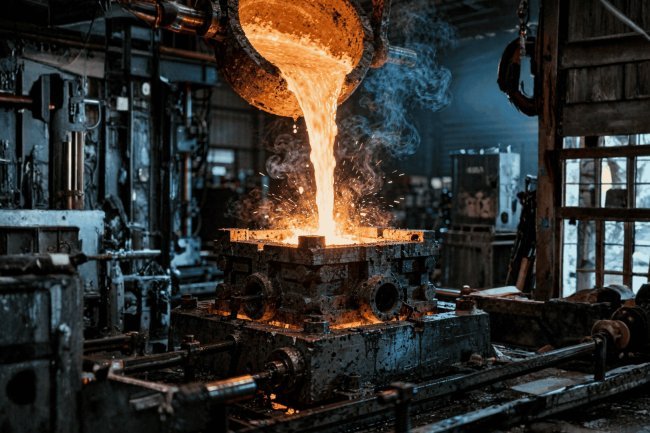
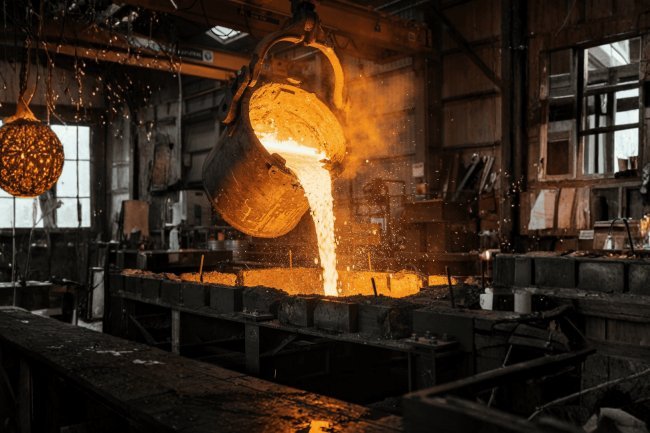
For centuries, the foundry floor was governed not by data dashboards or simulation software, but by the accumulated wisdom of master craftsmen — seasoned workers who could read the shimmer of molten metal and adjust a pour by feel alone. This era of hand-crafted intuition, while producing remarkable results through skilled artisanship, introduced deep and often unpredictable levels of process variability into every production run.
Cycle-to-cycle variation was not merely accepted — it was expected. Every casting was subtly different from the last. Shrinkage porosity, surface defects, and dimensional inconsistencies were common realities that operators managed reactively rather than proactively. The "best production route" was frequently the fastest guess, a rapid trial-and-error approach born out of production pressure rather than engineering rigor.
The Core Problem
Without quantitative models, identifying the root cause of a bad casting batch was nearly impossible.
Operators could observe outcomes but rarely trace variation back to its precise origin — whether in mold temperature, metal chemistry, or cooling rate timing.
Why This Still Matters
Even today, many mid-tier foundries still operate with legacy intuition-based workflows.
Understanding the limitations of this era is essential to appreciating why simulation-driven approaches represent such a paradigm shift.
Foundry Evolution traces this critical transition from traditional craftsmanship to the smart, simulation-driven foundry of the 21st century — a journey that is as much cultural as it is technological.
Manual Mold Inspection
Visual checks and hand tools were the primary quality gates — slow, subjective, and prone to human error at scale.
Empirical Recipes
Alloy compositions and pour temperatures were documented as rough guides, often varying significantly between shifts and operators.
Reactive Rework
Defective castings were identified only after the fact, driving up scrap rates and eroding profitability with every production cycle.
For centuries, the foundry floor was governed not by data dashboards or simulation software, but by the accumulated wisdom of master craftsmen — seasoned workers who could read the shimmer of molten metal and adjust a pour by feel alone. This era of hand-crafted intuition, while producing remarkable results through skilled artisanship, introduced deep and often unpredictable levels of process variability into every production run.
Discrete-event simulation (DES) tools emerged as the foundry engineer's microscope — capable of modeling the precise timing and sequencing of every machine, operator, and material flow interaction within a production system.
By constructing virtual replicas of foundry workflows, engineers could uncover hidden dependencies that physical observation alone could never reveal: cascading queue buildups, equipment failure propagation, and bottleneck migration under varying demand scenarios.
Simulation exposed causes that were difficult to identify through physical observation alone.
These models revealed that many assumed "random" defects were in fact deterministic outcomes of poorly understood process interactions.
A delay in shake-out cooling, for instance, could alter grain structure in ways that only manifested as rejection failures several steps later in inspection.
Simulation Advantage provides a detailed breakdown of how these models pinpoint the true root causes of first-pass yield degradation.
The transition from observation-based quality control to model-based process optimization marked the foundry industry's first true step toward engineering-driven, repeatable manufacturing excellence.
Discrete-Event Simulation
Virtual Workflow Replicas
Uncovering Hidden Process Interactions
Example: Shake-Out Cooling Delay
Key Discoveries from Early Models
Where discrete-event simulation offered a periodic, offline lens into process behavior, the digital twin represents a permanent, living virtual replica—one that breathes in synchronization with the physical foundry it mirrors. Modern foundries at the frontier of Industry 4.0 now deploy digital twins that continuously ingest real-time data streams from SCADA systems, pyrometers, pressure sensors, and vision inspection units, creating a dynamic model that evolves with every casting cycle.
Digital twins fuse physics-based thermal solvers with live sensor feeds to detect temperature anomalies in mold filling and solidification stages—predicting shrinkage defects before they are locked into the casting geometry.
By training surrogate models on thousands of historical casting cycles, digital twins can forecast the probability of a defect occurring in the next pour based on current parameter drift—enabling pre-emptive corrections to die temperature, injection pressure, or cycle timing without halting production.
The most advanced implementations close the loop entirely: the digital twin's recommendations are translated into automated parameter adjustments via PLC commands, reducing human latency in the correction cycle and maintaining consistency across multi-shift, multi-operator production environments.
Digital Twin Technology provides an in-depth exploration of how these systems are deployed in continuous casting environments and the measurable gains they deliver in yield, cycle time, and energy efficiency.
The Rise of the Digital Twin
Alerts in seconds, not shift reports.
Forecast the next pour, correct pre-emptively.
PLC commands, no human latency.
moving quality from inspect-and-reject
to predict-and-prevent.
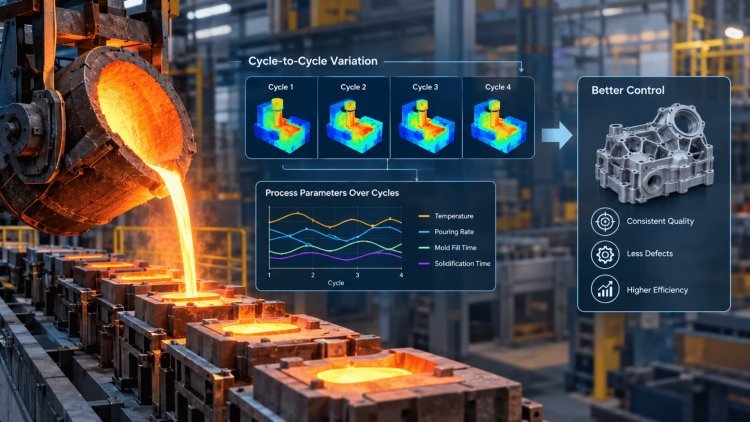
The journey from hand-poured intuition to physics-driven autonomy represents one of the most profound engineering transformations in modern manufacturing history. Today, by modeling every variable in the casting process — from the fluid dynamics of mold filling and the crystallization kinetics of solidification to residual stress states and distortion profiles — foundries are achieving levels of cycle-to-cycle consistency that were simply unimaginable a generation ago.
Three forces have converged to make autonomous foundry manufacturing a present-day reality rather than a future aspiration: AI and machine learning models trained on vast casting datasets, physics-based solvers that simulate metallurgical phenomena with high fidelity, and decades of accumulated historical process data now made accessible through modern data infrastructure.
Together, these capabilities empower engineers and operators to transition from reactive troubleshooting — firefighting defects after they appear — to predictive and ultimately autonomous manufacturing, where the system self-corrects before variation ever becomes a defect.
Scrap Rate Reduction
Foundries deploying full digital twin and AI pipelines report first-pass yield improvements of 10–30%, directly translating to lower material costs and higher throughput without capital investment in new equipment.
Operator Empowerment
Rather than replacing skilled foundry workers, autonomous systems elevate them — freeing human expertise for higher-order decision-making while routine parameter optimization is handled by intelligent models.
Sustainability Gains
More consistent processes consume less energy per good part produced, and reduced scrap means lower raw material demand — aligning the economic and environmental imperatives of modern manufacturing strategy.
"The foundry of the future does not merely react to variation — it anticipates, models, and eliminates it before the first drop of metal is poured."
The modeling of cycle-to-cycle variation is no longer an academic exercise confined to research journals. It is the operational backbone of the competitive, high-quality foundry — and the clearest path from inconsistency to excellence in metal casting manufacturing.
The Autonomous Future of Foundry Manufacturing
The Convergence Driving Change
What This Means in Practice
What's Your Reaction?