Reynolds-Averaged Flow Models for Casting Applications
A deep-dive into how Reynolds-Averaged Navier–Stokes (RANS) and Unsteady RANS (URANS) turbulence models are transforming the science of metal casting — from gating design to defect prevention, and from mean-flow prediction to time-resolved solidification analysis.
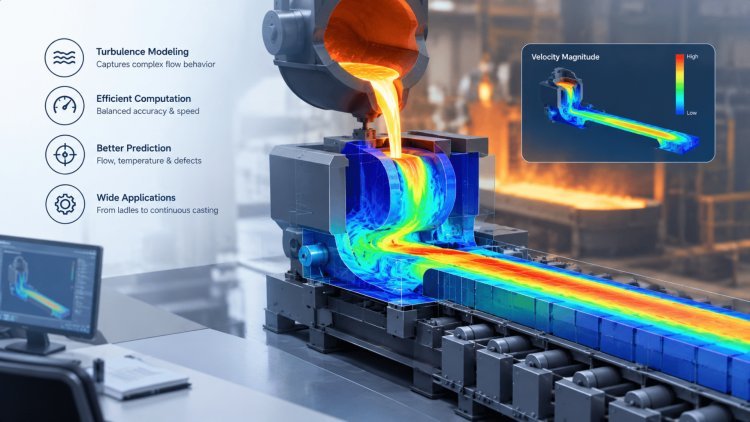
Why "Averaged" Flow Modeling Wins in Casting
In metal casting, the behavior of molten metal as it travels through gates, runners, and into the mold cavity is not merely a fluid dynamics problem — it is the central determinant of part quality. Turbulence, oxidation, and air entrapment during filling are the root causes of the most costly and frustrating defects in foundry production. Reynolds-averaged approaches offer a computationally tractable yet physically meaningful framework for predicting and controlling these phenomena at production scale.
The Core Problem: Turbulence in the Runner
Foundry flow through gates and runners must be carefully controlled to limit turbulence intensity.
When flow becomes chaotic, it entrains air, generates oxide films, and erodes mold surfaces — all of which translate directly into scrap and rework costs.
The Reynolds number (Re) is the primary dimensionless parameter used to characterize the flow regime, and keeping Re low in the runner system is a foundational design objective for any gating engineer.
Design Decisions Hinge on Flow Regime Targets
Gating system design — the ratios between sprue, runner, and ingate cross-sections — is fundamentally a flow-regime engineering exercise.
A pressurized gating system (where the ingate is the smallest cross-section) maintains backpressure to keep runners full, suppressing air aspiration.
An unpressurized system prioritizes velocity reduction before metal enters the cavity.
RANS-based simulation allows engineers to evaluate these tradeoffs quantitatively before any tooling is cut, predicting velocity profiles, pressure distributions, and turbulence kinetic energy fields throughout the gating geometry.
Explore gating design principles and simulation-guided optimization at PoligonCast Engineering and learn how integrated solvers handle the full flow pathway.
Turbulence Control
Minimize Re in runners to suppress chaotic flow, oxide entrainment, and mold erosion during filling.
Oxidation Risk Reduction
Averaged flow models identify high-velocity free-surface zones where melt oxidizes most rapidly.
Air Entrapment Prevention
Velocity and pressure fields from RANS reveal aspiration-prone regions in the gating architecture.
Quantitative Gating Design
Replace rule-of-thumb gating ratios with simulation-validated cross-section decisions for every new casting.
In metal casting, the behavior of molten metal as it travels through gates, runners, and into the mold cavity is not merely a fluid dynamics problem — it is the central determinant of part quality. Turbulence, oxidation, and air entrapment during filling are the root causes of the most costly and frustrating defects in foundry production. Reynolds-averaged approaches offer a computationally tractable yet physically meaningful framework for predicting and controlling these phenomena at production scale.
The evolution from steady-state RANS to time-resolved URANS represents one of the most practically significant advances in casting simulation methodology. Understanding both approaches—their assumptions, their strengths, and the conditions under which each is appropriate—is essential for any engineer seeking to extract maximum value from computational fluid dynamics in a foundry context.
URANS introduces temporal resolution to reveal organized flow changes that a steady-state solution cannot represent.
Predicts mean velocity, pressure distribution, and bulk turbulence intensity.
Captures filling-front oscillations, metal-jet collapse, and transient melt-surface behavior.
Resolves individual turbulent eddies, with higher computational requirements.
Research into URANS stability and accuracy has consistently shown that turbulence-model selection and the order of numerical discretization are primary drivers of solution quality.
Higher-order spatial and temporal discretization schemes significantly reduce numerical diffusion, preserving sharp gradients in velocity and temperature that lower-order schemes smear out.
For URANS, the choice between first- and second-order time integration can determine whether the simulation captures physically meaningful oscillatory behavior or damps it into a spurious steady state.
Critically, well-configured URANS has been demonstrated to match Large Eddy Simulation for qualitative, temporally resolved behavior in casting-relevant geometries—including filling-front dynamics, gate-jet behavior, and early-solidification flow patterns.
This makes URANS the pragmatic choice for production-scale casting simulation where LES mesh and timestep requirements would make routine analysis economically infeasible.
URANS can deliver LES-quality qualitative insight at RANS-level computational cost when discretization is carefully configured—a decisive advantage for foundry simulation workflows.
Steady mean-flow, eddy-viscosity closure
Time-resolved unsteadiness, organized transients
Resolves turbulent eddies, highest fidelity
For a deeper look at how simulation models are structured for casting workflows, see the PoligonSoft Simulation User Guide.
RANS to URANS: From Mean Flow to Time-Resolved Reality
From Mean Flow to Transient Behavior
Mean Velocity Profiles
Time-Resolved Dynamics
Turbulent Eddy Resolution
Model Choice and Discretization Matter
Turbulence-Model Selection
Higher-Order Discretization
Time Integration
URANS for Production-Scale Casting Simulation
Key Principle
Comparing the Three Simulation Approaches
Steady Mean Flow
Time-Resolved Flow
Turbulent Eddy Resolution
The true value of RANS and URANS modeling in casting is not the flow field itself—it is the chain of coupled predictions that flow data enables. Velocity and temperature fields from the fluid solver feed directly into solidification, porosity, and mechanical stress modules, creating an integrated digital thread from liquid metal to finished part quality.
RANS/URANS computes time-evolving velocity and temperature fields throughout the mold cavity, revealing whether metal reaches all thin sections before freezing (misrun risk), whether filling is smooth or turbulent (oxide/entrainment risk), and whether the filling sequence promotes or suppresses air pocket formation.
The thermal fields computed by the flow solver define the local cooling rate and solidification sequence throughout the casting. These are the direct inputs to solidification analysis: where the last liquid pools form (hotspots), how the solidification front progresses, and whether feeding metal can reach isolated liquid regions before they freeze off.
Non-uniform cooling generates thermal gradients that translate directly into residual stress, distortion, and cracking risk. RANS/URANS thermal outputs feed into structural mechanics solvers that compute the stress and strain history of the solidifying casting.
RANS/URANS provides the fluid-side foundation for this stack. The coupling between solvers—passing velocity fields to thermal models, thermal fields to stress models—is what transforms a flow simulation into a comprehensive defect-prevention tool.
For many casting applications, time-averaged RANS predictions—mean velocity, mean temperature, bulk turbulence intensity—provide sufficient information to make confident design decisions about gating and risering. For applications where filling dynamics are inherently unsteady (thin-wall castings, complex geometries with multiple gates, or alloys with strong surface tension effects), URANS transient predictions capture the filling-front behavior that time-averaged models miss.
What RANS/URANS Predicts Inside
the Mold — and Why It's ActionableMisrun, cold shut, air pocket prediction.
Hotspots, macroporosity, microporosity.
Hot tears, cold cracks, warpage compensation.
flow → thermal → stress—creating an integrated digital thread
from liquid metal to finished part quality.
Reynolds-averaged and unsteady Reynolds-averaged flow modeling represent the most practical and impactful class of turbulence simulation tools available for production casting engineering today. When properly configured and integrated into a multi-physics workflow, they transform casting development from an empirical trial-and-error process into a predictive, data-driven engineering discipline — one where defects are identified and eliminated in the digital model before the first metal is poured.
RANS and URANS are not academic exercises — they are production engineering tools that pay for themselves in reduced scrap, shorter development cycles, and greater first-article success rates.
Every casting geometry, alloy, and process combination has a unique flow behavior that determines its defect signature. Simulation makes that behavior visible before metal is poured, giving engineers the ability to intervene at the design stage rather than at the scrap bin.
To go deeper into integrated casting simulation — from flow through solidification to residual stress — explore the full POLIGONSOFT module ecosystem and the casting engineering resources at PoligonCast Engineering and the PoligonSoft Simulation User Guide.
Conclusion: A Foundry Workflow That Uses RANS/URANS to Reduce Defects
The Strategic Imperative
Key Takeaways
What's Your Reaction?