Visualizing Transient Metal Flow in Casting Simulation
From costly physical trials to real-time digital precision — how computational fluid dynamics and thermal modeling are transforming the modern foundry into a virtual testing environment where every pour can be predicted, optimized, and perfected before a single drop of metal is cast.
The Era of Shop Floor
Trial and Error
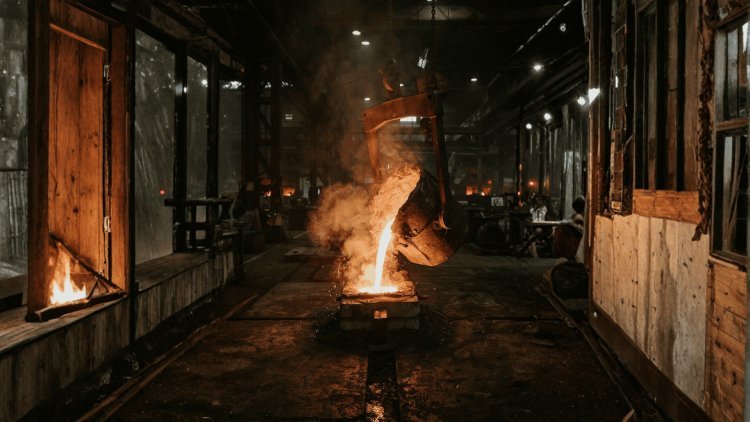
For much of the twentieth century, casting engineering was guided as much by practical experience as by scientific analysis. Foundry engineers depended heavily on intuition, shop-floor knowledge, and repeated physical experimentation to refine casting designs. Every new component required multiple production trials, creating long development cycles, substantial material waste, and significant uncertainty regarding final quality outcomes.
How Casting Development Traditionally Worked
Casting as an Empirical Art
Foundries historically depended on decades of accumulated practical experience, shop-floor intuition, and metallurgical expertise. Design decisions were frequently based on proven rules of thumb rather than predictive analysis, making casting success heavily dependent on individual expertise and organizational knowledge.
Common Challenges of the Era
The Hidden Defect Problem
One of the greatest limitations of physical trial-and-error development was the inability to detect critical internal defects until after casting and cooling were complete. In many cases, flaws remained hidden until machining or destructive testing exposed the internal structure.
When Defects Were Finally Discovered
The first decisive breakthrough came from applying numerical heat transfer methods to solidification—replacing physical prototypes with a structured grid of computational nodes.
At every time step, the temperature at each node is updated based on the thermal properties of the surrounding material—liquid metal, solidifying alloy, sand mold, or metallic chill. This iterative calculation tracks the thermal history of every point in the casting domain, revealing how heat flows, where it accumulates, and how solidification progresses.
Engineers could import or construct 3D geometries and automatically discretize them into a volumetric mesh—a network of nodes, each representing a small cube of material.
Assign thermal conductivity, specific heat, latent heat, and density to each region; define boundary conditions, pouring temperature, and alloy composition.
By analyzing the solidification time field and identifying regions where liquid metal becomes thermally isolated from the feed supply, early thermal models could flag potential shrinkage porosity with striking accuracy. Engineers could then redesign gating systems, adjust riser placement, or modify section thickness—all in the virtual domain.
The Foundation:
Thermal-Volumetric ModelingReplace differential equations with discrete approximations.
Democratizing thermal simulation for foundries.
Flag defects before the first pour.
into a predictable, engineerable process.
Engineers moved beyond thermal-only models to transient fluid simulation, tracking the free surface of molten metal as it advances, deforms, and traps gas pockets. This dynamic visualization revealed defect mechanisms invisible in static heat maps.
Tools like FLOW-3D CAST and STAR-Cast solve Navier-Stokes equations alongside energy equations, tightly coupling fluid dynamics and heat transfer. This integration captures velocity fields and thermal gradients throughout filling and solidification.
By visualizing these phenomena, engineers can redesign filling systems with precision and confidence.
The Rise of Transient Fluid Dynamics
From Static Heat Maps to Fluid Front Tracking
Modern Platforms: FLOW-3D CAST & STAR-Cast
Multiphase Modeling & Complex Phenomena
Modern casting simulation has progressed from simple mold-filling visualization into a comprehensive digital representation of the casting process. Advances in numerical methods, turbulence modeling, solidification physics, and computational performance now allow engineers to resolve phenomena spanning multiple length scales, from sub-millimeter turbulent structures to entire industrial casting systems. These capabilities enable unprecedented accuracy in quality prediction, process optimization, and defect prevention.
Large Eddy Simulation represents the highest practical level of turbulence modeling currently employed in casting applications. Instead of statistically averaging all turbulent behavior, LES directly resolves the large energy-carrying eddies that dominate industrial flow structures while modeling only the smallest turbulence scales.
Models all turbulent scales and provides an averaged flow solution.
Directly resolves major turbulent structures and transient flow behavior.
High-value castings used in aerospace, energy, and medical industries often involve complex mold motion and force environments. Advanced simulation solutions now explicitly model rotating molds, changing gravity directions, and pressure-assisted filling dynamics.
High-Fidelity
Simulation in PracticeThree Pillars of High-Fidelity Simulation
Large Eddy Simulation (LES)
LES vs. Traditional RANS Modeling
Statistical Averaging
Explicit Eddy Resolution
Thin Slab Continuous Casting Applications
Why LES Matters
Centrifugal, Tilt-Pour & Rotational Casting
Engineering Parameters Optimized Virtually
Phase Changes & Conjugate Heat Transfer
Decades of numerical, hardware, and software advances have produced a virtual foundry—where every aspect of the casting process can be designed, tested, and optimized before metal is poured.
Animated renderings let engineers develop an intuitive understanding of how design decisions propagate into casting behavior. Gating and risering systems can be refined with microscopic accuracy—adjusting ingate cross-sections by fractions of a millimeter, tuning runner lengths for optimal velocity control, and calculating riser volumes precisely to match volumetric shrinkage.
The design–test–revise cycle shrinks from weeks of physical iteration to hours or days of computational analysis, dramatically reducing time-to-market for new casting designs.
Scrap, oversized risers, and test pours are minimized because engineers arrive at the optimal process design computationally—especially valuable for high-value alloys such as nickel superalloys, titanium, and tool steels.
Where once the behavior of metal inside a sealed mold cavity was entirely hidden—knowable only through destructive examination—today's transient simulation renders it fully visible. Engineers can watch the metal solidify in animated clarity: observing turbulent jet dispersion, tracking when a hot spot becomes thermally isolated, or identifying the precise instant a gas pocket becomes entrapped.
The Modern Advantage:
Digital PrecisionSee the process, tune the design.
Compress the cycle, cut the waste.
Inference → Observation.
enables unprecedented quality, efficiency, and precision in casting design.
What's Your Reaction?