Contact Heat Transfer at the Metal–Mold Interface
Understanding the physics at the metal–mold interface during solidification is central to producing high-quality aluminum castings. This presentation explores how contact pressure, gap nucleation, inverse segregation, and mold topography interact to determine surface defect formation — and how engineering these parameters can yield defect-resistant casting processes.
The Stakes:
Why Early Interface Physics
Dominates Defects
The quality of an aluminum ingot is often decided within the first few seconds of solidification — long before the bulk of the metal has frozen. At this critical early stage, the physics of the metal–mold interface sets the trajectory for everything that follows. Non-uniform heat extraction, driven by imperfect contact and air-gap formation, is one of the primary root causes of surface defects that plague industrial casting operations.
How Early Interface Physics Propagates
The Industrial Problem
Aluminum ingots routinely exhibit surface defects — rippling, cold shuts, segregation banding, and subsurface porosity — that originate from spatially uneven heat removal during the earliest moments of solidification.
These defects are not superficial; they penetrate deep enough into the ingot that the surface layer must be mechanically removed before downstream rolling or forging operations can begin.
Four Defects, One Interface Origin
or Milling
The defective outer layer must be mechanically removed before downstream rolling or forging operations can begin.
Removed from the Ingot Surface
The Cost Cascade Begins at the Interface
At industrial scale, scalping and milling represent significant yield loss, increased energy consumption, and additional processing cost — all tracing back to interface physics that occurred in the first few seconds of casting.
The Engineering Goal
The overarching objective of research in this area is to reduce scalp depth by developing predictive models and design guidelines that give engineers control over early-stage interface behavior.
Five Phenomena Must Be Controlled Together
None of These Phenomena Acts Alone
By Eliminating Defects at Their Origin
Predictive interface models and evidence-based mold design guidelines shift the engineering objective away from removing defective material after casting and toward preventing the defective layer from developing in the first place.
The First Seconds
Can Determine the Quality
of the Entire Ingot.
Early metal–mold interface physics has a disproportionate influence on aluminum ingot quality because initial contact conditions establish the heat-transfer, stress, gap-growth, and solute-transport environment from which the solidified shell develops. Spatially uneven heat removal can generate rippling, cold shuts, segregation banding, and subsurface porosity deep enough to require 5–15 mm or more of scalping or milling before rolling or forging. At industrial scale, that remediation translates directly into yield loss, increased energy consumption, and additional processing cost. The engineering objective is therefore to predict and control thermal contact resistance, air-gap nucleation and growth, thermo-mechanical stress, near-surface solute redistribution, and mold surface geometry simultaneously. Mastering that coupled interface behavior provides the path to reducing scalp depth and creating a more defect-resistant casting process at the source.
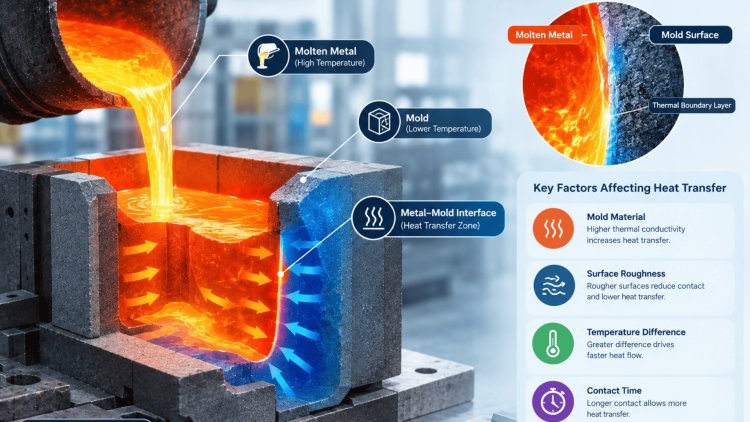
Before any gap forms, heat flow across the metal–mold interface is governed by the intimate contact between the two surfaces. The thermal resistance in this regime depends on how well the surfaces conform to each other—a function of contact pressure, surface roughness, and the mechanical properties of both materials.
Thermal resistance is set by contact conditions and contact pressure. Higher pressure improves conformity between the metal and mold surfaces, reducing the effective thermal resistance and increasing heat flux.
As the solid shell contracts due to thermal shrinkage, and the metallostatic pressure in the liquid core diminishes, the contact pressure at the interface eventually falls to zero. This is the moment of gap nucleation—a critical transition that fundamentally changes the heat transfer mode.
Once a gap exists, thermal resistance is dominated by gap size. The gas trapped in the gap (typically air) has very low thermal conductivity (~0.025 W/m·K), making even a narrow gap of a few micrometers a significant thermal barrier.
Real mold surfaces are never perfectly flat. Microscale topography—waviness, machining marks, and grain-scale roughness—means that contact pressure varies spatially across the interface. Regions of higher local pressure conduct heat more efficiently, while regions of lower pressure (or early gap formation) extract heat more slowly.
Differential cooling rates across the ingot surface produce differential thermal contraction, which generates thermal stress gradients within the solidifying shell. If these stresses are large enough—particularly near the mushy zone where the alloy has limited ductility—they can cause plastic deformation, warping, or even hot tearing.
The causal chain from uneven contact to distortion and defects underscores why managing interfacial heat flux—through surface finish, contact pressure, and gap control—is central to producing sound castings.
Start Simple:
Contact Pressure and Contact ResistanceContact pressure sets thermal resistance.
Contact pressure → zero → gap forms.
Gap size dominates thermal resistance.
Topography drives spatial non-uniformity.
Differential cooling → stress → defects.
govern thermal resistance; after nucleation, gap geometry dominates
—and the transition between these regimes sets the trajectory for defect formation.
Gap nucleation — the instant at which the solid shell separates from the mold surface and a continuous air gap begins to form — is one of the most consequential events in early solidification.
Capturing this moment accurately in models is essential because it marks the transition between two fundamentally different heat transfer regimes. Once a gap forms, heat extraction slows dramatically, and the conditions that existed at that instant are largely “locked in” as initial conditions for subsequent evolution.
The solidifying shell remains in contact with the mold, allowing stronger heat extraction.
Heat extraction slows dramatically as the continuous insulating gap begins to develop.
The solidifying shell undergoes thermal contraction as it cools, creating a tendency to separate from the mold surface.
As the shell thickens and the free surface drops, the liquid pressure holding the shell against the mold diminishes.
When shell contraction stress exceeds the liquid pressure holding the shell against the mold, contact is lost and a gap nucleates.
A well-studied reference configuration involves a rigid mold with sinusoidal surface topography characterized by amplitude ~1 μm and wavelength ranging from 1–5 mm, with an applied liquid pressure of 8,000 Pa, representative of shallow casting depths.
Gap nucleation time is not merely an academic quantity — it sets the spatial distribution of heat extraction across the interface and is the starting point for all subsequent gap growth, stress evolution, and defect formation.
The “Moment the Gap Is Born”: Gap Nucleation Time
Direct Contact
Air Gap
When Contact Pressure Reaches Zero
Thermal Contraction Pulls Away
Metallostatic Pressure Diminishes
Rigid Mold Topography
What Accelerates — and Delays — Nucleation?
Faster Nucleation
Delayed Nucleation
Four Parameters, One Interface
Nucleation Time Sets the Starting Point
During solidification, contraction flow draws solute-rich liquid toward the surface through the mushy zone. In Al–Cu alloys this creates copper enrichment near the casting surface, altering local freezing behavior and changing how the shell reforms against the mold surface.
When inverse segregation is included, local liquidus temperatures shift and remelting events at mold-surface troughs are predicted more accurately. The resulting air-gap thickness and spatial distribution differ noticeably from models that neglect segregation effects.
As copper concentration increases, segregation becomes stronger and its effect on thermal behavior becomes more pronounced. Models that ignore solute transport increasingly underestimate the influence of composition on interface evolution.
Accurate commercial Al–Cu casting simulation requires full coupling of thermal transport, stress development, solidification kinetics, and solute redistribution. Inverse segregation is not an optional refinement but a core physical mechanism governing gap formation.
Shorter mold-topography wavelengths concentrate stress and accelerate air-gap nucleation.
Higher copper content increases segregation intensity and amplifies gap evolution effects.
Melt superheat influences shell formation timing and the duration of pre-solidification mold contact.
Thermal conductivity directly controls shell growth rate, gap nucleation time, and stress evolution.
Air-gap formation, stress development, heat transfer, and solute redistribution are inseparable phenomena. Accurate prediction of mold-shell interaction in commercial alloys demands a fully coupled thermo-mechanical-solutal simulation framework.
Inverse Segregation Reshapes Gaps & Stresses
The Role of Inverse Segregation
Gap Evolution With Segregation
Why Composition Matters
Modeling Requirement
Key Parameter Sensitivities
Wavelength
Cu Concentration
Superheat
Mold Material
Core Engineering Insight
The culminating insight from this body of research is that mold surface topography is not merely a manufacturing tolerance to be minimized — it is a design variable that can be engineered to control the entire chain of interface physics, from initial contact conditions through gap nucleation, heat extraction uniformity, solidification front shape, and ultimate stress state in the cast product. Choosing the right topography is the key lever for defect prevention.
Modeling results reveal a clear and important relationship: larger wavelengths increase both solidification front unevenness and the equivalent stress experienced by the solidifying shell.
A more uneven solidification front means that different regions of the ingot are at different stages of solidification simultaneously — creating larger temperature gradients and, consequently, larger thermal stress differentials across the shell.
Design Payoff:
Optimum Topography to Reduce
Defects and Hot-Tearing SusceptibilityOne Surface Parameter Influences the Entire Chain
Effect of Wavelength on
Front Unevenness and StressLarger Wavelength → Larger Defect Drivers
Why Larger Wavelengths Raise Risk
What's Your Reaction?