Simulation of Aerospace Hydraulic Components
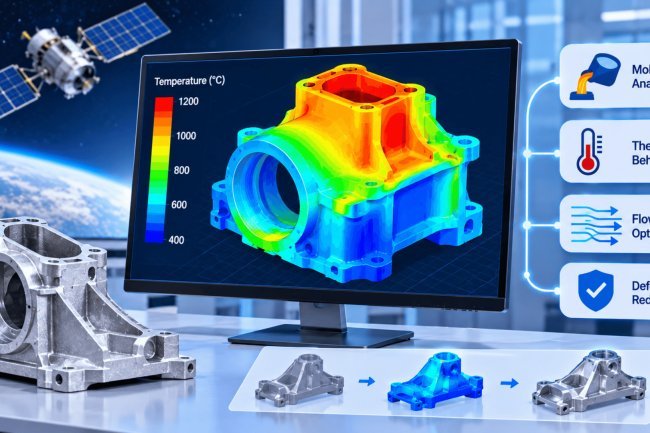
Hydraulic systems are the circulatory network of modern aircraft and spacecraft — controlling everything from landing gear deployment to flight surface actuation. As operational demands intensify and safety margins tighten, the ability to simulate the behavior of these components before a single part is manufactured has become a defining capability in aerospace engineering. This presentation explores how advanced simulation methodologies are transforming the design, qualification, and production of aerospace hydraulic components — turning uncertainty into precision and prototype failures into digital predictions.
The Cost of Traditional
Trial-and-Error
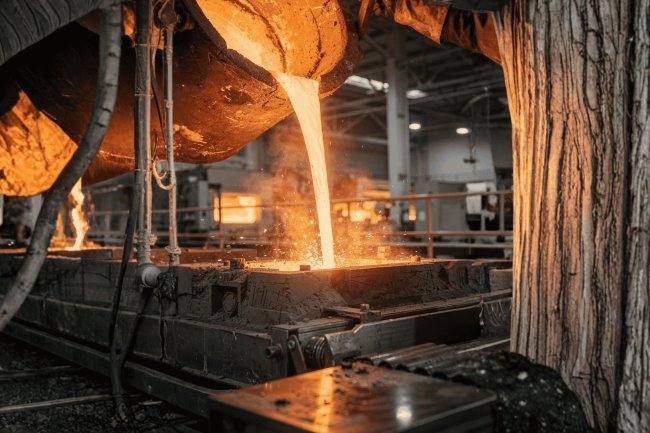
Aerospace hydraulic components operate in some of the most punishing environments imaginable — cycling from cryogenic deep-space temperatures approaching -270°C to the searing heat of jet engine compartments exceeding 1,000°C. Pressure fluctuations, vibration loads, and corrosive fluid interactions compound this challenge. For decades, manufacturers have relied on iterative physical prototyping and destructive testing to validate these components, a methodology that is not only expensive but increasingly inadequate for modern performance requirements.
The Hidden Cost of Physical Trials
When components fail during physical qualification, the downstream consequences cascade quickly.
Tooling must be scrapped, alloy charges are wasted, and lead times stretch by weeks or months.
High scrap rates — sometimes exceeding 30% in complex investment castings — drive up unit costs dramatically.
Worse, inconsistent quality between batches means that a component that passes one qualification round may fail the next, undermining the repeatability that aerospace certification demands.
Bridging Compliance and Capability
Virtual Qualification has emerged as the essential bridge between document compliance and true process capability.
Rather than demonstrating that a component meets a specification after the fact, simulation-driven qualification proves — computationally — that the manufacturing process is inherently capable of producing conforming parts, every time.
This paradigm shift moves quality assurance upstream, transforming it from an inspection activity into a design and process engineering discipline that reduces risk at the source.
Extreme thermal cycling from cryogenic to hypersonic heat regimes
Scrap rates above 30% in complex hydraulic castings
Batch-to-batch inconsistency that undermines certification
Virtual qualification closes the gap between paperwork and performance
Avg. Scrap Rate
Typical scrap in complex aerospace investment castings using traditional trial-and-error methods.
Cryogenic Extreme
Lower thermal bound for space-rated hydraulic components operating in deep-space environments.
Jet Engine Heat
Upper thermal extreme encountered in hydraulic actuator environments near turbine sections.
Aerospace programs can no longer rely on costly trial-and-error qualification cycles. Virtual qualification transforms validation from a reactive testing exercise into a predictive engineering discipline, reducing scrap, accelerating certification, improving repeatability, and ensuring that process capability is proven before production begins.
The most dangerous defects in aerospace hydraulic components are the ones you cannot see. Surface inspection techniques — including visual checks, dye penetrant testing, and even standard X-ray — consistently miss internal discontinuities that become fatigue initiation sites under cyclic hydraulic loading. Subsurface porosity, microshrinkage networks, and cold shut interfaces may remain dormant through qualification only to propagate catastrophically in service. The aviation industry's most sobering incident reports trace structural failures back to defects that were present at the time of manufacture but undetected by conventional inspection.
Gas or shrinkage voids below the surface that act as stress concentrators under pressure cycling.
Interconnected micro-void clusters that reduce fatigue life by 40–60% compared to fully dense material.
Incomplete fusion interfaces caused by premature solidification fronts meeting at incorrect temperatures.
Pockets of trapped gas from turbulent fill that create weakened zones invisible to surface NDT.
Microstructural irregularities that only manifest as cracks after millions of pressure cycles in service.
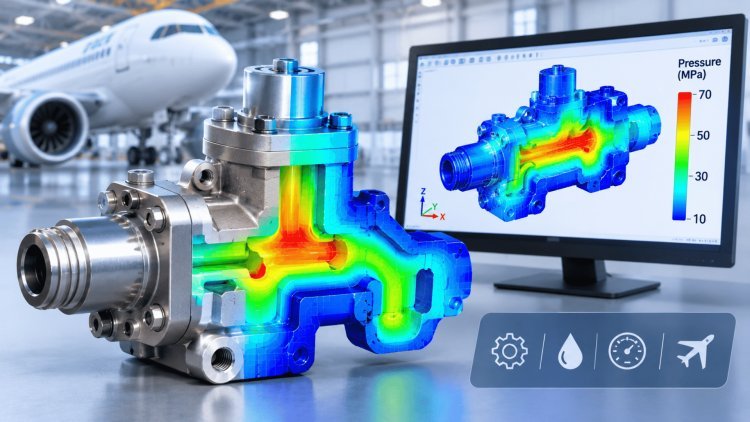
Computational Foundry tools apply Finite Element Method (FEM) and Finite Difference Method (FDM) solvers to numerically integrate the complex coupled fluid dynamics and heat transfer differential equations that govern the casting process. By discretizing the mold geometry into millions of computational cells, these solvers track the advancing solidification front with millisecond precision — predicting exactly where shrinkage porosity will nucleate, where cold metal will fail to fuse, and where turbulent fill will entrap air.
Critically, this analysis is performed before tooling is committed — meaning engineers can redesign gating systems, adjust pouring temperatures, and reposition risers entirely in the digital domain, at a fraction of the cost of physical iteration. The result is a manufacturing process that arrives at the production floor already optimized and defect-characterized.
FEM solvers map solidification contraction in real time, identifying hot spots where insufficient feed metal causes volumetric shrinkage voids before tooling is ever cut.
Turbulent mold filling is simulated with full Navier-Stokes fluid dynamics, revealing air entrapment zones and cold shut risk areas that conventional pour trials cannot locate in advance.
High-resolution thermal gradient mapping across the entire casting envelope ensures uniform solidification rates, preventing the differential cooling that creates residual stress and distortion.
Predicted microstructural outputs from solidification simulation feed directly into fatigue life models, giving engineers a probabilistic component life estimate before the first part is poured.
Solving the Hidden Defect Crisis
What Conventional Inspection Misses
Internal Porosity
Microshrinkage Networks
Cold Shuts
Air Entrapment
Fatigue Initiation Sites
Computational Foundry: The Digital Answer
Simulation Capabilities
Shrinkage Prediction
Fill Analysis
Thermal Mapping
Fatigue Life Estimation
No aerospace component better illustrates the absolute necessity of simulation than the single-crystal turbine blade. These remarkable engineering artifacts operate in an environment that defies intuition: gas temperatures in modern high-bypass turbofan engines exceed the melting point of the nickel superalloys from which the blades are made—sustained only by an intricate network of internal cooling channels that circulate compressor bleed air through the blade's interior.
Conventional polycrystalline alloys contain grain boundaries—interfaces between individual crystals—that are the preferential sites for high-temperature creep deformation and oxidation attack. At turbine operating temperatures, these boundaries become the blade's weakest link.
Predictive modeling of the Bridgman withdrawal process—in which a ceramic shell mold containing the investment-cast blade is slowly withdrawn from a furnace at a precisely controlled rate—allows engineers to digitally optimize the thermal gradient ahead of the solidification front.
The Pinnacle:
Single Crystal Turbine BladesEliminate the blade's weakest link.
Find the narrow acceptable gradient window.
or crystallographic orientation—and the blade fails.
Simulation finds the narrow window
that keeps single-crystal integrity intact.
The aerospace industry's journey toward zero-defect manufacturing is not a distant aspiration — it is an engineering program underway today, powered by simulation-driven workflows that are delivering measurable, documented results across the industry. The convergence of high-fidelity casting simulation, real-time process monitoring, machine learning-augmented defect prediction, and digital twin technology is creating a manufacturing paradigm in which every component arrives at first-article inspection already characterized, with its quality proven in the digital domain before physical production begins.
Manufacturers adopting simulation-driven workflows report 40–70% reductions in first-article defect rates across hydraulic castings
Digital validation reduces the number of physical tooling iterations required before production release by up to 60%
Virtual qualification pathways compress component certification timelines by up to three times compared to traditional test programs
The most profound shift in simulation-driven aerospace manufacturing is conceptual rather than technical: the design phase is no longer just a geometry-definition exercise — it is a risk-elimination engine.
Every simulation run does not merely predict what will happen; it systematically eliminates a failure mode from the production risk register.
By the time a component reaches physical production, its failure modes are known, characterized, and engineered out. Digital validation transforms the manufacturing floor from a site of discovery into a site of confirmation.
The stakes of this technology are ultimately human. Aerospace hydraulic components — actuators, manifolds, pump housings, servo valve bodies — are primary load-bearing, flight-critical parts.
A single undetected internal defect in a landing gear actuator housing or a flight control servo body can cascade into a loss-of-control event.
The transition from tolerance-based quality control to simulation-guaranteed structural integrity represents not just an engineering advancement but a fundamental commitment to keeping every passenger, crew member, and pilot safe.
A Future of Zero-Defect Manufacturing
Defect Reduction
Tooling Iteration Cut
Faster Qualification
Digital Validation as a Risk Engine
The Zero-Defect Imperative
What's Your Reaction?