The Role of Turbulence Modeling in Casting Simulations
In modern foundry engineering, the difference between a flawless casting and a defective one often lies in what happens beneath the surface — literally. Turbulence modeling has become a cornerstone of advanced casting simulation, enabling engineers to predict and control fluid flow behavior with unprecedented precision.
Flow Dynamics
Why Turbulence Matters in Casting
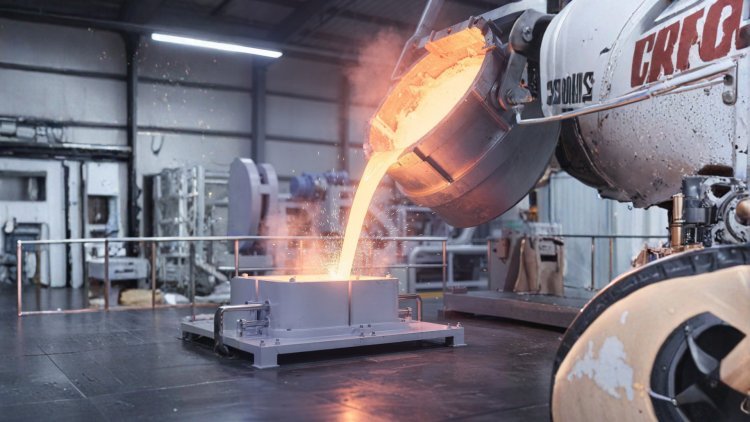
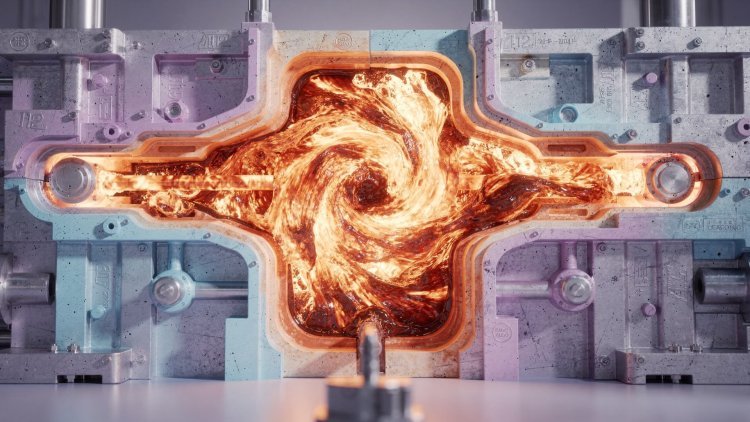
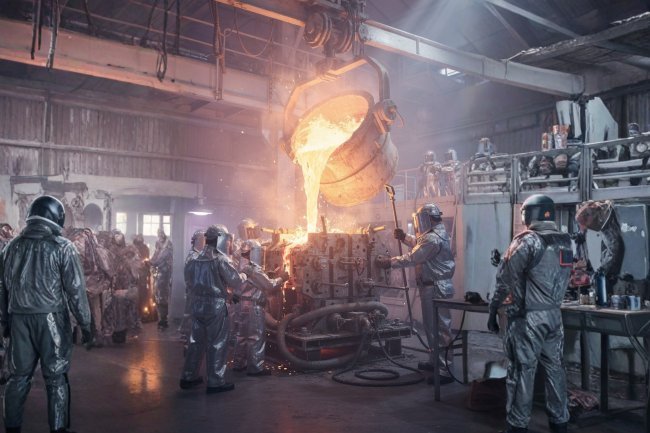
When molten metal enters a mold, it rarely flows in a smooth, predictable manner. Turbulent flow creates complex fluid behavior that directly influences casting quality, defect formation, and overall production efficiency.
01
Gas Entrapment
Turbulent flow traps air and gases within the molten metal, increasing the likelihood of porosity and internal casting defects.
02
Oxide Inclusions
Chaotic flow patterns fold oxide films into the melt, creating inclusions that can weaken structural integrity and performance.
03
Erosion
High-velocity eddies can erode mold surfaces, introducing contaminants into the melt and increasing defect risk.
Computational Fluid Dynamics
The Physics Behind the Models
Turbulence modeling translates complex fluid dynamics into computable equations. At its core, it solves the Navier-Stokes equations governing momentum, mass, and energy while leveraging advanced turbulence closure models to predict chaotic flow behavior without resolving every microscopic fluctuation.
CFD
Momentum
Governs how molten metal accelerates, changes direction, and transfers forces throughout the mold cavity.
Mass
Ensures conservation of material flow, accurately tracking how molten metal fills every region of the mold.
Energy
Models heat transfer and temperature evolution, which directly influence solidification behavior.
Turbulence Closure Models
Advanced closure models approximate the effects of chaotic eddies and flow instabilities, allowing engineers to predict real-world casting behavior with high accuracy while maintaining computational efficiency.
Turbulence Modeling
Key Turbulence Models Used in Casting
Different turbulence models offer varying balances between computational cost and predictive accuracy. Selecting the appropriate model is essential for accurately simulating mold filling, defect formation, and flow behavior in casting processes.
k-ε
k-ε Model
The industry workhorse. Balances computational cost with accuracy for most filling and gating scenarios, making it ideal for fully turbulent, high-Reynolds-number flows.
SST
k-ω SST Model
Delivers superior near-wall accuracy and is particularly effective for thin sections, complex geometries, and flows dominated by boundary-layer effects.
LES
LES (Large Eddy Simulation)
A high-fidelity approach that directly resolves large turbulent structures. Often used for research-grade simulations and critical casting applications.
RNG
RNG k-ε
An enhanced k-ε variant offering improved accuracy for swirling flows and rapid strain-rate changes commonly encountered in runner systems.
Quality Improvement
Impact on Casting Quality
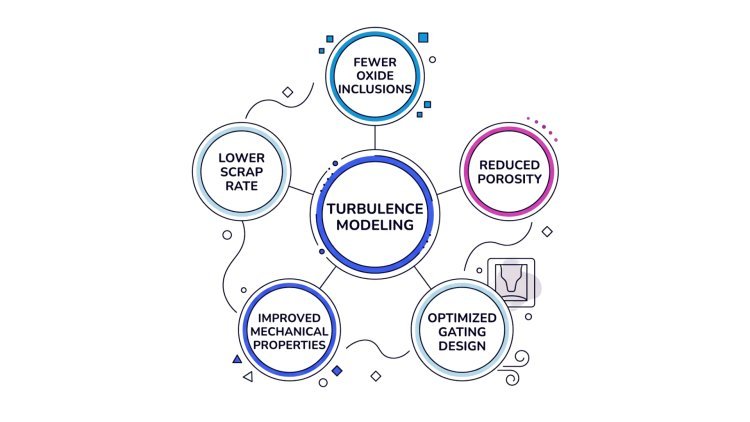
Accurate turbulence modeling directly translates into measurable quality improvements across the casting process. By predicting flow-related defects before production begins, engineers can optimize designs, improve yield, and reduce manufacturing costs.
01
Reduced Porosity
Predicting gas entrapment zones enables engineers to refine gating systems and eliminate porosity risks before the first pour.
02
Fewer Inclusions
Identifying high-turbulence regions helps prevent oxide film folding and reduces non-metallic inclusion defects.
03
Lower Scrap Rate
Simulation-driven optimization minimizes costly trial-and-error, improving yield and reducing overall foundry scrap rates.
Simulation Workflow
Turbulence Modeling in Practice: The Simulation Workflow
A rigorous simulation workflow ensures that turbulence model selection is matched to the specific alloy, process, and component geometry — maximizing predictive accuracy and engineering value throughout the casting development cycle.
01
Geometry & Mesh
Build the casting geometry and generate a computational mesh for accurate flow analysis.
02
Materials & BCs
Define alloy properties, thermal parameters, and boundary conditions for the process.
03
Turbulence Model
Select and apply the most appropriate turbulence model for the casting application.
04
Results & Optimize
Analyze flow behavior, identify risks, and refine the design for optimal casting quality.
Engineering Precision Through Simulation
Matching the right turbulence model to the alloy system, process conditions, and component geometry ensures reliable predictions, reduced defects, and higher confidence in production-ready casting designs.
Process-Specific Modeling
Choosing the Right Model for Your Process
Different casting processes generate unique flow conditions. Selecting the appropriate turbulence model ensures accurate prediction of filling behavior, defect formation, and overall casting performance.
HPDC
High-Pressure Die Casting
Fast fill times and high Reynolds numbers typically favor k-ε or RNG k-ε models due to their robustness under extreme flow conditions.
S&G
Sand & Gravity Casting
Lower flow velocities and complex free-surface behavior benefit from k-ω SST models, which capture boundary-layer transitions more accurately.
IC
Investment Casting
Thin walls and intricate channels often require LES or hybrid RANS-LES approaches to achieve research-grade fidelity for critical components.
Engineering Excellence
Poligoncast's Approach to Turbulence Simulation
At Poligoncast, turbulence modeling is not a checkbox — it is a core engineering discipline embedded in every simulation project. Our team combines advanced CFD expertise with practical foundry knowledge to deliver accurate, production-ready insights.
01
Model Selection Expertise
We match the most appropriate turbulence model to your alloy, geometry, filling behavior, and process parameters for maximum predictive accuracy.
02
Validated Results
Our simulations are benchmarked against physical trials and foundry data, ensuring reliable predictions that translate into real-world performance.
03
Design Optimization
Simulation insights drive gating, runner, and riser redesigns that eliminate defects, improve yield, and reduce development costs before production begins.
CFD
Final Thoughts
Conclusion: Simulation as a Competitive Advantage
Turbulence modeling transforms casting simulation from a visualization tool into a true engineering decision engine. By understanding and controlling fluid flow behavior, foundries can eliminate defects, reduce scrap, and accelerate time-to-market — turning simulation investment into measurable competitive advantage.
Fewer Defects
Predict and eliminate flow-related defects before production begins.
Lower Scrap
Reduce material waste and costly trial-and-error through digital optimization.
Faster Delivery
Accelerate development cycles and bring optimized castings to market sooner.
Partner with Poligoncast
Poligoncast combines deep foundry expertise with state-of-the-art simulation technology to help manufacturers achieve first-time-right casting quality. From turbulence modeling and defect prediction to complete process optimization, our engineering team delivers the insights needed to improve yield, reduce costs, and strengthen competitive performance.