Predicting Distortion in Complex Cast Geometries
In modern foundry and manufacturing, dimensional accuracy is everything. As cast geometries grow more complex, predicting and controlling distortion becomes a critical engineering challenge — one that PoligonCast solves through advanced casting simulation.

Why Distortion Happens
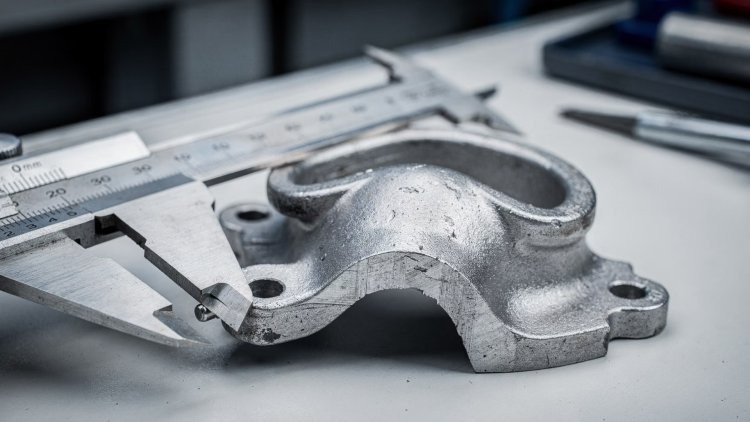
Non-Uniform Cooling
Different sections cool at different rates, creating uneven contraction forces throughout the casting.
Residual Stresses
Locked-in stresses remain after solidification and cooling, causing deformation once constraints are released.
Complex Geometry Effects
Varying wall thicknesses and intricate features amplify thermal imbalance and dimensional deviation.
Why Early Detection Matters
Undetected distortion can compromise structural integrity and lead to assembly failures downstream. Identifying distortion risks during simulation enables engineers to correct problems before tooling investment and production begin.
Simulate heat distribution and solidification patterns across the entire geometry.
Predict residual stress buildup during cooling to identify distortion-prone zones.
Compare simulated vs. target geometry before a single mold is produced.
The Role of Casting
SimulationThermal Analysis
Stress Modeling
Dimensional Validation
Each factor interacts with the others in complex ways. PoligonCast's simulation platform models all six simultaneously, enabling engineers to isolate root causes and apply targeted design corrections — rather than relying on costly trial-and-error iterations.
Key Factors Driving Distortion
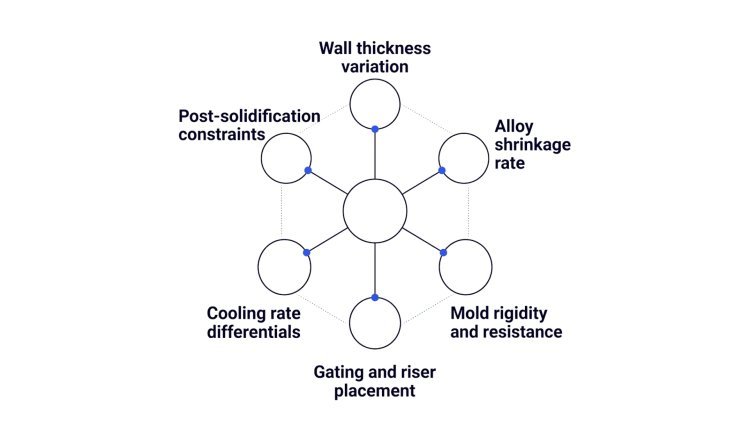
Thermal
GradientsResidual
StressGeometry
ComplexityWall Thickness
VariationCooling Rate
DifferencesProcess
ParametersMulti-Variable Simulation Intelligence
By integrating CAD geometry with physics-based solvers, PoligonCast delivers accurate distortion maps early in the design phase — enabling proactive corrections that reduce scrap rates, shorten lead times, and improve first-pass yield.
PoligonCast's Predictive Approach
Geometry
ImportSimulation
SetupDistortion
PredictionDesign
OptimizationFrom Prediction to Production
Typical reduction in rejected parts after simulation-guided design.
Design cycles accelerated through virtual prototyping versus physical trials.
Target conformance achieved on complex geometries with optimized tooling.
These outcomes reflect PoligonCast's commitment to precision engineering — transforming simulation from a validation tool into a competitive advantage for foundries worldwide. By reducing scrap, accelerating development cycles, and achieving exceptional dimensional accuracy, manufacturers can bring high-quality castings to market faster and more efficiently.
Real-World Impact
Scrap Reduction
Faster Iteration
Dimensional Accuracy
Engineering Results That Matter
Physics-based modeling tailored to your alloy, geometry, and process.
Foundry specialists guiding every stage from design to production.
End-to-end digital solutions for modern, high-precision foundry operations.
Partner with PoligonCast
Advanced Simulation
Expert Engineering Support
Digital Manufacturing
What's Your Reaction?