Benchmarking Simulation Software: What's New in 2025 for Foundry Technologists?
The foundry industry stands at a pivotal moment in 2025, where simulation software has evolved from a nice-to-have tool to an essential component of competitive manufacturing. With new AI-driven capabilities, enhanced physics modeling, and cloud-based solutions, today's simulation platforms are transforming how we approach metal casting challenges.
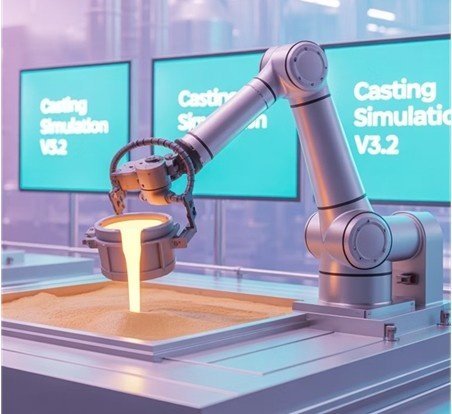
The Evolution of Casting Simulation Technology
|
Traditional Approach
Today’s simulation platforms integrate multiple physics domains simultaneously, providing unprecedented insight into casting behavior while becoming more accessible to engineering teams of all sizes. |
|

Key Simulation Methods Driving 2025 Innovation
Computational Fluid Dynamics (CFD)
Enhanced turbulence modeling and multiphase flow capabilities now predict inclusion formation and air entrapment with 95% accuracy. New algorithms reduce computation time by 40% while improving resolution.
Finite Element Analysis (FEA)
Advanced stress prediction models now account for microstructural evolution during solidification. Integration with metallurgical databases enables real-time property prediction based on local cooling rates.
Thermal-Mechanical Modeling
Coupled thermal-stress analysis prevents hot tearing and distortion issues. New material models incorporate phase transformation effects and residual stress evolution throughout the casting cycle.
Game-Changing Features in Modern Simulation Platforms
01. AI-Powered Process Optimization
Machine learning algorithms analyze thousands of simulation runs to automatically suggest gating and feeding system improvements. Platforms like PoligonCast now offer predictive defect analysis that learns from your specific alloy and process conditions.
02. Real-Time Parameter Adjustment
Cloud-based solutions enable dynamic process modification during simulation runs. Engineers can adjust pouring temperatures, fill rates, and cooling patterns without restarting lengthy calculations.
03. Integrated Quality Prediction
Advanced modules predict mechanical properties, porosity distribution, and surface finish quality before the first pour. This capability reduces prototype iterations by up to 60% for complex geometries.
Industry Trends Shaping the Future
1. Digital Twin Integration
2025 sees widespread adoption of digital twins that connect simulation models with real-time production data. Sensors monitor actual casting conditions and automatically update simulation parameters for continuous improvement.
2. Sustainability Focus
Environmental regulations drive demand for energy-optimized processes. New simulation modules calculate carbon footprint and energy consumption, helping foundries meet sustainability targets while maintaining quality.
3. Cross-Industry Applications
Aerospace and energy sectors increasingly rely on simulation for critical components. Advanced modeling of superalloys and additive manufacturing integration opens new markets for foundry expertise.
Strategic Recommendations for 2025
Success in today's competitive landscape requires a systematic approach to simulation implementation and continuous improvement.
Start with Strategic Pilot Projects
Begin with high-volume or problematic castings where simulation impact is immediately measurable. Focus on components with known quality issues or tight tolerance requirements where traditional methods fall short.
Invest in Team Development
Allocate 20% of simulation software budget to training and certification. Cross-train metallurgists and process engineers to bridge the gap between simulation results and practical implementation.
Build Comprehensive Material Databases
Collaborate with suppliers and research institutions to develop accurate material property databases. Validate simulation predictions against actual casting trials to build confidence in results.
Embrace Cloud-Based Solutions
Consider subscription-based platforms that provide access to cutting-edge features without massive upfront investments. Cloud solutions offer scalability and automatic updates that keep your capabilities current.
The foundry industry's future belongs to those who effectively harness simulation technology's full potential. By addressing challenges and following strategic best practices, foundries can achieve unprecedented levels of quality, efficiency, and innovation in 2025 and beyond.
What's Your Reaction?