Simulation-Based Quality Assurance for Critical Cast Components
A forward-looking framework for replacing guesswork with predictive engineering — transforming how defects are understood, controlled, and ultimately designed out of safety-critical cast parts.
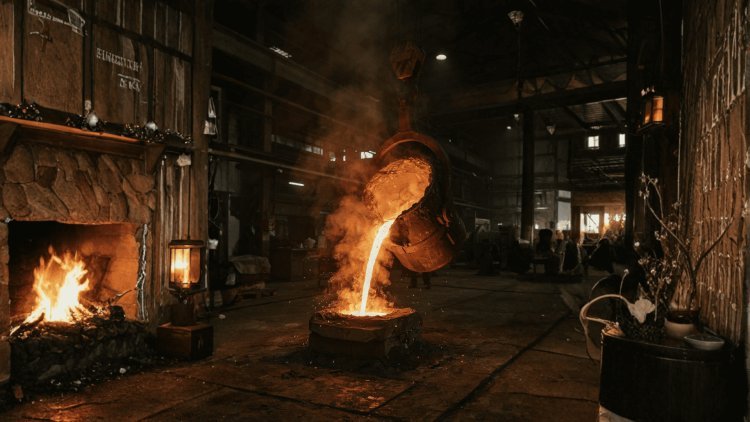
The Problem: Castings Still
"Guess" at Defects
Despite decades of manufacturing advancement, casting quality assurance still depends heavily on engineering intuition, empirical rules, and conservative assumptions. The result is a persistent gap between design intent and the physical reality of the produced casting.
Ideal Casting
Perfect geometry, ideal material properties, optimal loading conditions, and deterministic engineering calculations.
Real Casting
Influenced by porosity, shrinkage, inclusions, segregation, thermal gradients, and process variability.
Over-Engineering by Default
Because defect behavior cannot be confidently forecasted, engineers routinely compensate by increasing safety factors, adding wall thickness, and applying conservative design rules. While these approaches reduce risk, they also increase manufacturing costs, weight, and material usage.
The Cost of Uncertainty
Defects That Hide Until It's Too Late
Porosity
Porosity
Inclusions
Tears
When Defects Are Typically Discovered
The Industry Still Spends More Effort Detecting Defects Than Predicting Them
Until defect behavior can be predicted with confidence before metal is poured, manufacturers will continue to rely on conservative designs, costly inspections, and reactive quality assurance. The next frontier of casting engineering is predictive defect intelligence: moving quality assurance upstream so defects are prevented rather than discovered after production.
Conventional NDE can reveal an indication—but detection alone cannot reliably explain how that indication will affect structural integrity and performance in service.
A detected indication, such as a 2 mm porosity cluster.
The same flaw may be critical near a stress concentration but insignificant elsewhere.
Surface indications are commonly classified as nonconformances or repair candidates. The deeper question—whether leaving the indication or excavating and welding it produces the better structural outcome—is rarely studied systematically.
Welding can introduce microstructural changes, residual stresses, and new potential defect sites. Yet many specifications default to “repair if found” without comparing the resulting performance against the unrepaired condition.
When defect-performance relationships are poorly quantified, acceptance standards compensate with conservative safety factors. The result is more destructive testing, larger sampling plans, costly proof loads, and schedules that validate individual components without building transferable knowledge.
What Traditional QA Can't Do
A flaw has context.
Different consequenceWorkmanship Targets
Repair is not automatically risk-free
Protecting against ignorance
Advanced platforms solve coupled Navier-Stokes fluid dynamics with thermal and phase-change models. They predict melt pressure distributions, feeding flow paths, and porosity nucleation as functions of thermal gradients and metallostatic pressure, producing spatially resolved defect probability maps.
Shrinkage porosity arises when feeding paths are interrupted. Simulation tracks feeding flow and pinpoints the exact moment liquid supply becomes inadequate. Incorrect riser or gate sizing is flagged, predicting defect patterns with high fidelity.
In investment casting, ProCAST simulations identified feeding deficiencies and trapped air pockets as root causes of recurring defects. Predictions matched observed defect locations and magnitudes, validating simulation accuracy and establishing it as a primary design driver for gating and feeding optimization.
Simulation Makes Defects Predictable (Not Just Detectable)
Multi-Phase Simulation Capabilities
Feeding Zones and Shrinkage Mechanics
ProCAST Validation: Investment Casting
Simulation-based quality assurance fundamentally changes the role of engineering. Instead of discovering defects after they form, engineers can predict, quantify, and eliminate defect mechanisms before production begins. Defects become controllable design variables rather than unavoidable manufacturing surprises.
Inspect castings after production and identify defects after value has already been lost.
Predict defect mechanisms virtually and eliminate them before production begins.
From "Find the Flaw"
to "Design It Out" (and Prove It)The Quality Evolution
Find The Flaw
Design It Out
High-fidelity simulation, coupled structural analysis, and automated optimization make it possible to engineer quality by prediction rather than inspect it in through trial and error.
Inspection requirements are calibrated to what each critical location can tolerate, replacing blanket limits based on worst-case assumptions with performance-linked criteria.
Automated multirun optimization can vary gating geometry, riser size and placement, pouring temperature, and other parameters while evaluating porosity, shrinkage distribution, and solidification time against quantitative constraints.
Simulation-integrated QA is now positioned for practical industrial adoption through mature software, accessible computing, and growing process-property databases.
Performance-Driven,
Standards-Ready QASimulation to Specification
Quality and Yield Together
Adopt prediction-led qualification.
it is built into the simulation model before the first pattern is cut.”
What's Your Reaction?