Parametric Simulation Models for Casting Development
How advanced digital modeling and automated optimization are transforming the way foundries design, validate, and refine cast components — eliminating costly physical trials and accelerating the path to precision-engineered parts.
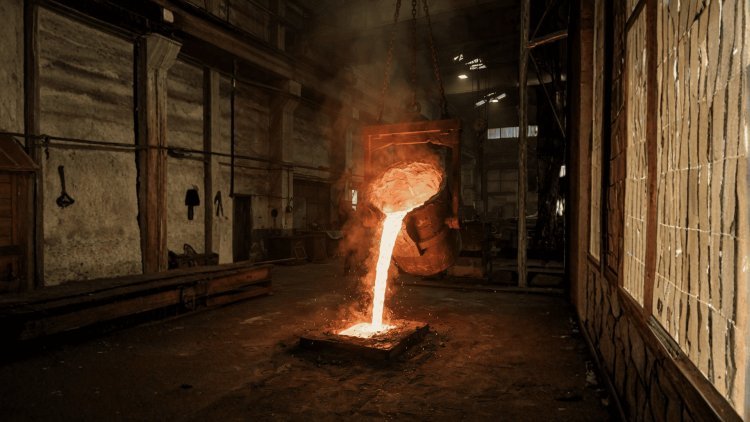
The Foundation:
Predictive Modeling
Modern casting development increasingly relies on mathematical simulation rather than costly and time-consuming shop floor experimentation. By digitally predicting pouring behavior, solidification dynamics, and cooling performance, foundries gain a level of process understanding that physical trials alone cannot provide. This shift enables engineers to identify and eliminate defects before a single mold is ever poured.
Three Pillars of Predictive Modeling
Replacing Physical Trials
Traditional casting development relied heavily on repeated production trials to evaluate gating systems, mold performance, and defect formation. Each iteration required time, labor, material consumption, and production resources. Predictive simulation replaces this cycle with mathematical models capable of forecasting casting behavior before production begins.
Traditional vs Predictive Development
Core Physics: Finite Difference Methods
At the heart of predictive casting simulation lies the Finite Difference Method (FDM). This numerical approach discretizes the casting and mold into a structured computational grid and solves heat transfer equations at every node over time. The technique allows engineers to track thermal evolution with high spatial and temporal resolution throughout the entire casting process.
What FDM Predicts
Finite Difference Workflow
Detecting Defects Before First Pour
One of the most valuable outcomes of predictive modeling is the ability to identify defects before committing material, tooling, or production resources. Engineers can locate problematic regions within a virtual casting and evaluate alternative designs long before physical manufacturing begins.
Predict Before Production
Digital Design Optimization
Physical Second
Predictive modeling allows foundries to evaluate multiple gating systems, feeding strategies, and process conditions digitally before committing resources to real-world production.
Built Through Prediction
Modern foundries increasingly rely on simulation-driven decision making to minimize risk, accelerate development, and improve casting quality before production begins.
The Most Valuable Casting Trial
Is The One You Never Have To Run.
Predictive modeling fundamentally changes the economics of casting development. By replacing costly physical experimentation with virtual analysis, engineers can evaluate process behavior, understand thermal dynamics, and identify defects long before production starts. Supported by Finite Difference Methods, these simulations resolve temperature evolution, latent heat release, and volumetric contraction across complete casting geometries. Most importantly, they enable proactive defect prevention, allowing teams to optimize designs digitally and approach first-pour production with significantly greater confidence, lower risk, and improved manufacturing outcomes.
Engineers select alloys from a database of 230+ options, each defined by thermophysical properties. CAD-based mold geometry is imported, and boundary conditions such as coatings and ambient settings are applied to reflect foundry practice.
Geometry is subdivided into millions of nodes forming a computational mesh. Fine resolution is applied to complex or high-gradient regions, while coarser elements manage cost. Heat transfer equations solve temperature evolution across all nodes and time steps.
Simulation results are evaluated against porosity indices, hot spot maps, and feeding efficiency. Engineers adjust gating, risers, chills, or pouring parameters, then re-simulate. This closed-loop continues until all quality targets are met, ensuring confidence before physical production.
Casting simulation is a cyclical process — each iteration builds deeper insight, driving progressive improvements and ensuring defect-free production.
Casting Simulation Process
Digital Preparation
The Meshing Process
Continuous Refinement Loop
While iterative simulation represents a major improvement over traditional foundry trial-and-error, it still depends heavily on engineering intuition to suggest design changes. The next stage of casting simulation evolution is automated parametric optimization, where mathematical algorithms systematically explore the design space and identify superior solutions without relying on manual intervention between simulation cycles.
Conventional simulation workflows require engineers to manually propose, model, execute, and evaluate each design modification. Although effective, this process is naturally constrained by time, experience, and human bias toward familiar solutions. Automated optimization removes this limitation by allowing mathematical solvers to evaluate large numbers of candidate designs independently.
Design changes are generated sequentially and evaluated one at a time based on engineering intuition and experience.
Hundreds of alternatives can be systematically tested through objective mathematical search strategies.
HyperOpt solvers treat casting design variables as mathematical parameters that can be automatically adjusted during optimization. Each design configuration is evaluated against one or more objective functions, and the optimization engine uses those results to intelligently determine which parameter combinations should be explored next.
The Shift to Automation:
Introducing OptimizationThree Pillars of Casting Optimization
From Manual to Automated
Engineer Driven
Solver Driven
Evolution of the Design Process
HyperOpt Engines: How They Work
Volume of Fluid (VOF) models resolve both liquid metal fronts and entrained gas phases, predicting oxide inclusions, air entrapment, and misruns. Coupled microstructural evolution links grain growth and dendrite spacing with macroscale thermal fields, bridging process parameters to final mechanical properties.
Permanent mold and die casting require multi-cycle simulations. Cyclic analysis tracks heat accumulation across consecutive cycles until steady state, ensuring accurate predictions of solidification behavior and die life in high-volume production.
Gas trapped in shrinkage voids exerts backpressure, influencing shrinkage profiles. Incorporating heated air effects yields more realistic predictions, especially in large gravity sand castings where feeding distances are long and porosity risk is high.
Advanced simulation frontiers — from VOF multiphase modeling to cyclic thermal analysis and shrinkage accuracy — empower engineers to design complex castings with unprecedented fidelity and confidence.
Expanding the Boundaries of Casting Analysis
Multi-Scale & Multiphase Modeling
Cyclic Thermal Analysis
Heated Air & Gravity Shrinkage Accuracy
The trajectory of parametric simulation in casting is unmistakable: greater automation, higher physical fidelity, and tighter integration with advanced manufacturing systems. Together, these developments are enabling foundries to achieve unprecedented process performance while simultaneously reducing development costs, shortening lead times, and minimizing material waste.
Achieved through 100 fully automated optimization cycles without operator intervention.
Characterized alloys with comprehensive thermophysical properties for simulation.
Autonomous evaluations exploring the full parameter space.
Counter Pressure Casting (CPC) is emerging as one of the most promising technologies for next-generation structural casting applications. By carefully controlling pressure differentials during mold filling and solidification, CPC provides enhanced process stability and significantly improved casting quality.
Combining CPC with advanced multi-physics simulation enables engineers to accurately model pressure-driven solidification effects and unlock the process's full industrial potential.
The significance of modern casting simulation extends far beyond individual manufacturing processes. It represents a fundamental shift from empirical, experience-driven production methods toward predictive, data-driven engineering.
As digital twins become increasingly accurate and accessible, foundries of every size gain the ability to compete based on engineering capability rather than accumulated tribal knowledge and historical process intuition.
Future casting facilities will continuously adapt process conditions in real time, delivering unprecedented levels of quality, consistency, efficiency, and manufacturing control.
Modern parametric simulation is not simply a method for reducing development costs. It is the engineering foundation connecting traditional casting expertise with the next generation of precision-engineered, high-performance manufacturing.
The future of casting development lies in the convergence of automated optimization, high-fidelity simulation, digital twins, real-time monitoring, and intelligent manufacturing control. Technologies such as Counter Pressure Casting and multi-physics simulation are already pushing process capability beyond traditional limits, while autonomous optimization systems routinely evaluate hundreds of design alternatives with minimal human involvement. As digital manufacturing platforms mature, foundries will increasingly operate as self-optimizing engineering systems capable of continuously improving product quality, reducing waste, accelerating development, and producing highly complex components with unprecedented precision. Modern parametric simulation is no longer merely an engineering tool. It is the foundational infrastructure that will power the next generation of high-performance casting manufacturing.
The Future of
Casting DevelopmentPerformance Benchmarks Driving the Industry Forward
The Path Forward: CPC & Multi-Physics Integration
Key Benefits of Counter Pressure Casting
High-Value Industries Driving Adoption
Simulation as the Bridge to Precision Manufacturing
The Evolution of Manufacturing Philosophy
The Next Chapter of Casting Production
Future Autonomous Manufacturing Workflow
Precision at Industrial Scale
More Than a Cost-Saving Tool
The Future Foundry
Will Not Be Driven By Trial And Error.
It Will Be Driven By Prediction.
What's Your Reaction?