Simulation-Driven Manufacturing for Space Exploration Components
The convergence of advanced simulation, generative design, and additive manufacturing is fundamentally transforming how humanity builds components for space exploration. This presentation examines how digital engineering pipelines— from computational models to certified flight hardware—are compressing timelines, improving performance metrics, and enabling the next generation of off-world manufacturing capabilities.
The Problem:
AM Breaks When We Don't
Model the Whole Lifecycle
Additive Manufacturing enables unprecedented design freedom for aerospace and space systems, but geometry alone does not guarantee success. Every printed component is the product of interconnected decisions spanning design, build physics, post-processing, inspection, and operational service conditions.
Additive Manufacturing Is A System
Design-Induced Process Failures
A topology-optimized geometry may appear ideal in CAD while remaining fundamentally unmanufacturable in practice. Residual stress accumulation, anisotropic material behavior, support removal effects, and thermally driven distortion can transform a successful digital design into a failed physical component.
Why Geometry Alone Fails
Modern aerospace simulation is evolving from a verification step into a generative design engine—so engineering requirements produce the structure instead of merely checking it afterward.
The direct handoff eliminates intermediate reinterpretation, reducing information loss and human error between the digital model and the physical part.
Geometry is not optimized in isolation. Material choice and fabrication method are evaluated alongside mass, process complexity, surface-finish requirements, cost, and performance margin.
Requirements Into
Manufacturable StructuresEncode engineering intent from the beginning.
A direct digital-to-physical flow
Optimize the full continuum.
Optimal across design, manufacture, and operation.
Encode the requirements—and let them generate the shape.
Traditional aerospace design cycles required sequential handoffs across teams, consuming weeks. Generative tools and robotic fabrication collapse this cycle, automating iterations and enabling near-immediate fabrication. What once took months now executes in days.
NASA documented requirements-to-parts timelines of 1–2 weeks using integrated generative design and AM workflows. Performance metrics improved 2x–4x in structural efficiency, mass reduction, and load-path optimization — step-change gains enabled by simulation infrastructure.
With fabrication no longer rate-limiting, the critical path shifts to stakeholder requirements. Precise specification of interfaces, load cases, safety margins, and constraints is essential. Ambiguous requirements yield suboptimal designs at machine speed.
NASA generates design outputs quickly to elicit requirements. Prototypes help stakeholders identify missing constraints or conflicts more effectively than abstract reviews. Fast generative iterations make this strategy economically viable.
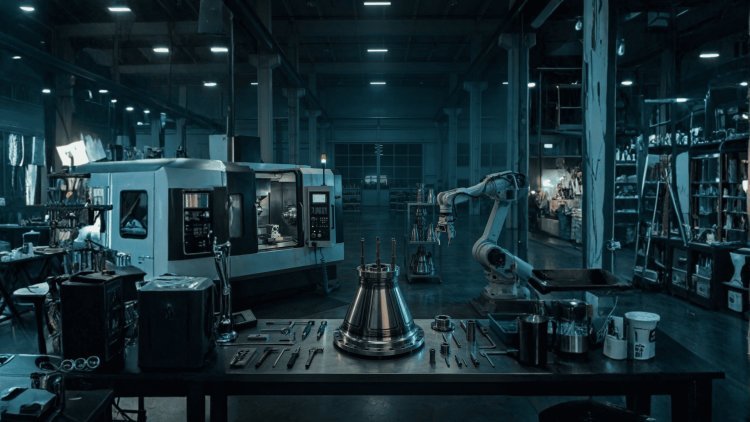
Robotic fabrication systems — multi-axis CNC, directed energy deposition, hybrid cells — execute designs directly from CAD models. Digital-to-physical handoff becomes instantaneous, governed by machine precision rather than human variability.
NASA-documented requirements-to-parts timeline
Structural efficiency, mass reduction, load-path optimization
Direct CAD-to-robotic fabrication eliminates handoff errors
The "Requirements to Parts" Time Collapse
From Months to Days
NASA's Reported Benchmarks
1. The New Bottleneck: Requirements Definition
2. The Practical Workaround: Iterate Fast
3. Robotics as the Execution Layer
1–2 Weeks
2–4x Improvement
~0 Manual Reinterpretation
Performance gains and manufacturing speed are meaningless if hardware cannot be certified for flight. NASA's additive manufacturing qualification framework represents the turning point that transforms AM from a rapid prototyping technology into a trusted production platform for mission-critical spaceflight hardware.
Establishes qualification and certification requirements for additive manufacturing hardware used in NASA missions.
Defines process qualification, material characterization, and acceptance criteria for AM metallic hardware.
The standards create a common qualification language across NASA programs, eliminating the need for every mission team to independently develop certification methodologies and qualification practices from scratch.
Demonstrates that machine settings, atmosphere controls, laser parameters, powder characteristics, and process conditions consistently produce acceptable microstructure and material properties. Qualification occurs for each machine-material-parameter combination.
Verifies that a specific geometry, build orientation, support strategy, and post-processing sequence can reliably produce hardware meeting all design and performance requirements.
Statistical characterization of mechanical, thermal, and physical properties including anisotropy and build-direction sensitivity.
Continuous monitoring of process stability to detect drift and provide objective evidence that qualification remains valid.
Once qualified, the process plan becomes the baseline for production. Machine settings, feedstock sources, post-processing routes, and operating conditions cannot be changed casually because seemingly minor variations may introduce significant microstructural differences invisible to routine inspection.
Unlike conventional manufacturing, additive manufacturing can exhibit part-to-part variation due to thermal history, powder variation, machine condition changes, and process sensitivity. As a result, inspection emphasis shifts toward comprehensive evaluation rather than relying primarily on statistical sampling.
Modern qualification programs increasingly leverage validated, high-fidelity simulations as supporting certification evidence. Thermal, fluid-flow, stress, and process simulations extend the reach of physical testing, allowing engineers to evaluate scenarios that would be prohibitively expensive or impractical to reproduce experimentally.
Additive manufacturing becomes truly transformative only when qualification frameworks convert technical possibility into operational trust. NASA's standards, rigorous process control, comprehensive inspection strategies, and simulation-informed certification together establish a repeatable pathway from digital design to flight-ready hardware. In the certification era, simulation is no longer a design tool alone. It is part of the evidence chain that makes mission approval and safe spaceflight possible.
Certification Era:
Simulation-Informed Qualification
Makes Flight PossibleNASA's Certification Foundation
Spaceflight Systems
Metallic Materials
One Framework. Many Missions.
The Four Pillars of AM Qualification
Qualified Metallurgical Process
Qualified Part Process
Material Property Suite
Statistical Process Control
Follow The Qualified Process. Exactly.
Change Control Logic
Every Part Matters
Simulation As Qualification Evidence
Modern Qualification Stack
Certification Is The Bridge
Between Innovation And Flight
Evolutionary Digital Twins move beyond monitoring: they learn from reality, generate new designs, adapt manufacturing in real time, and support autonomous remanufacturing where human intervention is limited or impossible.
Develop self-learning loops, autonomous redesign, and closed-loop remanufacturing in controlled facilities with human oversight.
Test autonomous adaptation under communication delays, thermal cycling, contamination, and radiation.
Produce replacement parts and mission hardware from in-situ resources when resupply and real-time support are infeasible.
Continuously updates material models, process signatures, and failure predictions from sensor data.
Creates and evaluates design variants when requirements change or degradation is detected.
Modifies process parameters in real time to compensate for environmental or equipment variation.
Traditional manufacturing is brittle under perturbation. EDT-enabled manufacturing is adaptive: it detects deviation, models consequences, generates a response, and executes correction faster than human-in-the-loop processes can manage.
Qualification evidence is generated continuously during autonomous manufacturing, making certification a byproduct of production rather than a separate downstream gate.
EDTs paired with ISRU processing could turn lunar regolith or Martian materials into simulation-optimized, autonomously fabricated components.
The Next Frontier
Three capabilities turn a twin into an agent.
Detect → Model → Respond → Correct
Evidence is produced with the part.
Local materials, local capability.
adapting every design and component from the first layer to the last.
What's Your Reaction?