Simulation Challenges in Mega-Casting Production
As the automotive and aerospace industries push toward larger, more complex single-piece castings, simulation has become the backbone of successful production. At PoligonCast, we explore the critical engineering challenges that define mega-casting — and how advanced simulation tools are reshaping the foundry landscape.
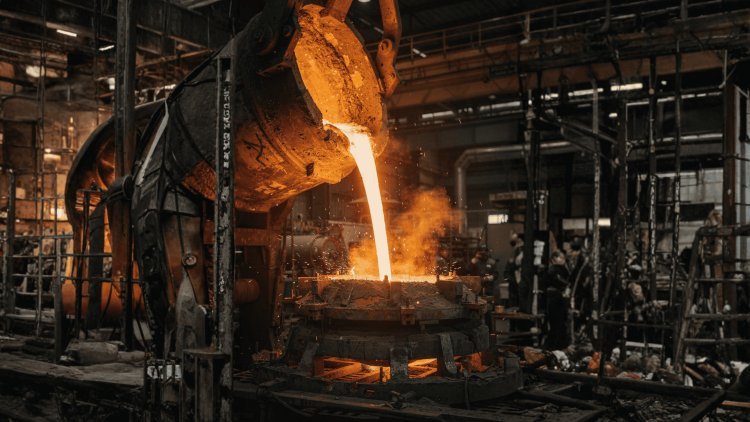
What Is Mega-Casting?
Scale
Structural components often exceed one meter in size and can weigh hundreds of kilograms.
Complexity
A single mega-casting can replace dozens of smaller components and assembly operations.
Material
High-strength aluminum alloys provide the combination of strength, stiffness, and lightweight performance.
Traditional Assembly vs Mega-Casting
Traditional Design
- Many individual castings
- Multiple welds and joints
- Higher assembly complexity
- More manufacturing steps
Mega-Casting
- Single-piece structure
- Reduced part count
- Lower assembly costs
- Improved production efficiency
Larger Castings Demand Greater Simulation Accuracy
Mega-casting introduces unprecedented challenges in mold filling, thermal management, solidification control, and defect prevention. PoligonCast's simulation-driven workflow enables engineers to validate large structural castings digitally, ensuring dimensional accuracy, material integrity, and production readiness before the first pour is made.
Predicting heat distribution across massive geometries is exponentially harder — uneven cooling causes warping and residual stress.
Simulating turbulent metal flow at high velocity across large cavities requires extreme computational accuracy to prevent porosity and cold shuts.
Controlling volumetric shrinkage in thick sections demands precise riser and gate design validated through multi-phase simulation.
Mega-cast models contain billions of mesh elements — simulation runtimes can span days without optimized HPC infrastructure.
Core Simulation Challenges
Thermal Management
Mold Fill Dynamics
Solidification & Shrinkage
Computational Load
Converting complex CAD data into simulation-ready meshes.
Integrating thermophysical data and machine settings.
Executing high-fidelity flow and thermal analysis.
Finalizing design through digital failure mode analysis.
A robust simulation workflow integrates CAD geometry, alloy thermophysical data, machine parameters, and defect prediction into a unified digital model — enabling engineers to identify failure modes before a single mold is poured.
The Simulation Workflow at Scale
Geometry & Mesh
Process Parameters
Multi-Physics Sim
Validation & Opt
Simulation identifies trapped air regions and turbulent flow zones that can generate internal porosity and compromise structural integrity.
Predicts isolated hot spots and feeding deficiencies that may create shrinkage cavities in thick casting sections.
Detects areas experiencing excessive thermal strain during solidification where cracking may occur before full solidification.
Evaluates mold filling behavior to identify locations where metal may solidify prematurely before complete cavity filling.
By predicting gas porosity, shrinkage cavities, hot tears, and misruns before manufacturing begins, PoligonCast enables foundries to reduce physical trials, lower scrap rates, improve yield, and accelerate large-scale mega-casting programs with greater confidence and repeatability.
Defect Prediction & Prevention
Gas Porosity
Shrinkage Cavities
Hot Tears
Misruns
Simulation-Based Prevention Workflow
Fewer Trials. Less Scrap. Faster Production.
Finite element and computational fluid dynamics solvers model coupled thermal, mechanical, and flow phenomena simultaneously.
Machine learning accelerates parameter optimization and identifies optimal gate locations, cooling channel layouts, and process windows faster than traditional DOE.
Linking simulation models to real-time machine data creates a living digital twin that continuously refines predictive accuracy across production runs.
Advanced Tools & Technologies
High-Fidelity FEA & CFD
AI-Assisted Optimization
Digital Twin Integration
Mega-casting simulation is not just a technical exercise — it is a strategic competitive advantage. Companies that master simulation-driven design reduce time-to-market and deliver structurally superior components.
At PoligonCast, our foundry engineering and digital simulation expertise empowers manufacturers to tackle the most demanding casting challenges with confidence.
PoligonCast: Engineering Confidence at Every Scale
What's Your Reaction?