Precision in Molten Metal: Simulating Copper Alloy Casting
A deep dive into how digital simulation is transforming the way engineers design, validate, and optimize copper alloy casting processes — from mold geometry to grain-level microstructure.
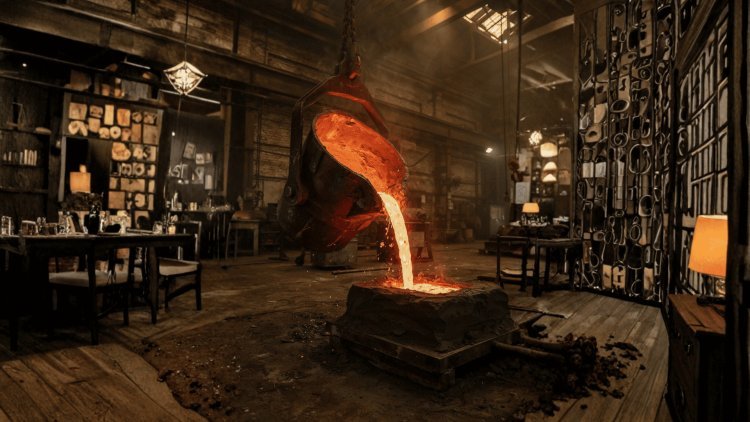
The Complexity of
Copper Casting
Copper alloys, including high-tensile brasses, leaded bronzes, and aluminum bronzes, occupy an essential position across marine, aerospace, hydraulic, and precision engineering industries. Their valuable combination of corrosion resistance, thermal conductivity, electrical conductivity, and mechanical strength makes them indispensable, yet these same characteristics also make copper alloys among the most difficult materials to cast consistently and reliably.
Three Major Challenges in Copper Casting
Dimensional & Geometric Challenges
Traditional sand and shell molding processes naturally introduce dimensional variation through pattern withdrawal, pattern rapping, mold distortion, and draft requirements. While these dimensional shifts may appear small, even fractions of a millimeter can create significant challenges in precision copper alloy components.
The difficulty increases substantially when castings require complex internal passages, undercuts, or curved cooling channels. Success depends on extremely accurate core positioning, mold alignment, and assembly consistency throughout production.
Sources of Dimensional Variation
Small Errors Become Critical
Tight-tolerance copper alloy castings demand exceptional control over mold construction and core positioning to prevent costly machining, rework, or part rejection.
Metallurgical & Thermal Control
Copper alloys solidify across a temperature interval rather than at a single temperature. During this period, liquid and solid phases coexist within a mushy zone whose behavior strongly influences defect formation and final mechanical properties.
Effective process design requires balancing pouring temperature, feeder design, mold thermal diffusivity, and cooling conditions to achieve uniform solidification while minimizing stress development and shrinkage-driven defects.
Critical Thermal Variables
Thermal Imbalance Consequences
Critical Defect Mechanisms
Porosity Formation
Gas and shrinkage porosity remain the most common defects in copper alloy castings. These discontinuities typically form in regions of final solidification where liquid feeding becomes inadequate and volumetric contraction cannot be compensated.
Cold Shuts & Misruns
When advancing metal fronts lose temperature and fluidity before complete fusion occurs, cold shuts develop. These planar discontinuities weaken the casting and significantly reduce structural reliability.
Hot Tearing
Thermal contraction stresses acting during the semi-solid stage can separate grain boundaries and generate hot tears. This defect is particularly problematic in aluminum bronze alloys because of their demanding solidification characteristics.
Most Critical Defect Types
Requires Process Excellence
The remarkable performance of copper alloys can only be realized when dimensional precision, thermal management, feeding design, and defect control are optimized simultaneously.
Copper Alloy Casting
Is A Balance Of Geometry,
Metallurgy, And Thermal Control.
Copper alloys deliver an exceptional combination of corrosion resistance, conductivity, and mechanical performance, but achieving those benefits consistently requires extraordinary process discipline. Dimensional variation, mushy-zone solidification behavior, feeding requirements, and defect mechanisms interact throughout the casting cycle, making copper alloys some of the most technically demanding materials processed in modern foundries. Advanced simulation and process optimization technologies now provide the ability to predict these interactions before production begins, reducing development risk while improving quality, yield, and reliability in critical engineering applications.
For much of the twentieth century, the art of foundry practice was precisely that — an art. Skilled craftsmen and metallurgists accumulated decades of empirical knowledge, translating intuition and past experience into decisions about sprue placement, feeder sizing, and pouring temperature.
Every new part design required a series of physical casting trials to identify and eliminate defects. Foundries poured multiple test batches simply to understand how a particular geometry behaved during filling and solidification.
Engineers and pattern makers adjusted process parameters based on observation and inference rather than data. Changes to sprue height, feeder position, or local cooling were performed iteratively on the shop floor.
Engineers could not directly observe the casting process inside the mold. Flow-front behavior, thermal gradients, and the progression of solidification remained hidden until defects appeared after shake-out.
The cumulative cost of trial-and-error development for a single complex casting could reach tens of thousands of dollars before an acceptable process was established.
The Traditional Trial-and-Error Era
Where the Process Broke Down
Every new part meant another experiment.
Engineers changed parameters by observation.
The most important events happened out of sight.
The Price of Trial-and-Error
Ny = G / √Ṙ relates thermal gradient (G) to cooling rate (Ṙ). Values below 0.1 K·s¹/²/mm correlate with microporosity risk. Simulation maps these values across casting volume, guiding riser placement, gating geometry, and chilling to push high-risk regions above threshold before tooling.
Since the 1980s, casting simulation software like MAGMASOFT, ProCAST, AnyCasting, and SolidCast disrupted defect control. FDM and FEM discretize geometry into thousands of nodes, solving heat transfer and fluid flow equations to predict porosity, hot spots, and shrinkage defects before molds are produced.
Pre-Simulation Reject Rate
Post-Simulation Reject Rate
Defect Rate Reduction
Simulation-led optimization reduces scrap rates by up to 60% and shortens tooling cycles from months to weeks — making magnesium and copper alloy casting commercially viable at scale.
Revolutionizing Casting Development
What Simulation Predicts
The Niyama Criterion
The Simulation Revolution
32.9%
0.2%
99%
As computational power has expanded and simulation technologies have matured, casting analysis has evolved far beyond traditional thermal solidification models. Modern platforms now combine multiple interacting physical phenomena within unified simulation environments, allowing engineers to reproduce the full complexity of copper alloy casting processes with unprecedented accuracy and predictive capability.
Modern casting platforms employ transient time-dependent solvers capable of tracking the continuously evolving interaction between molten metal, displaced gases, molds, and cores. Unlike static approaches, transient analysis captures process evolution from the first moment of mold filling through complete solidification.
Multi-phase flow models follow both liquid metal and the gases contained within the cavity, enabling highly accurate prediction of gas entrapment, turbulence, and filling-related defects.
High Pressure Die Casting (HPDC) introduces physical phenomena that cannot be represented adequately using conventional gravity-casting models. Extremely rapid filling rates generate gas compression, pressure surges, and advancing flow fronts that require dedicated numerical approaches.
Modern HPDC simulations incorporate compressible gas behavior and moving injection systems, allowing engineers to investigate the interaction between machine parameters and casting quality before tooling is manufactured.
Pressure-coupled flow solvers optimize pressure differential programs to reduce gas porosity, increase casting density, and improve overall component integrity.
One of the most important developments in casting simulation is the connection between macro-scale process behavior and micro-scale metallurgical outcomes. Multi-scale models translate thermal gradients, cooling rates, and solidification conditions into direct predictions of microstructural evolution.
This capability allows simulation to move beyond defect prevention and into predictive control of material properties, enabling true digital materials engineering.
Simulation predicts β-phase transformation volume fraction and morphology, directly influencing strength, toughness, and service performance.
Modeling forecasts lead particle size and distribution, enabling optimization of machinability and pressure-tightness characteristics.
Multi-scale simulation bridges manufacturing engineering and metallurgy, allowing casting processes and material properties to be optimized simultaneously rather than independently.
Advanced simulation no longer focuses solely on preventing casting defects. It enables direct engineering of grain structure, phase balance, and material performance before production begins.
Advanced multi-physics simulation represents one of the most important advances in modern copper alloy casting technology. By integrating transient fluid flow, gas behavior, heat transfer, pressure evolution, solidification kinetics, and microstructural prediction within a unified framework, engineers gain visibility across every stage of the manufacturing process. Multi-scale modeling extends this capability even further by linking macro-scale process conditions directly to micro-scale material outcomes such as dendrite arm spacing, phase transformations, and particle distributions. The result is a new generation of simulation platforms capable of optimizing not only casting integrity and defect avoidance, but the final mechanical and functional performance of the alloy itself. This convergence of process engineering and materials science is transforming simulation into a true digital materials engineering platform.
Advanced Modeling
and Multi-PhysicsThree Pillars of Advanced Simulation
Transient Multi-Phase Flow & Conjugate Heat Transfer
Physical Phenomena Captured
Conjugate Heat Transfer Modeling
Specialized Process Simulation: HPDC & CPC
HPDC Simulation Components
Pressure-Controlled Density Optimization
Multi-Scale Modeling
Multi-Scale Prediction Workflow
Microstructural Variables Predicted
Alloy-Specific Microstructure Control
Aluminum Bronzes
Leaded Brasses
Unified In One Digital Environment
Toward Microstructure Engineering
Multi-Scale Simulation
Connects How A Casting Is Made
To How It Ultimately Performs.
Leading foundries increasingly treat simulation validation as a prerequisite for production release. Predictions are correlated against destructive and inspection-based test results to build statistically validated models tailored to specific alloys, mold materials, and process conditions.
Validated models support mold designs matched to the precise cooling requirements of each component.
Simulation reduces reliance on experimental tooling and can return its investment within a single product development cycle.
Parametric design exploration combined with simulation engines can evaluate thousands of design variants automatically across a predefined design space.
Quantitative prediction of porosity location, size, and volume fraction enables targeted corrective action before physical tooling is committed.
Simulation-optimized processes can reduce energy, metal consumption through right-sized feeders, and labor requirements.
Digital iteration compresses development cycles from months of physical trials toward weeks of simulation-led development.
Fewer scrap castings, reduced re-melt energy, and lower consumable usage support more environmentally responsible manufacturing.
Precision simulation is no longer an optional tool in the copper alloy foundry. It is redefining what quality, efficiency, sustainability, and defect-free production can achieve across the industry.
From Prediction to Continuous Improvement
Validated Simulation as the Design Standard
Building Confidence Through Correlation
Cooling Tailored to the Component
Less Empirical Guesswork
Automated Exploration & AI-Assisted Optimization
How the Optimization Engine Narrows the Process Window
Four Outcomes of Precision Simulation
Defect Prediction
Process Efficiency
Time-to-Market
Sustainable Production
Precision Simulation Is the Fundamental Engine of Modern Foundry Production
What's Your Reaction?