Predicting Hot Tears in Complex Castings Using Advanced Simulation
Hot tearing remains one of the most challenging defects in modern foundry operations — costly, unpredictable, and often invisible until it's too late. At PoligonCast, advanced casting simulation is transforming how engineers detect, predict, and eliminate these failures before a single mold is poured.
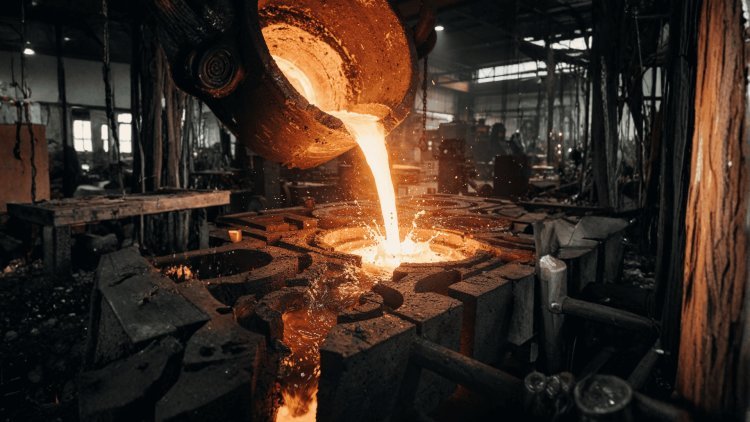
What Are Hot Tears?

Hot tears — also called hot cracks — are fractures that form during solidification when thermal contraction is resisted by the semi-solid metal structure.
When They Form
In the mushy zone between liquidus and solidus temperatures.
Why They're Dangerous
They compromise structural integrity and often go undetected until service failure.
Engineering Impact
Hot tears reduce fatigue life and reliability, making early detection and simulation essential.
Modern casting simulation software enables foundry engineers to model thermal gradients, stress distributions, and solidification sequences with high fidelity — predicting hot tear risk zones before tooling is ever cut.
Maps temperature gradients across the entire casting geometry.
Calculates mechanical stress during solidification and cooling.
Applies validated indices (e.g., Clyne-Davies) to flag vulnerable regions.
The Role of Advanced Simulation
Thermal Analysis
Stress Modeling
Hot Tear Criteria
Accurate hot tear prediction depends on precise input parameters. Each variable influences how stress accumulates in the semi-solid state — small changes in alloy composition or mold design can dramatically shift defect risk.
Even minor variations in alloy composition or mold design can dramatically alter defect risk.
Simulation accuracy improves significantly when real alloy thermophysical data is used rather than generic database values.
Key Simulation Parameters
Precision Matters
Real Data Advantage
Assess casting geometry for potential stress concentration zones.
Run thermal and stress simulations to predict defect-prone regions.
Identify hot tear risk zones before tooling is cut.
Iterative refinement eliminates hot tear risk, reducing scrap rates and accelerating time-to-production.
Fewer defective castings through predictive redesign.
Fewer physical trials needed before production approval.
Lower tooling rework and warranty costs for clients.
PoligonCast's Simulation-Driven Approach
Geometry Review
Simulation Modeling
Defect Prediction
Design Optimization
Reduced Scrap
Faster Development
Cost Savings
Hot tears don't have to be an accepted risk. With advanced simulation, PoligonCast empowers foundries to engineer confidence into every pour — transforming complex casting challenges into competitive advantages.
Identify hot tear risk zones digitally.
Redesign geometry and process parameters.
Cast with confidence and zero surprises.
Simulation Is the Future of Defect-Free Casting
Predict
Optimize
Produce
What's Your Reaction?