Mold Filling Around Complex Core Geometries
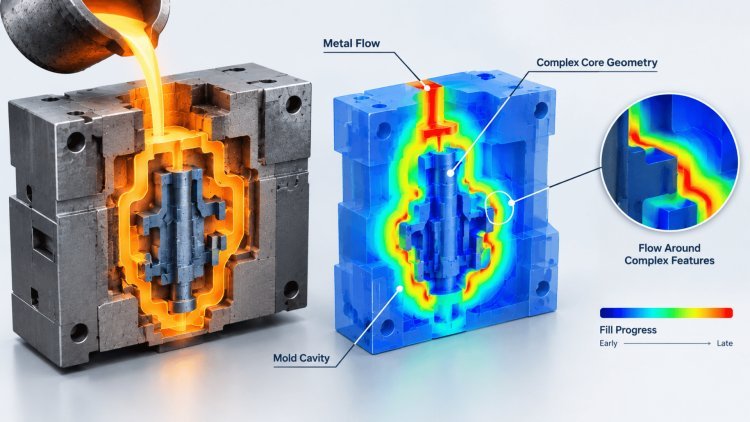
In the world of precision casting, few challenges are as demanding as achieving consistent, defect-free mold filling around complex core geometries. Whether it is intricate internal passages, curved tubular features, or varying wall thicknesses, the physics of molten metal flow does not forgive poor planning. This blog explores the engineering principles, simulation technologies, and advanced tooling strategies that make it possible to cast geometrically complex components with repeatable dimensional accuracy — from the very first pour.
The Challenge of Complexity
Complex core geometries introduce a unique set of metallurgical and mechanical challenges that standard casting approaches are simply not equipped to handle. When molten metal must navigate intricate internal passages, tight bends, and regions of dramatically varying wall thickness, the risk of defects escalates significantly. Understanding these failure modes is the first step toward engineering a robust solution.
High-Risk Zones
Intricate internal passages and varying wall thicknesses create localised turbulence zones within the mould cavity.
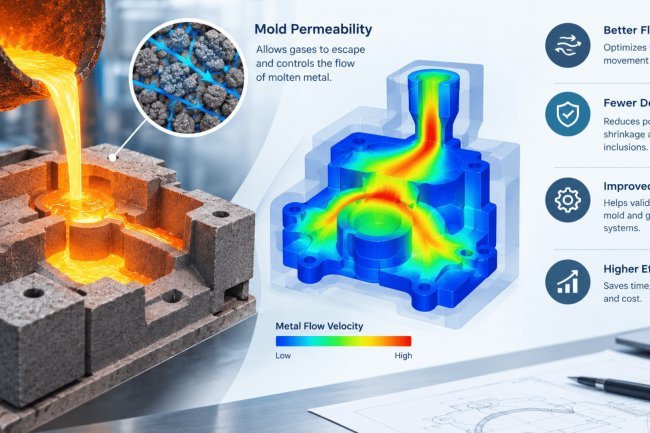
Turbulent flow is a primary driver of air entrapment — trapped gas bubbles that result in porosity, reduced mechanical strength, and surface defects in the finished casting.
Thin sections are particularly vulnerable, as the metal cools rapidly before the cavity is completely filled, leading to misruns and cold shuts that compromise structural integrity.
Limitations of Standard Approaches
Conventional linear mould movements and traditional gating systems are engineered for relatively straightforward part geometries.
When applied to complex, curved internal features, they are unable to deliver controlled, laminar flow across the entire cavity.
The result is inconsistent metal front advancement, premature solidification at critical junctions, and unpredictable filling sequences that make quality control extremely difficult to maintain at production volumes.
Why Distortion Prediction Matters
Predicting distortion in complex cast geometries is essential to avoid structural failure in end-use components.
Differential cooling rates across thick and thin sections generate internal stresses during solidification, causing warping and dimensional deviation that may not be visible until post-machining.
Without proactive distortion modelling integrated into the design phase, costly rework and scrap rates become unavoidable outcomes.
Defects Associated With Complex Geometries
Air Entrapment
Trapped gas from turbulent flow causes internal porosity and weakens mechanical properties of the cast part.
Cold Shuts
Premature solidification at flow junctions creates visible seams and structural discontinuities in the component.
Misruns
Incomplete cavity filling leaves unfilled sections, rendering the component dimensionally and structurally unacceptable.
Warping & Distortion
Differential cooling stresses cause geometric deviation that violates tight engineering tolerances post-solidification.
Complex core geometries introduce a unique set of metallurgical and mechanical challenges that standard casting approaches are simply not equipped to handle. When molten metal must navigate intricate internal passages, tight bends, and regions of dramatically varying wall thickness, the risk of defects escalates significantly. Understanding these failure modes is the first step toward engineering a robust solution.
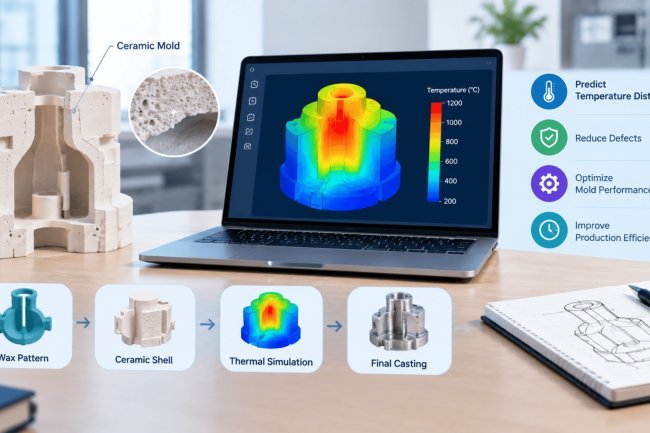
Overcoming the challenges of complex core geometries demands a shift from reactive problem-solving to proactive, simulation-driven engineering. Modern casting facilities leverage computational fluid dynamics, solidification modelling, and digital qualification frameworks to design filling systems that deliver controlled, predictable metal flow — before a single tool is cut or a single pour is made.
Identify high-risk zones, thin walls, and complex passages in the component CAD model.
Model metal fill paths, turbulence zones, and solidification sequences computationally.
Optimise runner, gate, and riser geometry to deliver laminar, controlled metal flow.
Validate process parameters digitally before committing to physical tooling and trial pours.
Engineering the Flow
From Geometry Analysis to Virtual Qualification
Geometry Analysis
Flow Simulation
Gating Design
Virtual Qualification
Even with an optimised filling strategy, complex core geometries present a fundamental mechanical challenge: how do you demould curved, undercut, and tubular features without damaging the casting or the tooling? The answer lies in a combination of advanced mechanical mechanisms, digital fabrication techniques, and integrated thermal analysis.
Large-arc swing core-pulling mechanisms represent a significant advancement in demoulding technology for curved and tubular cast geometries. Unlike conventional straight-pull cores that can only extract along a single linear axis, swing mechanisms follow a precisely engineered arc trajectory during extraction.
Digital pattern making combined with 3D-printed sand cores has fundamentally transformed what is geometrically achievable in a modern foundry. Traditional core-making was constrained by the limitations of physical tooling—undercuts, deep internal passages, and compound curves were either impossible or prohibitively expensive to produce.
Shrinkage defects are among the most persistent quality challenges in complex casting. They form in regions where the metal solidifies last—typically at thick sections, isolated bosses, and areas adjacent to complex core features—and insufficient liquid metal is available to compensate for volumetric contraction.
Together, swing core mechanisms, 3D-printed sand cores, and integrated solidification analysis make the previously impossible entirely achievable—expanding castable part designs while ensuring sound, defect-free castings.
Solving the Core Dilemma
Arc-trajectory extraction for curved geometries.
No tooling, no geometric constraints.
Predict hot spots before they form.
solve the core dilemma—enabling complex geometries
without sacrificing casting quality or dimensional integrity.
The convergence of advanced simulation, intelligent tooling design, and proactive quality engineering makes it possible to consistently produce complex castings that meet the tightest dimensional and structural requirements — at production volumes, without compromise. The path from complex geometry to production-ready casting is no longer defined by uncertainty; it is engineered with precision from the very first design iteration.
The gap between a complex casting design and a dimensionally excellent production component is bridged by engineering discipline and the right simulation infrastructure.
At every stage — from initial geometry review and flow simulation through gating optimisation, core mechanism design, and final solidification analysis — a data-driven approach eliminates the guesswork that historically made complex castings unpredictable and expensive.
Proactive stress modelling identifies distortion before it occurs, allowing compensatory adjustments to be built into the tool geometry itself, ensuring that the finished casting springs to the correct dimension after extraction and heat treatment.
At PoligonCast, we specialise in transforming the most geometrically demanding casting designs into repeatable, production-ready components.
Our integrated approach combines advanced casting simulation, digital pattern making, 3D-printed core technology, and large-arc swing mechanisms to solve the core challenges that defeat conventional foundry approaches.
Whether you are developing a new complex component or seeking to eliminate persistent quality issues in an existing casting, our engineering team is ready to bring simulation-backed expertise to your project.
From your first design consultation through virtual qualification, tooling development, and production launch — we are your precision casting partner for complex core geometries.
Every project begins with comprehensive digital analysis — no guesswork, no costly trial pours without engineering evidence.
Swing core mechanisms and 3D-printed sand cores unlock geometries that traditional foundry methods simply cannot achieve.
Integrated distortion modelling and thermal analysis ensure final parts meet tight geometric specifications consistently.
Virtual qualification and digital iteration compress timelines, reducing prototype cycles by up to 60 percent before first pour.
The convergence of advanced simulation, intelligent tooling design, and proactive quality engineering makes it possible to consistently produce complex castings that meet the tightest dimensional and structural requirements — at production volumes, without compromise. The path from complex geometry to production-ready casting is no longer defined by uncertainty; it is engineered with precision from the very first design iteration.
Achieving
Dimensional ExcellenceFrom Design to Production-Ready Reality
Partner with PoligonCast
???? Simulation-First
⚙️ Advanced Tooling
???? Dimensional Accuracy
???? Faster to Production
What's Your Reaction?