Adaptive Mesh Refinement for Complex Casting Geometries
A deep dive into how intelligent, automated mesh refinement is transforming casting simulation — delivering higher fidelity, faster cycle times, and dramatically improved casting yields across complex industrial geometries.
The Challenge of Complexity
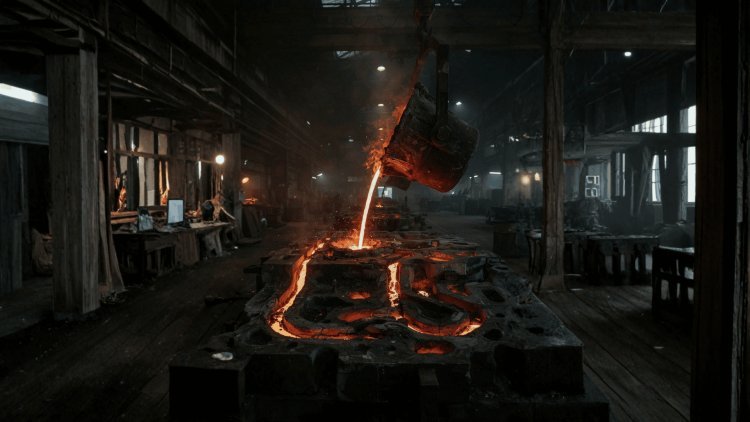
Modern castings are no longer simple geometries. Thin walls, internal dividers, intricate cores, undercuts, and highly detailed mold features push traditional simulation workflows to their limits. Engineers must simultaneously increase predictive accuracy, reduce turnaround time, and manage growing model complexity without overwhelming computational resources.
What Makes Modern Castings Difficult?
Defect Prediction Demands Fidelity
Defects such as porosity, shrinkage cavities, cold shuts, and misruns emerge from highly localized thermal and flow behavior. Small errors in temperature gradients, solidification rates, or melt-front position can translate into missed defect predictions and expensive production losses.
Critical Defects Depend on Local Physics
Uniform meshes often smooth out the very gradients responsible for defect formation, reducing predictive reliability.
Manual Meshing Bottleneck
Traditional simulation pipelines require extensive geometry cleanup, mesh generation, repair, and quality verification. For complex castings, engineering teams often spend more time preparing models than running simulations.
Per Complex Model
A single casting may require hours of geometry preparation, mesh generation, and validation before simulation even begins, directly slowing product development cycles.
Thin-Wall Resolution
Thin sections require mesh sizes substantially smaller than wall thickness to correctly capture heat extraction, thermal gradients, and advancing solidification fronts. This creates a difficult compromise between accuracy and computational cost.
Fast but inaccurate.
Accurate but expensive.
AMR resolves the accuracy-versus-cost trade-off by placing computational resolution where the evolving physics demands it—and removing it where it does not.
Refinement criteria are commonly gradient-based, activating when local thermal or velocity gradients exceed a defined threshold.
AMR increases mesh density around solidification fronts, thermal-shock zones, and filling interfaces, capturing sharp changes in temperature, velocity, and phase fraction.
Slowly varying bulk regions—such as mold volumes far from the active front—can use larger elements without sacrificing accuracy where defects are determined.
AMR workflows distribute evolving mesh regions across CPU cores or compute nodes. Load balancing prevents refinement events from creating processing bottlenecks and supports high-fidelity simulations within overnight batch windows.
The Power of Adaptive
Mesh RefinementThe mesh follows the physics—not a fixed plan.
Put detail at the active front.
Remove detail from quiet regions.
Dynamic meshes need dynamic load balancing.
Coarsen where it does not.
Scripted pipelines detect cast volumes, resolve mold interfaces, and handle closure operations without manual CAD work. New design variants are processed end-to-end, generating simulation-ready geometry packages and eliminating human error.
Automated modules identify mold features — runners, risers, gates, chills — and apply mesh refinement strategies. Best-practice rules from casting physics ensure consistent and optimal mesh configurations across models.
Workflow automation enables reproducible batch processes. Dozens of casting variants can be queued overnight, each automatically meshed, solved, and post-processed. Setup time drops from 4–8 hours to just 0.5 hours per model family.
Automating the Workflow
Automatic Geometry Updates
Intelligent Feature Recognition
Batch Processing and Reproducibility
Measurable Time Savings
Once adaptive mesh refinement (AMR) and automated simulation workflows are in place, casting engineering moves beyond analysis and enters optimization. Instead of manually adjusting risers, gates, chills, and cooling systems through trial-and-error, optimization frameworks systematically explore thousands of design alternatives to identify the highest-yield, highest-quality casting solution.
Optimization frameworks convert rigging geometry into parameterized design variables and automatically evaluate thousands of combinations. Instead of manually testing designs, engineers define the allowable design space while algorithms perform the exploration.
Rapidly converges using local sensitivity information.
Explores broad design spaces using evolution-inspired search.
Optimization is only as reliable as the underlying simulation physics. High-resolution Volume of Fluid (VOF) methods track the moving metal-air interface during mold filling with exceptional precision, enabling accurate prediction of entrainment, temperature gradients, and defect-sensitive filling behavior.
Optimization routinely discovers non-intuitive rigging solutions that outperform traditional hand-designed systems while maintaining quality requirements.
Quality constraints prevent optimization from sacrificing soundness for yield. Every candidate design is screened against industry standards and customer acceptance requirements before being considered acceptable.
Engineers are presented only with Pareto-optimal solutions: designs representing the best achievable balance between maximum casting yield and minimum defect severity. Inferior solutions are automatically eliminated from consideration.
The best design is not necessarily the design with the absolute highest yield. It is often the design least sensitive to real-world manufacturing variation. Sensitivity analysis identifies which variables most strongly influence casting quality.
Robust solutions remain sound despite normal production fluctuations, reducing the gap between simulation predictions and actual foundry performance.
Advanced optimization transforms casting simulation from a verification tool into a design-generation engine. By combining automated meshing, adaptive refinement, multiphase flow simulation, robust defect prediction, and intelligent optimization algorithms, engineers can systematically discover higher-yield, higher-quality rigging strategies. The result is a foundry design process that is faster, more objective, more data-driven, and capable of uncovering solutions that traditional manual engineering approaches would rarely identify.
Advanced Optimization Techniques
Closed-Loop Optimization Workflow
Design Variable Automation
Typical Optimization Variables
Intelligent Search Strategies
VOF Multiphase Accuracy
AMR Focuses Resolution Automatically
Objective-Driven Rigging Design
Optimization Target
Typical Yield Improvement
Shrinkage & Porosity Constraints
Pareto Frontier Selection
Sensitivity Analysis & Robustness
Performance Beyond the Simulation
The Future Engineer
Optimizes Objectives,
Not Individual Designs.
Adaptive mesh refinement, automated geometry workflows, and objective-driven optimization are redefining what simulation-driven casting design can achieve at industrial scale.
A 30-point gain that can reduce material cost and energy use per acceptable part.
Traditional 4–8 hour preparation can fall to under 30 minutes per casting family.
Bidirectional AMR reduces mesh size while preserving detail at critical gradients.
Automated workflows replace manual mesh intervention with repeatable, objective-driven simulation that can respond quickly to geometry and process changes.
The return can be measured through engineering time recovered, improved yield, avoided defects, and faster movement from design release to production.
Evaluate AMR-capable platforms, invest in scripting and automation, and pilot the approach on a representative high-complexity casting family.
Driving the Future
of CastingFrom geometry to optimized casting
Win on multiple dimensions.
Measure value in the first program.
Transform the simulation bottleneck.
Automate
Pilot
Turn simulation effort into sustainable competitive advantage.
What's Your Reaction?