Thermal Simulation of Casting Machine Components
From heat flow analysis to defect prediction, thermal simulation has transformed how modern foundries design, validate, and optimize casting machine components — long before the first metal is ever poured. This presentation explores the physics, workflows, and real-world payoffs of coupling heat transfer, solidification modeling, and virtual process validation into a single, integrated decision system.
Why Thermal Physics
Runs the Whole Show
Temperature is not just one variable among many in casting — it is the governing force that determines whether a component will be sound, dimensionally accurate, and reliable over its service life. Every defect, every deviation, every failure mode traces back to how heat moved, accumulated, or dissipated during solidification.
Hot Spots & Shrinkage Porosity
Thermal behavior directly drives the formation of hot spots — localized zones that remain liquid longer than surrounding material.
These pockets become the nucleation sites for macro- and microporosity as the metal contracts during solidification without sufficient feed metal to compensate.
Both macro shrinkage (visible voids) and microporosity (sub-surface weakness) originate here, compromising mechanical integrity in structural components.
Compounding Errors Across the Production Chain
Wrong heat management does not produce a single, isolated defect — it compounds across the entire production chain.
What begins as a subtle temperature imbalance in the mold cavity can manifest much later as warpage during heat treatment, dimensional deviation after machining, or brittle cracking under service loads.
By the time the problem is visible, the cost of correction is exponentially higher than the cost of prediction.
Predict Before You Commit to Tooling
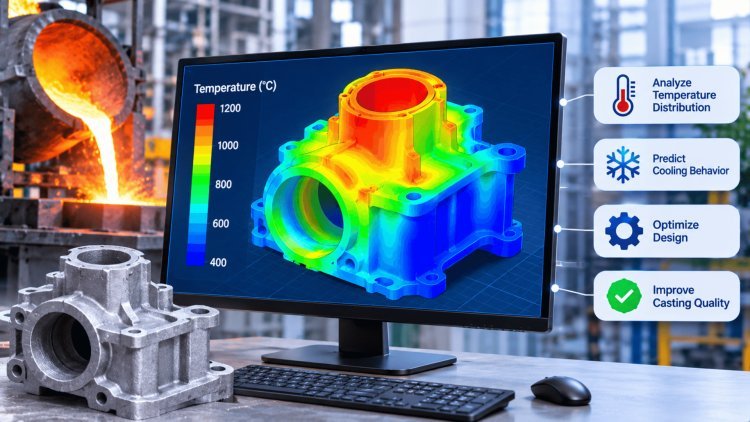
The strategic goal of thermal simulation is unambiguous: predict combined temperature and phase fields before tooling is commissioned, so that quality risks never reach the shop floor.
Catching a feeding inadequacy or a thermal imbalance in simulation costs hours of engineer time.
Catching the same problem after hardened tooling is built costs weeks of rework, scrap losses, and potential customer delays.
Thermal simulation turns invisible heat physics into visible, actionable risk maps — before a single die is cut or a single ladle is poured.
Temperature governs filling behavior, solidification pathways, defect formation, residual stress development, dimensional stability, and long-term component reliability. Understanding and controlling thermal physics is therefore not one aspect of casting engineering — it is the foundation upon which every successful casting process is built.
Effective thermal simulation is not a single calculation — it is a tightly coupled chain of physical models that each contribute essential information.
PoligonSoft's solver architecture links Fourier-based heat transfer with radiation modeling, latent heat release, and fluid flow to produce a complete picture of the solidification process from pour to final solid.
The Fourier conduction model is the backbone of the simulation. It predicts evolving temperature fields throughout the casting and mold system by accounting for conduction through solids, convection at boundaries, radiation from exposed surfaces, and critically — the release of latent heat as metal transitions from liquid to solid.
All are derived from the temperature history at every point in the domain.
For processes where cavity surfaces are exposed — investment casting, lost-foam, and open riser systems — radiation becomes the dominant heat transfer mechanism and cannot be approximated.
PoligonSoft's radiation module handles re-radiation between cavity surfaces and accounts for geometric shading effects, where one surface blocks radiant exchange to another.
These events can produce cold shuts, misruns, or surface defects.
The critical design insight is that thermal fields are never output in isolation — they are immediately tied into feeding adequacy and porosity consequence maps.
Conduction, convection, radiation, latent heat.
Phase fields, mushy zone, hot spots.
Euler solver, freeze-off, cold shuts.
Porosity, shrinkage, feeding adequacy.
The Core Workflow: Coupling Heat Transfer, Radiation & Solidification
Fourier Heat Transfer & Phase Fields
What the Solver Identifies
Radiation Modeling & Mold Filling (Euler)
Euler Solver Functions
Thermal Fields Are Never Isolated
The Four Connected Simulation Stages
Heat Transfer Setup
Solidification Prediction
Flow & Fill Analysis
Defect Risk Mapping
The true value of thermal simulation is not in generating temperature contour plots—it is in translating those results into engineering decisions that change the design before metal flows. PoligonSoft's workflow is structured around three interconnected decision domains: mold material selection, boundary condition calibration, and feeding system validation.
Different mold materials—green sand, chemically bonded sand, ceramic shell, metallic dies—produce fundamentally different thermal histories in the casting. Simulation allows engineers to compare materials by running full solidification physics for each option: mapping hot spot locations, feeding sequence evolution, and mold temperature buildup cycle-to-cycle.
Pour temperature, preheat temperature, and interface heat transfer coefficients between casting and mold are the three most influential boundary conditions in any casting simulation. Setting them incorrectly invalidates every downstream result.
Risers and feeding channels exist for one purpose: to supply liquid metal to the casting as it contracts during solidification. Simulation validates whether the feeding system actually achieves this—checking that risers freeze last, that feed paths remain open throughout solidification, and that every high-shrinkage zone has an adequate feed metal supply.
Turning Results into Decisions:
Materials, Feeding & Virtual ValidationDifferent materials, different thermal histories.
Three inputs determine prediction quality.
Risers must supply liquid metal as it contracts.
of learning in foundry engineering: discovering a design flaw
on the production floor after tooling has been committed.
The same underlying thermal engine that predicts solidification in a simple sand mold scales across every major casting technology — each with its own dominant physics, defect vocabulary, and process constraints. This universality is what makes thermal simulation a foundry-wide decision system rather than a niche tool for a single process. Explore technology-specific applications at PoligonCast Applications and dive deeper into process physics at PoligonCast Technology.
Sand casting presents thermal challenges rooted in the low conductivity of the mold medium: heat dissipates slowly, feeding distances are longer, and the risk of misruns and cold shuts in thin-walled geometries is real.
Thermal simulation maps hotspot locations within the sand mold, predicts porosity risk zones before pattern tooling is built, and helps engineers position chills or cooling fins strategically to accelerate solidification exactly where it is needed. The result is a feeding system designed from physics rather than experience-based guesswork.
Investment casting operates in a radiation-dominated thermal environment that makes it uniquely demanding for simulation.
The ceramic shell preheated to casting temperature, combined with the complex geometry of multi-part clusters, means that radiant heat exchange between adjacent parts and surfaces is the primary cooling mechanism. PoligonSoft's radiation module with shading effects handles these geometry-dependent view factors rigorously, predicting how shell thickness variations and cluster arrangement affect solidification uniformity and porosity distribution across the entire casting tree.
Continuous casting introduces steady-state thermal gradients, secondary cooling zones, and thermally-induced stress and cracking as the dominant concerns.
Simulation of the continuous casting process optimizes spray cooling parameters, predicts surface and sub-surface crack susceptibility from thermal stress gradients, and identifies shell thickness profiles that govern strand integrity. By coupling thermal prediction with stress analysis, engineers can reduce defect rates and improve strand quality without costly trial runs on live equipment — protecting both yield and capital equipment.
Simulation guides mold material selection, cooling channel placement, chill positioning, and die geometry — all validated before tooling is committed.
Feeding system design is validated against thermal solidification sequence, ensuring risers freeze last and feed paths remain open throughout the entire solidification event.
Porosity, shrinkage, cold shuts, misruns, and stress cracks are identified and mitigated in the virtual environment — eliminating the first-article failure cycle from the production timeline.
Thermal simulation, implemented through PoligonSoft's coupled solver architecture, becomes the central decision system for the entire casting development process. It compresses months of iterative trial casting into days of virtual experimentation, reduces scrap and rework costs, and delivers a process that is right — thermally, dimensionally, and structurally — from the very first production cast.
Whole-Process Payoff: Less Trial-and-Error Across All Casting Technologies
Sand Casting
Investment Casting
Continuous Casting
Mold & Tooling Decisions
Risers & Gating Optimization
Defect Mitigation Before First Cast
What's Your Reaction?