Virtual Qualification of Aerospace Casting Processes
A comprehensive framework for simulation-driven design, Nadcap compliance, and the future of flight-critical structural integrity in aerospace manufacturing.
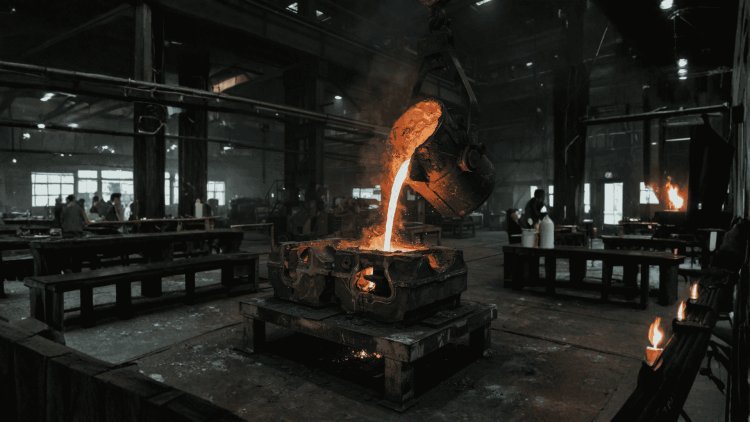
The Hidden Risk in Aerospace Casting
What Inspection Sees
Dimensions • Surface Finish • Visual Features • Documentation
What Remains Hidden Below the Surface
Reliance on Physical Trials
Casting qualification traditionally depended on repeated trial pours, physical experimentation, and empirical adjustments. Process knowledge often remained proprietary, forcing suppliers to redevelop expertise for each new program and creating inconsistent quality outcomes across the supply chain.
Defects That Evade Inspection
The most dangerous casting defects are often microscopic and subsurface in nature. Components may successfully pass dimensional and first-article inspections while containing internal flaws that only emerge during fatigue loading, thermal cycling, or service operation.
AS9100 vs Process Control
AS9100 Provides
- Traceability
- Risk management
- Documentation control
- Nonconformance management
Process Control Requires
- Metallurgical controls
- Pyrometry validation
- Solidification management
- NDT acceptance criteria
Where Catastrophic Failures Begin
Compliance Does Not Guarantee Control
Aerospace castings exist at the intersection of metallurgy, thermodynamics, and structural risk. A compliant quality management system is essential, but it cannot replace rigorous process control, simulation-driven validation, metallurgical discipline, and advanced non-destructive evaluation. The greatest danger lies in the gap between documented compliance and actual process capability—because that is where hidden defects become future failures.
Tools like MAGMASOFT, ProCAST, and AnyCasting model flow, thermal gradients, solidification, and porosity to identify likely misruns, cold shots, and air entrapment before any mold is produced.
Suppliers report 40–70% reductions in first-article defect rates when simulation-validated tooling replaces empirically derived designs, directly addressing macroporosity, cold shuts, and oxide inclusions.
Finding design flaws in the computational phase avoids costly tooling changes, scrap, delays, and nonconformance reports, delivering a strong risk-adjusted return on simulation investment.
The result is fewer physical trials, lower scrap, faster qualification, and more predictable delivery for aerospace casting programs operating under tight schedule and quality constraints.
The Power of Virtual Qualification
Predicting the Invisible
From Blind Iteration
Real-World Impact
Before Nadcap, suppliers maintained separate quality plans and records for each OEM, creating duplication, audit fatigue, and procedural errors. Nadcap’s unified model eliminates this duplication and establishes a single authoritative performance standard.
AC7142 for Sand Casting (2022) and AC7141 for Investment Casting (2023) codify best practices for mold preparation, core inspection, chemistry verification, solidification monitoring, and post-cast inspection — complementing AS9100 with process-level rigor.
The MMMTG governs Nadcap casting checklists, reviewing audit findings and updating requirements in response to systemic drift or new failure modes. This closed-loop governance ensures Nadcap remains a living, technically current standard.
Nadcap accreditation is now recognized by Boeing, Airbus, GE Aviation, Rolls-Royce, and Safran as a preferred or mandatory supplier qualification — eliminating redundant OEM audits for accredited facilities.
Standardizing the Special
The Shift Away from Fragmentation
Key Milestones: AC7142 & AC7141
The Metallic Materials Manufacturing Task Group
Industry Recognition
Modern Nadcap audits are performed by technical specialists with deep expertise in metallurgy, thermal processing, welding, and inspection technologies. The objective is no longer simply confirming documentation exists, but proving that production processes consistently perform as intended under actual operating conditions.
Nadcap auditors rigorously evaluate System Accuracy Tests (SATs), Temperature Uniformity Surveys (TUSs), furnace instrumentation, qualified work zones, calibration traceability, survey methodology, and real-time load monitoring. The goal is to prove every thermal cycle delivered exactly the treatment required by specification.
Suppliers could focus on preparing for a representative audit job and demonstrating compliance during a limited review window.
Continuous live audits incentivize consistent process discipline across all jobs, shifts, operators, and production conditions.
The transition from periodic record reviews to continuous in-process observation represents one of the most important advancements in aerospace quality assurance. By combining live production audits, AMS 2750 thermal-process verification, focused review of high-risk operations, and expanded job coverage, Nadcap is creating a far more accurate measure of sustained process capability. The result is accreditation that reflects everyday manufacturing performance rather than a single moment in time.
Deep-Dive: The Audit of the Future
How the Audit Philosophy Changed
Single Audit
Process Audits
Live SurveillanceFrom Reviewing Records to Challenging Reality
Highest-Risk Audit Focus Areas
RISKPyrometry Verification Under the Microscope
The Real Impact on Supplier Behavior
Continuous Surveillance Delivers Real Process Confidence
Programs like METAL and CAST-IT bridge the generational knowledge gap by combining structured curricula with mentored shop-floor experience in simulation and metallurgy.
ISO 9001, AS9100, and Nadcap accreditation together form a layered qualification framework that is both commercially compelling and technically defensible.
Accreditation should be treated as a strategic asset that opens OEM pathways, reduces audit burden, and signals genuine process mastery for flight-critical work.
Procurement and quality teams should require AMS 2750-compliant pyrometry records, real-time thermal cycle data, and simulation validation reports as true evidence of process control.
Building simulation validation into supplier selection and drawing release makes casting simulation a contractual deliverable and lowers risk on flight-critical applications.
The Future of Aerospace Integrity
Workforce Modernization
Winning Portfolio
Strategic Nadcap
What's Your Reaction?