Modeling Compacted Graphite Iron: Precision in Solidification
A deep dive into the physics, microstructure, and simulation science behind one of metallurgy's most demanding engineering materials — and how modern modeling transformed an unpredictable process into a tool of precision.
The Industrial Challenge
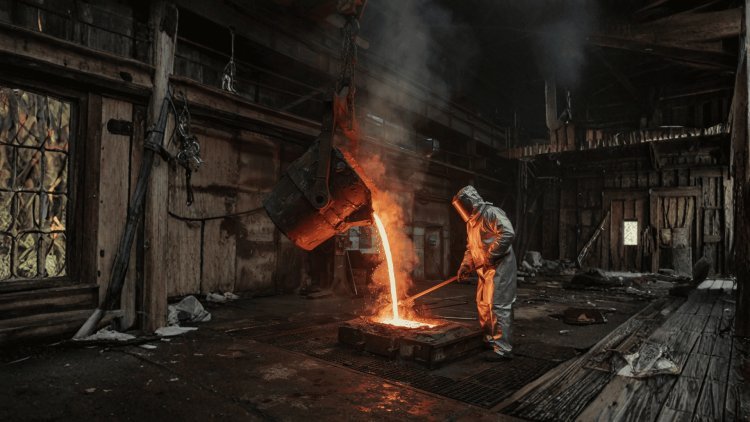
Compacted Graphite Iron (CGI) has become one of the most strategically important materials in modern engine manufacturing. Combining superior strength, stiffness, and thermal conductivity with good castability, CGI bridges the performance gap between gray iron and ductile iron. As automotive manufacturers pursue lighter, more powerful, and more thermally efficient engines, CGI has emerged as a preferred material for highly loaded components operating under severe service conditions.
Why CGI Matters
Major CGI Applications
The Graphite Morphology Challenge
The performance of CGI is governed almost entirely by graphite morphology. Unlike gray iron or ductile iron, CGI operates within an extremely narrow metallurgical window where graphite must develop into a compacted vermicular form rather than lamellar flakes or fully spheroidal nodules.
Maintaining this structure requires tight control of residual magnesium levels, inoculation practice, and melt chemistry throughout production. Small compositional variations can shift the microstructure outside specification and significantly alter mechanical performance.
A Few Hundredths Of A Percent Matter
Residual magnesium content frequently determines whether graphite becomes lamellar, compacted, or fully nodular, making CGI one of the most process-sensitive cast iron families in industrial production.
Morphology Control Balance
Key Manufacturing Risks
Local Nodularity Variations
Graphite morphology may vary across different regions of the same casting, creating inconsistent strength, stiffness, fatigue durability, and thermal performance.
Shrinkage Porosity
Thick sections frequently present feeding challenges because of their complex thermal history and prolonged solidification behavior.
Magnesium Fading
Residual magnesium content continuously changes over time, increasing sensitivity to production delays and ladle-to-ladle process variation.
Why CGI Is Difficult To Manufacture
Early Production Failures
Early industrial CGI production struggled because engineers lacked visibility into the complex relationship between temperature fields, graphite formation, and local microstructural evolution. Even when overall chemistry appeared correct, localized regions within large castings could drift outside specification.
As a result, large engine components often failed quality requirements only after machining, inspection, and costly downstream processing had already been completed.
Unlike scanning electron microscopy, which captures surface topology, X-ray topography penetrates through the material and reveals the true three-dimensional structure of compacted graphite.
Research by König and collaborators established the foundational architecture for modern 3D micro-macro modeling of CGI, coupling macroscale heat transfer across the full casting geometry with microscale nucleation and growth at the level of individual eutectic grains.
The two scales continuously influence one another through the volumetric heat release rate, which depends on the evolving microstructure.
The turning point came when CGI was understood not merely as a casting material, but as a three-dimensional evolving microstructure that had to be modeled across scales.
X-Ray Topography
Reveals the TruthKönig & the 3D
Micro-Macro FrameworkBidirectional Coupling
At the Betsaide foundry in the Basque Country, nineteen melt samples were tracked under varying inoculation and magnesium treatments. Cooling curves were recorded with calibrated thermocouples, and microstructures were analyzed metallographically. Correlating these datasets established robust predictive relationships between measurable thermal parameters and graphite morphology.
Limited branching of CGI graphite lamellae was identified as the physical cause of deep undercooling in cooling curves. Suppressed branching reduces interfacial area, slowing latent heat release and requiring deeper undercooling to sustain growth. This mechanistic insight linked microstructure, kinetics, and thermal signatures into a coherent framework for real-time quality control in production foundries.
Cooling curve analysis now serves as a powerful in-process quality control tool, enabling foundries to monitor melt quality and graphite morphology in real time.
Linking Thermal Signatures to Microstructure
The Betsaide Foundry Experiments
Key Thermal Signatures
The Critical Finding: Limited Branching Drives Deep Undercooling
Advances in computational power, validated thermodynamic models, and extensive experimental databases have fundamentally transformed CGI manufacturing. Modern simulation platforms can now predict solidification behavior, graphite evolution, shrinkage formation, and local microstructure development with engineering-grade accuracy. This shift allows foundry engineers to move from reactive troubleshooting to proactive process optimization before production begins.
Modern CGI algorithms simulate the competition between stable graphitic solidification and metastable carbidic solidification throughout every stage of the casting process. At each computational location, the software continuously evaluates local thermal conditions, melt chemistry, cooling rate, and available nucleation sites.
The resulting phase balance determines whether a region evolves toward desirable graphitic microstructures or toward hard carbide-rich structures that significantly reduce machinability and toughness.
Thin sections cool extremely quickly, increasing the risk of metastable eutectic solidification and unwanted carbide formation that can compromise machinability and component performance.
Shrinkage prediction in CGI is uniquely complex because solidification involves two competing volume effects. Metal contraction tends to generate feeding requirements and porosity risk, while graphite formation introduces localized expansion that partially offsets shrinkage.
Modern simulation platforms calculate both mechanisms simultaneously while tracking feeding paths, liquid pressure fields, riser effectiveness, and solidification front movement throughout the casting volume.
One of the most significant achievements in modern CGI simulation is the ability to predict local nodularity across an entire casting. Instead of relying on average chemistry values, simulation calculates how graphite morphology evolves differently in every region according to local thermal and metallurgical conditions.
Because nodularity strongly influences tensile strength, stiffness, fatigue resistance, and durability, these predictions effectively become spatial maps of expected mechanical performance throughout the component.
Simulation enables engineers to modify magnesium treatment, inoculation strategy, chilling practice, and cooling conditions before a casting is produced.
The Modern
Simulation EraThree Breakthrough Capabilities
Stable vs. Metastable Solidification Competition
Solidification Competition
Rapid Cooling Favors Carbides
Shrinkage and Porosity Prediction
What Modern Simulations Predict
Engineering Benefits
Local Nodularity as a Predicted Output
Directly Predictable Properties
Adjust Treatment Before Failure
The story of CGI solidification modeling is, at its core, a story about how systematic scientific investigation can transform an empirical craft into a disciplined engineering practice.
Nucleation kinetics, irregular eutectic growth, stable-metastable competition, and volumetric change are expressed through quantitative models.
Model parameters have been measured and validated against industrial data, turning simulation into a reliable engineering tool.
Validated mathematical models have become practical software tools that engineers can use throughout casting development.
We have moved decisively beyond the era of empirical guesswork and iterative trial-and-error. The governing physics of CGI solidification are now expressed in quantitative models whose parameters have been measured and validated against industrial data.
These predictive tools directly empower automotive engineers to exploit the full mechanical potential of CGI in complex, thin-walled architectures. Components that previously required conservative overdesign can now be optimized toward minimum weight with confidence that the local microstructure will meet specification throughout the casting.
Thick sections, generous material allowances, and conservative designs were used to buffer against uncertainty.
Local microstructure can be predicted, enabling lighter architectures while maintaining confidence in performance.
The future trajectory of CGI casting technology lies in the deeper and earlier integration of predictive simulation into the standard product development workflow. As simulation run times decrease and model fidelity improves, simulation shifts from a post-design validation step to a co-design tool.
The continued collaboration between academic metallurgists, computational scientists, and industrial foundry engineers remains the essential engine driving further advances — ensuring that the gap between theoretical understanding and shop-floor capability continues to narrow.
CGI solidification modeling demonstrates how systematic scientific investigation can transform complex casting behavior into predictable, validated, and actionable engineering knowledge.
From Mystery to Mathematical Precision
Measured Mechanisms
Industrial Confidence
Everyday Engineering
Beyond Guesswork
High Performance With Confidence
Simulation-Integrated Development
Science, Computation & Industrial Experience
Mystery Has Become Mathematical Precision.
What's Your Reaction?