Casting Simulation for Aerospace Copper- Alloy Components
How advanced numerical simulation eliminates defects, accelerates certification, and transforms the way aerospace foundries qualify copper-alloy parts — before a single drop of metal is poured.
Stakes First: Why "Zero-Defect"
Is the Only Goal
Aerospace casting operates under a fundamentally different set of rules than conventional manufacturing. Components must perform flawlessly across a punishing range of thermal extremes — from cryogenic oxygen-feed environments down to –196 °C, all the way up to turbine-adjacent heat loads exceeding 800 °C. In this context, casting quality is not a cost variable; it is a certification prerequisite and a flight-safety obligation.
The Failure Modes That Disqualify a Part
Copper-alloy aerospace components fail fast and fail decisively when foundry assumptions diverge from physical reality.
Solidification shrinkage creates internal voids that become stress concentrators under cyclic loading.
Porosity — whether gas-induced or shrinkage-driven — compromises pressure-tight integrity in fluid systems.
Warpage from residual thermal stress causes dimensional non-conformance that rejects parts at final inspection, adding weeks and cost to a program.
Certification Demands Traceability, Not Luck
Aviation authorities require documented evidence that every critical feature of a casting meets design intent.
That means defect prediction must happen upstream — in the design and process-engineering phase — not discovered during destructive testing or, worse, in-service.
The only acceptable defect rate for flight-critical copper-alloy castings is zero, and achieving that standard demands simulation-driven process design long before tooling is cut or metal is melted.
Learn more about the industry context at Casting Simulation in Industry.
Solidification Shrinkage
Volumetric contraction during phase change creates internal voids and macro-shrinkage cavities that weaken structural cross-sections.
Gas & Micro-Porosity
Dissolved gases expelled during solidification nucleate pores that compromise leak-tightness in hydraulic and cryogenic systems.
Warpage & Distortion
Differential thermal contraction locks in residual stress that manifests as dimensional shift once the casting is ejected from the mold.
Hot Cracking
Tensile stress in the semi-solid mushy zone tears grain boundaries before the alloy has sufficient strength to resist — catastrophic for structural ratings.
In aerospace manufacturing, quality is not measured by acceptable defect levels but by the complete elimination of risk. Defect prediction, process traceability, and simulation-driven validation must occur before production begins, ensuring every casting meets certification requirements and flight-critical performance expectations.
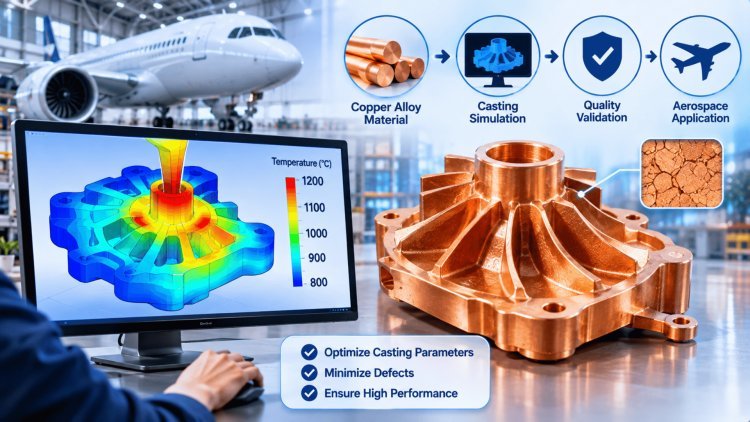
Modern casting simulation is not guesswork dressed up with software. It is a rigorous application of coupled numerical physics — fluid dynamics, heat transfer, solid mechanics, and metallurgical kinetics — solved simultaneously on a detailed 3-D mesh of the casting and mold system. The goal is to make the physics of solidification fully transparent to the engineer before a single production trial is authorized.
Finite Element Method (FEM) and finite-volume approaches discretize the casting geometry, mold cavity, cores, and feed system into hundreds of thousands of computational cells. The solver tracks temperature history at every node through filling and solidification, computing the local solid fraction as a function of time.
Heat transfer coefficients at every metal-mold interface are calibrated against alloy-specific thermophysical property databases. For copper alloys, properties including thermal conductivity, specific heat, latent heat of fusion, and density as a function of temperature must all be validated against physical measurements. Errors in these inputs propagate directly into inaccurate shrinkage and porosity predictions.
The critical region — the "mushy zone" where the alloy is simultaneously liquid and solid — is where shrinkage porosity nucleates, and accurate prediction of its geometry and duration is the foundation of a reliable simulation result.
Fill simulation tracks the advancing metal front using volume-of-fluid (VOF) or similar interface-capturing methods, revealing cold-shut risks, air entrapment zones, and oxide film inclusion paths — all invisible to intuition but predictable by simulation.
Once the cavity is filled, coupled stress analysis computes the evolving strain field as thermal gradients drive differential contraction across the casting cross-section.
Residual stress maps identify regions at risk of hot tearing during solidification and cold cracking during extraction and heat treatment. For copper-alloy aerospace parts — which often carry complex internal geometry for fluid passages — these predictions directly inform gating system redesign, chill placement, and riser sizing before any physical tooling investment is made.
Explore the full simulation physics scope at Casting Simulation Tools for Foundries.
Each simulation stage builds on the previous, creating a fully coupled prediction of casting quality that mirrors the actual physical sequence of events.
The Physics You Must Predict Before Metal Is Melted
Numerical Methods & Thermal Modeling
Computational Discretization
Thermal Property Calibration
The Critical Mushy Zone
Flow, Stress & Residual Strain
Fill Simulation
Stress Analysis
Residual Stress & Aerospace Casting Risks
The Coupled Casting Simulation Sequence
Fill Analysis
Thermal Solidification
Feeding & Porosity
Stress & Distortion
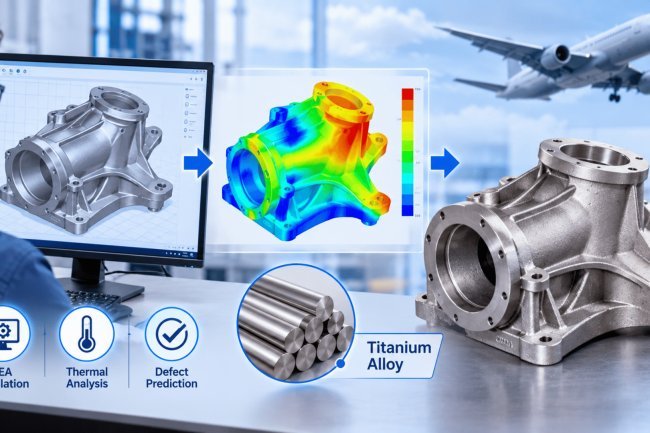
Traditional foundry qualification relied on iterative physical trials—pour a casting, section it, find the shrinkage, redesign the gating, pour again. For aerospace copper-alloy components, each trial pour can cost tens of thousands of dollars in tooling, material, inspection, and program schedule. Virtual casting qualification replaces that cycle with simulation-driven engineering sign-off, compressing months of physical iteration into days of computational analysis.
The casting CAD model, mold cavity, cores, risers, and gating system are imported and meshed. Alloy grade, pour temperature, mold material, and process route (sand, permanent mold, investment, or die casting) are defined with validated property databases.
The solver runs fill simulation to verify complete cavity fill without cold shuts or misruns, followed by solidification analysis that maps the progression of the mushy zone and feeding efficiency of the riser system across the entire casting volume.
Porosity risk maps, shrinkage cavity locations, residual stress distributions, and distortion vectors are visualized. The engineer identifies which regions exceed acceptable defect thresholds and diagnoses the geometric or process root cause driving each issue.
Riser geometry, gating design, chill placement, and mold preheat are adjusted virtually. Each design change is re-simulated in hours rather than weeks, with validated thermophysical property databases ensuring each iteration reflects physical reality—not idealized assumptions.
When simulation results satisfy all dimensional, metallurgical, and defect criteria, the process is documented and submitted as digital evidence for qualification review—giving program managers confidence before committing to production tooling.
Virtual Casting Qualification:
From "Try-and-Error" to Digital ProofDefine the virtual casting environment.
Verify fill and solidification behavior.
Diagnose the root cause of each issue.
Re-simulate in hours, not weeks.
Digital evidence before production tooling.
impactful input for simulation accuracy—
reducing physical trial counts by 50–70%.
PoligonSoft delivers a fully integrated casting simulation environment purpose-built for the complexity of aerospace-grade alloy casting. Rather than patching together separate tools for flow, thermal, and stress analysis, PoligonSoft couples hydrodynamics, solidification, feeding, and metallurgical analysis into a single validated workflow — giving aerospace foundries the predictive accuracy they need to qualify copper-alloy components on the first production run, not the fifth.
The platform covers the complete thermal cycle of a casting: mold heating and preconditioning, metal fill and cavity pressurization, solidification and mushy-zone progression, part extraction and cooling, and post-process metallurgical analysis.
Every stage that generates defects in the physical process is modeled and predicted before production begins.
Integrated hydrodynamics and solidification physics allow engineers to predict porosity, shrinkage cavities, misruns, cold shuts, hot cracks, and warpage simultaneously — across sand casting, permanent mold, investment, and pressure die casting routes — without switching tools or reformatting data between simulation modules.
The business case for simulation-driven qualification is straightforward: fewer physical trials means lower tooling cost, shorter program schedules, and earlier first-article inspection submission.
For aerospace copper-alloy components — where a single rejected casting can delay a critical sub-system delivery — the ability to predict and eliminate defects virtually is a competitive and contractual advantage.
Scrap rates fall because the gating system, riser design, and process parameters are optimized before metal is committed. Process revision cycles shrink from weeks to days. And the simulation record itself becomes part of the manufacturing qualification package submitted to the certifying authority.
Explore the full capability set at Casting Simulation Tools for Foundries and understand the broader industrial context at Casting Simulation in Industry.
Porosity, shrinkage, misruns, cracks, and warpage — all in one coupled simulation run.
Validated simulation workflows routinely cut physical iteration counts by more than half compared to traditional try-and-error methods.
Sand, permanent mold, investment, and pressure die casting — all within the same integrated simulation environment.
For aerospace programs where certification timelines are fixed and defect tolerance is zero, simulation-driven process design with PoligonSoft is not an optional efficiency tool — it is the engineering standard that separates programs that qualify on schedule from those that don't. Learn more and explore the product at poligoncast.in/product.
The Outcome: Faster Qualification with PoligonSoft, Not More Iterations
What PoligonSoft Simulates End-to-End
Measurable Impact on Aerospace Programs
Defect Types Predicted
Reduction in Physical Trials
Casting Routes Supported
What's Your Reaction?